Showing posts with label Cat Stevens/Yusuf Islam. Show all posts

22.10.25

CAT ON THE ROAD TO FINDOUT by Yusuf/Cat Stevens – Part 2

The life of Cat Stevens was forever changed in the autumn of 1975 when, by his reckoning, he was saved from drowning by the Almighty. Swimming in the Pacific off the coast of Malibu, a powerful undercurrent pulled him away from the shore, his heart froze and his limbs felt too weak to get him back to land. “In a split second of the rapidly dwindling moments that remained of my life, I looked and prayed, ‘Oh God if you’ll save me, I’ll work for You.’” 

He was as good as his word and, though it didn’t happen overnight, Cat Stevens soon became Yusuf Islam and thereafter followed the Muslim faith, devoting himself largely to good works prescribed by a religion that, in his opinion, doesn’t get a fair crack of the whip in the Western world. 

        “Never was there a troubadour more handsome than Cat Stevens, nor a career so coloured with romantic stories and downright peculiarity,” I wrote in 1983 as the introduction to my book about Cat Stevens, and 42 years later – after reading his autobiography – I have come some way to understanding why he did what he did and, perhaps more importantly, what this likeable man had to endure when he swapped pop stardom for life as a Muslim. 

        It is a book of two halves, the first devoted to his life as Cat Stevens, initially as a rather dandyish and, we are told, reluctant pop star, then as the sensitive singer/songwriter who sold millions of records and became rich. The second half, roughly from 1977 onwards, is devoted his life as a Muslim, with plenty of emphasis on the difficulties he faced, some brought about by his earlier vocation, others by what he perceives as an antipathy towards Islam by an unsympathetic media that concentrates only on negativity. To this end he deals with issues like Salmon Rushdie, the Iranian Revolution and 9/11, invariably pointing out that  as in all religions  there are the good, the bad and the ugly. 

        This sets the book well apart from just about every other music biography I’ve ever read, as does Yusuf’s focus on his family, be it the mum and dad who raised him and his elder brother and sister in the Moulin Rouge restaurant near Cambridge Circus, or the family of four daughters and one son he raised after marriage to fellow Muslim Fawziah Ali in 1979. Yusuf writes about them all with affection and the frequency that other musicians devote to bass players, drummers and record producers. The on-off relationship with his brother and sometimes manager David is an ongoing sub-plot to the book.

        The slightly precocious, independent-minded child christened Steven Demetri Georgiou was fascinated by religious belief from an early age and, though the earthly temptations that came his way through exposure to the pop world were hard to resist, his eventual conversation seems somehow inevitable. Still, he road-tested other religions, among them Christianity, Buddhism and the I Ching, before settling on Islam to which he was drawn after David gifted him a copy of the Koran. 

        The clues were there in many of the songs he wrote between 1970 and 1975; expressing the thoughts of a seeker (‘On The Road To Find Out’ and ‘Miles From Nowhere’), climate-conscious environmentalist (‘Where Do The Children Play?’), disquiet at materialism (‘Hard Headed Woman’) and hope for mankind (‘Peace Train’ and ‘Sitting’). ‘Morning Has Broken’, of course, is an arrangement of a Christian hymn from 1931 while ‘How Can I Tell You’, to my mind his greatest love song, scores through the writer’s inadequacy to express himself. More than once in the book Yusuf recounts his dislike of being interviewed, and frustration at how the media misrepresented whatever opinions he was trying to express. 

        Yusuf has a friendly, unpretentious writing style and though some may be deterred by the detours into religious reasoning that occupy large chunks of the book’s latter stages, I shared his exasperation at incidents where he was shoddily treated by immigration officials in the US and Israel. Much of this he attributes to his high profile as a one-time celebrity, the quid pro quo being his ability to fund charities and Islamic education from the fortune he amassed as a million-selling artist. His gradual re-emergence as a musician, somewhat unexpected after selling his guitars and giving the proceeds to charity, is a welcome relief towards the end of the book. 

        It’s a long read – 554 pages – and, unusually, the 24-page b&w photo section is at the back. Inexplicably for a lengthy autobiography, there is no index. Finally, I need to mention that he’s in no doubt that Carly Simon wrote ‘You’re So Vain’ about him. “I never understood the endless hide-and-seek of finding out who [it] was about bro!” he writes. “Naturally, I knew it was me.” His song ‘Sweet Scarlett’ from his 1972 LP Catch Bull At Four was his response. 


9.10.25

CAT ON THE ROAD TO FINDOUT: THE OFFICIAL AUTOBIOGRAPHY by Yusuf/Cat Stevens – Part 1


Just Backdated is off on his holidays, taking with him Cat/Yusuf’s autobiography which will be read by the pool alongside the house of friends who live in Valbonne, about 20 miles north east of Nice on the French Riviera. The book is of special significance to me because of my on-off relationship with the man I first knew as Steve in 1970 and – by way of a preface to my review of his book – here’s a bit of background.

The new-look Cat Stevens landed in the charts at number 21 with ‘Lady D’Arbanville’ in June of 1970 – the same month I joined Melody Maker. It was MM’s custom to publish stories on newcomers to the charts but Stevens, or Steve as he was known to his friends, was no newcomer. He might as well have been, however, since his new image was far removed from the foppish, velvet-suited Cat Stevens who’d graced the charts three years earlier with ‘I Love My Dog’ and ‘Matthew And Son’. 

        For this reason, instead of an interview he was invited to be the subject of MM’s Blind Date feature, during which musicians were played records ‘blind’ and invited to identify the artist and comment on their music. This was conducted by me in our offices and, meeting him for the first time, we got on pretty well. “He took a keen interest in the records played,” I reported, and among them were singles by Diana Ross & The Supremes (‘Love Child’ – “I don’t really like their sparkling dresses but they’re one of the greatest”) and The Moody Blues (‘Melancholy Man’ – “That’s a nice song. Their covers always look like cheap encyclopaedia covers”). 

        The following month I saw Steve performing for the first time at the NJF Festival at Plumpton Racecourse in East Sussex. Accompanied by his guitar playing sidekick Alun Davies, he “looked confident with a black pre-war Gibson that Sotheby’s might be interested in,” I wrote in the following week’s MM. “His quiet, pleasant and pretty songs drifted into the warm air with superb clarity, building up to ‘Lady D’Arbanville’, the song which, he said, had made him a pop star again.”

        In December that same year I interviewed Steve in the Red Lion pub behind MM’s office where he ordered a large vodka and told me he was concentrating on LPs now after recovering from the TB that took him out of the limelight for almost two years. “It seems as I am making a comeback but I have never been away,” he told me. Early the following year I was invited to watch Steve’s In Concert TV show being filmed at the BBC HQ in Shepherds Bush and I saw him again a year later at the Drury Lane Theatre in Covent Garden, a prestigious affair at which he was accompanied by a small choir, miniature string ensemble and, for the song ‘Rubylove’, a quartet of Greek musicians playing bouzoukis. My date was a huge fan, clearly besotted with him and rendered speechless when I introduced them at the post gig party. I sensed that women of all ages and backgrounds adored him. 

        Constantly surrounded by the rich and fashionable, Stevens mixed not with the rough and tumble of the rock’n’roll trade but with society friends, introduced to him by his manager Barry Krost, a flamboyantly gay man. He was courted by artists and models, actors and actresses, debutantes, dress designers and fashion photographers. 

        By now I had become a fan and his next two LPs, Tea For The Tillerman and Teaser And The Firecat – both multi-million sellers worldwide – were in constant rotation on my record player. He had become a leading light in the bed-sitter singer/songwriter genre and his name was coupled with a series of high-profile beauties, among them Linda Lewis and Carly Simon. 

        In June of 1973 I conducted a lengthy interview with Stevens at his well-appointed terraced house in Fulham. He was now a big star, of course, and this interview occupied a double-page spread in MM. I saw him only once during my period as MM’s editor in the US, in March of 1976 at Madison Square Garden, and attended a post-gig dinner for him afterwards. He was as friendly as ever and on his arm was another beautiful girl. 

        After I left MM in the spring of 1977 I lost touch with most of the rock stars I reviewed or interviewed, Steve among them, and when he converted to the Islamic faith and retired from music in 1978 I figured I would never see him again. However, in the autumn of 1982 I was approached by Proteus books to write a book about him. I told them I would do so only if Yusuf Islam – as he was then known – would co-operate in some way, and to this end set about finding him. 

        A helpful chap in a shalwar kameez at the London Central Mosque in Regents Park told me that Yusuf worked out of offices on Curzon Street in Mayfair, running an organisation called The Companions Of The Mosque and a children’s charity that was funded largely by the royalty stream from his back catalogue of music. He gave me the address, which I recognised as being the same as where his one-time manager Barry Krost once had offices. I wrote Yusuf a letter, enclosing my phone number, and hoped for the best.

        Sure enough, within a few days Yusuf called and invited me to meet him there. With his short hair and long beard he looked very different from the man I once knew but he recognised me from old and seemed interested when I told him about the book proposal. Our meeting was interrupted by prayers – he went off into another room to join colleagues while I listened to incantations and twiddled my thumbs – but he consented to help me, within limits, on condition that Proteus donated to the charity he headed. 

Yusuf explained to me that in the Muslim world there is a stipulation that no one must be seen to rise above anyone else lest this be interpreted as an attempt to challenge Allah, or God, and the publication of a biography might contravene this proviso. Nevertheless, although he declined to be interviewed, he agreed to read what I wrote, and correct any errors, and was as a good as his word, reading my manuscript and changing the text here and there. I knew he was something of a ladies’ man in the past but thought it best not to go into this, nor that he enjoyed a life of carefree indulgence in those days. I think he respected this discretion on my part. Our relations were friendly. 

        After a couple of these meetings I persuaded him to talk to me a bit about his life after he left music, his day-to-day routine as a Muslim, which he did, in part because he wanted to dismiss the popular notion that he was an eccentric recluse. He was also frustrated at having become a sort of unelected ‘spokesman’ for Muslims, this because whenever there was a news story about Muslims he was the one the media turned to for a comment, for no better reason than they knew of no one else to approach beside this ’former pop star’. 

        “There’s no equivalent of the Pope, Archbishop of Canterbury or Chief Rabbi in Islam,” he pointed out to me. “Everyone is equal.” Often, the stories were negative which meant he was forced to defend Islam, and he didn’t feel comfortable having to do this, time and time again. I sympathised with him.

        When it came out, the book, simply titled, Cat Stevens, was only about 26,000 words but for years afterwards was the only source of biographical information about him, and after its publishers went out of business it became rare and quite valuable. I once saw it advertised for over £1,000 on Amazon but it is no longer available, though last week one was on sale on eBay for £200. 

        By the mid-nineties the rights to books published by Proteus had been acquired by Music Sales, the sheet music publisher that also owned Omnibus Press, of which was now senior editor. Music Sales had acquired the rights to publish Cat Stevens’ songs as sheet music and when he turned up at our offices in Frith Street for a meeting about this he seemed delighted to see me again. I suggested we put my book back into print and when he asked if I had a copy to spare I gave him one of two that I owned which he never returned. Now I have only one. 

        After a bit of umming and erring, Yusuf decided he didn’t want it in print again, nor to take up my alternative suggestion to allow me to write a new book with his co-operation. Always gracious, he explained to me that he felt more comfortable out of the spotlight and iterated how unhappy he was at the way he’d been portrayed in the media over the years. The media continued to turn to him as a spokesman on Islamic matters, purely because he’d once been a pop star and was therefore the most prominent Muslim in the UK, at least to non-Muslims. It was not a role he wanted and one he wanted to shake off. A biography, he reasoned, would make this more difficult.

         I tended to agree with him, so no new biography appeared, though I had no doubt that the rather peculiar circumstances of his life and the many issues surrounding Muslims in the UK would make for a commercially successful book. Since his life outside music is largely an unknown quantity yet would need to be covered in some detail, no such book could be written without his co-operation. I never met with him again but by a strange coincidence I found myself often in the company of Alun Davies, his former accompanist, because Alun and his daughter Becky often performed – as Good Men In The Jungle – at The Compasses, the pub in my Surrey village. Alun, who was still in regular touch with Yusuf, kept me informed of what he was up to, and I asked him to put in a good word for me should Yusuf ever decide to write an autobiography and needed an editor. It never happened but Alun did mention to me that from time to time he continued to appear alongside Yusuf at isolated concert appearances. 

        In 2014 I was approached by Yusuf’s older brother David Gordon who planned to write a book about Yusuf. We met at our offices along with a woman who would ghost-write the book for him, and even went as far as to include David’s book on a schedule of forthcoming Omnibus books for 2016, the year I retired. David’s book never happened but along the way I told him that what I really wanted was for Yusuf to write his own book which Omnibus would gladly publish. This book didn’t happen either, well not for Omnibus. 

More recently, by which I mean during the past decade, Yusuf’s once strict devotion to Islam seems to have moderated. He’s released lots of new music, performed on stage with his guitar many times, including a Glastonbury appearance in 2023, and even accepted induction into the Rock & Roll Hall of Fame. Many of his old LPs have been remastered and reissued, and I was even commissioned by Universal to write sleeve notes for the first two issued by Decca from Stevens’ early pop-star period. What I wrote can be fond elsewhere on Just Backdated. 

        Now along comes the autobiography – at last – all 550 pages of it, which is on the bulky side for a holiday read but, as you can imagine, I’m looking forward to reading Yusuf’s take on his extraordinary life. 

        I’ll review it next week. 


27.6.23

YUSUF & ELTON AT GLASTONBURY

“Some things change, some stay the same,” sings Chrissie Hynde in ‘Hymn To Her’, a song on The Pretenders album Get Close that seems to me to be an invocation of women as supreme beings, the mothers of mankind, as they surely are. It certainly wasn’t meant to refer to ageing pop stars but it struck me as pretty apt on Sunday as I watched Yusuf/Cat Stevens and Elton John at Glastonbury from the comfort of our sofa. Yusuf had changed but Elton hadn’t, and it wasn’t just their choice of names.

        Sunday at Glastonbury was always likely to send me back to a time when reviewing shows by Elton, Cat Stevens and Blondie was what I did for a living. Indeed, I saw both Steve – as Cat Stevens, now Yusuf, was known to his associates – and Elton for the first time at outdoor festivals in 1970, the former at Plumpton on August 8, and the latter at Krumlin, near Halifax, two weeks later, on August 15, and 50-odd years ago now I interviewed and wrote about both extensively for Melody Maker. Blondie, of course, came later, at CBGBs in New York, and their Sunday set – midway between Yusuf and Elton – was pretty much the same as when I saw them last year in Brighton, very professional, up-to-date, slick, even if Debbie’s voice doesn’t quite pack the punch it once did. 

        But it’s Yusuf and Elton that concern me here. 

Yusuf looks much older, with thinning white hair, and he seemed slightly unsure of himself facing an audience that was surely far greater than he’d ever faced before in any of his multiple careers. He seemed genuinely surprised by the warmth with which he was received, and humble too, openly grateful that his songs still struck a chord with the crowd. Wisely, he ran through several of the earliest in a medley that included ‘First Cut Is The Deepest’ and he concluded his set an hour later with ‘Father And Son’, both songs that have been covered by many. Bravely, perhaps, he included a handful of more recent songs, but none slackened the momentum of his set, and I liked the animated, slightly quirky, understated graphics beamed behind him. His band, too, were low key.

        Back in the early seventies he usually sat on a tall stool to perform and bobbed around a lot as he played, and he was invariably accompanied by the guitarist Alun Davies, but to my disappointment there was no sign of Alun on Sunday. Steve, his long black hair framing olive Mediterranean features, was a heartthrob in those days. Girls adored him. Now he’s a kindly old man. I could imagine him surrounded by children, telling fairy stories at bedtime. 

In 1983 I wrote a book about Yusuf and met with him to discuss it. He was adamant that he’d put his guitar away for good, and would no longer perform or write songs, all which were proscribed by the Islamic faith he’d adopted in 1978 when he changed his name from Cat Stevens to Yusuf Islam. A change of heart occurred in 2006 when he released his first new album for 28 years and since then he’s performed intermittently around the world. 

“Don't you feel a change a coming,” he sang in ‘Changes IV’ from Teaser And The Firecat in 1971, the first of two albums (the other was Tea For The Tillerman released earlier the same year) that defined his career. Yes, you have changed a lot I thought as he exited the stage, waving shyly at a vast crowd on an afternoon he’ll surely remember for the rest of his days. 

An hour or three later, dinner with red wine consumed, I sat down to watch Elton. He hasn’t changed at all, I thought. The songs he sang were largely the same as those he sang when I saw him perform regularly, all bar five I specify below. He didn’t look that much different either, no less podgy but a tad stiff, ungainly in his movements, as if he’d risen from a long rest and needed to stretch, and he seemed to have considerably more hair than he did 50 years ago. His gold lamé suit, perhaps modelled on the one worn by Elvis, was a bit bulky and didn’t seem to fit him too well, but he was the same ebullient showman he always was, a curious mix of humility and effervescence, his sincerity and professionalism intact, just as they always have been. His voice was a bit deeper but, as ever, he played his grand piano superbly. 


  Elton delivered 21 songs, 16 of which were recorded during the first flourish of his career, up to 1976, a staggering proportion of old, safe and reliable material to my mind. (This was the year when he announced [to me] his impending retirement from live shows for the first time.) Of the rest, two were from 1983, one from 1984, one from 1991 and one, ‘Until I Found You’ by Stephen Sanchez, with whom he duetted, from 2021. 

His audience, however, looked to me to be considerably less than half his age, which is 76, the same as me, with many even younger. The 16 early songs were first released around 50 years ago, yet the huge crowd of boys and girls born long after they were recorded seemed to know them all, singing along lustily as festival audiences are inclined to do. The obvious conclusion is that Elton’s hits compilations sell far more than his albums of new material, but it must be galling for him to have to base his show on so many old evergreens.  Furthermore, his band included the same guitarist, Davey Johnstone, and drummer, Nigel Olsson, who’ve played with him for decades, as has percussionist Ray Cooper, which is not a criticism, just an observation. 

So it was that I couldn’t help but think that little of Elton has changed since I last saw him perform in person, in America in August 1976. It was on this trip, on his private plane mid-air between Chicago and Cincinnati, that he told me he, “felt like stopping for a time. I’ve done it for six years and I’m fed up with it. I could change my mind. I’m not retiring. I just want to lay off for a bit.” I thought back to that conversation as I watched him. 

        The 1970 Krumlin Festival where I first saw Elton was a disaster, though this energetic newcomer on piano did his utmost to raise the spirits of a cold, damp audience. I was unacquainted with his songs but thought he was terrific, a fabulous showman, and afterwards went to the caravan backstage that was his dressing room, knocked on the door and was admitted by Sandy Denny who was inside, sharing a bottle of cognac with him. Elton was delighted that someone from Melody Maker was showing an interest in his work and happily supplied the titles with which I was unfamiliar. I went back to the office and wrote up a rave review, said he was the highlight of the festival, a star in the making, and this cemented a genial yet professional relationship that lasted for as long as I was a working music writer. In that time, no matter how big he became, I was welcomed into Elton’s entourage, granted interviews and on first-name terms. 

       The relationship was unlikely to withstand my departure from MM but it didn’t matter. I watched his life progress, read about his troubles and triumphs, his tantrums and tiaras. Throughout it all he remained the same, as he still is, quite remarkably in fact; little difference between the eager 23-year-old I saw at Krumlin in 1970 and the wise old 76-year-old I watched on Sunday. If he does retire, which I somehow doubt, I wish him the best. 

(Pic of Yusuf: Guy Bell/REX/Shutterstock; Elton: Samir Hussein/Wire Image)

14.12.21

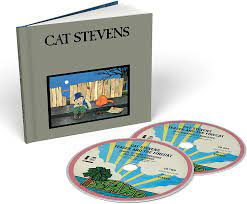
CAT STEVENS – TEASER AND THE FIRECAT, 2CD Deluxe edition


Beyond Buckden on the B6160 road to Hawes in the Yorkshire Dales there sits the tiny hamlet of Cray, two or three farmhouses and a pub called The White Lion Inn, outside of which, on the evening of Boxing Day, 1971, I parked my new car, an orange Mini, and went inside to have a beer or two with my sister and a few of her friends. 

        Anne’s pals asked me lots of questions about working for Melody Maker and one of them wanted to know whether I’d met Cat Stevens. Yes, I replied, and what’s more I have his new LP, Teaser And The Firecat, on cassette in my car. “Can we have a listen?” they asked. 

        I was pretty proud of the sound system in the car so I took a couple of girls outside, sat them in the back seat next to the speakers, started the motor, punched play and on came Steve, as I knew him in those days. 

        The girls loved it, adored it in fact, so much so that they spent the rest of the evening in my car while we ferried drinks out to them, even though it was a bit nippy. They were particularly taken with ‘Rubylove’, track two on side one, on which Steve’s Greek family background shines through; a verse sung in the language of his father and two of dad’s friends playing bouzoukia. They asked me to play this lively song again and again, cranked up pretty loud, and I came to realise that the reason they liked it so much was not because they were in love with Steve, which they probably were, but because of how sharp and clear it sounded. The finely-tuned Grecian strings rang out at the top end, little flamenco fills, trills and flourishes expertly played, while a soaring chorus held down the middle, double-tracked with Linda Lewis joining in so that it seemed like a whole choir had joined us in the Mini, and a percussive bass line deep in the mix, held back until verse two, that prevented the production from becoming too toppy, too shrill. 

        I wasn’t so wrapped up in The Who in those days that I couldn’t recognise a great production when I heard one. ‘Rubylove’, I reckoned, was as seamless an example of the art of hi-fi I’d ever heard, two minutes and 36 seconds of aural perfection, and as I sat there in the car beneath the stars that cold December night I thought ‘Rubylove’ simply could not be improved upon. And this, dont forget, was on a cassette. 

        Well, I was wrong. Remarkably, ‘Rubylove’ sounds even better on this newly remastered edition of Teaser..., released last month, as does everything else really. Paul Samwell-Smith’s work on the four records he made with Cat Stevens between 1970 and 1972 – Mona Bone Jakon, Tea For The Tillerman, this one and Catch Bull At Four – were notable for his simplicity of production, austere almost, that, regrettably, gave way to a fuller sound as the 1970s progressed. Either way, it’s the remastering of such minimalism that makes this record ring out so cleanly now, which makes the restraint all the more delightful and at the same time makes my 2021 hi-fi sound like the state-of-the-art system I know it isn’t. 

        Setting aside for a moment this astonishing upgrade in the aural department, as I wrote in my biography of Cat Stevens, published in 1984, six of the nine songs on Teaser... belong with the cream of his catalogue while the remaining three, notably ‘Peace Train’, suggest the excesses that would mar each of the albums that ultimately followed. Despite its strong arrangement, ‘Peace Train’ was awash in noble sentiments naively expressed – a fault that would multiply with irritating regularity in the years to come. ‘Changes IV’ and ‘Tuesday’s Dead’ suffered similar limitations, albeit to a lesser degree.

        Elsewhere, however, Teaser... contains many of Cat Stevens’ most memorable songs. ‘How Can I Tell You’, which closed the first side on the original LP, is unquestionably his finest love song; immensely fragile, yet moving to a degree that few writers have ever been able to capture. Like so many of the songs he recorded at this time, its beauty lies in its simplicity; simplicity as sincere as anything Stevens wrote before or since. ‘If I Laugh’, under arranged with equal taste, merely underlines the point that this kind of material is where Steve excelled and where he would have been wise to concentrate his efforts until he opted for a different life. 

        ‘Moonshadow’, a perennial favourite, written while on holiday, in Spain, is among Steve’s happiest, catchiest songs; a nursery tale with a beguiling melody, toe-tapping chorus and charmingly nonsense lyrics. ‘Morning Has Broken’, the second choice for a single (which reached number nine in the charts during January 1972), was an altogether more sombre affair, a hymn tune re-arranged by Stevens with words by Eleanor Farjeon, unashamedly middle of the road yet reassuring for the strength of its dramatic melody which mercifully overshadows any religious overtones. The new record finally credits Rick Wakeman for his outstanding piano part, a credit left off at the time for contractual reasons. 

        Disc 2 on the remastered Teaser… offers demos, including two songs with which I was unfamiliar (‘The Day They Make Me Tsar’ and ‘Fisherman Song’), alternative versions, a couple of live BBC recordings, and ‘I Want To Live In A Wigwam’, the B-side of ‘Morning Has Broken’, to the best of my knowledge hitherto unavailable on CD. I was fascinated to hear ‘Rubylove’ in its infancy, without the Greek verse or personnel, and ‘How Can I Tell You’ with incomplete lyrics. Only Bitterblue went through a fairly radical transformation, speeding up dramatically. Oddly, Stevens’ voice sounds slightly hoarse on some of the demos, as if they were recorded soon after he rose in the morning, before his vocalising got into its stride. 

        Finally, I should point out a minor editorial flaw in the accompanying booklet, in that the same quotes from Paul Samwell-Smith and guitarist Alun Davies, Stevens’ regular accompanist, about ‘If I Laugh’ are replicated four pages later for ‘How Can I Tell You?’ A proof reader is needed for the Cat-O-Log Collection, as the Stevens reissue programme is amusingly called. 


11.5.21

CAT STEVENS – NEW MASTERS


By the summer of 1967 Cat Stevens was an established name on the British pop scene but the scene was changing fast. On June 1 The Beatles released Sgt Pepper’s Lonely Hearts Club Band, the album now widely acclaimed as the zenith of their career. According to the Encyclopedia of Popular Music published by Oxford University Press, Sgt Pepper “revolutionised, altered and reinvented the boundaries of 20th century popular music, style and graphic art”, and over 50 years later its place at the heart of the Swinging Sixties remains unchallenged. The Beatles in the UK – and Bob Dylan in America – were leading the charge of young musicians determined to develop their work into an art form way beyond the disposable pop that in the past had done little more than provide accompaniment for ballroom dancing or cause teenage girls to scream their heads off. 

Cat Stevens found himself stranded between the two stools. 

On the one hand he was a handsome young pop star promoted by his advisors to appeal to young girls, traditionally the strategic market for singers of his age and demographic. A Fan Club had been launched, of which Cat was President, and its magazine Pause – a pun on the word paws, as in cat’s paws – was crammed with trivial information designed to appeal to teenage girls for whom Cat’s olive Mediterranean complexion was as key to his success as the records he made. The August 1967 issue includes a list of members seeking pen pals, all but one of whom are girls aged between 13 and 18. One member, Dee Rider, reports on a visit to the flat above his parents’ restaurant, The Moulin Rouge in Shaftesbury Avenue, where Cat still lived. In closing her report, she breathlessly recounts how at the end of her stay Cat, “leaned over and kissed my cheek. ‘Don’t tell the club members that,’ he said. Mr President, Sir, you must be joking. I couldn’t possibly keep that to myself.”

On the other hand, Cat Stevens was a gifted and unusually prolific songwriter with a mind of his own that was beginning to question the milieu in which he found himself. In some respects, the only other singer-songwriter with whom the Cat Stevens of 1967 could be compared was his Deram label-mate David Bowie. Both were earnest young singers who composed their own material and both were seeking to develop their own musical niche in this rapidly changing environment. In the fullness of time both would discover that niche and become as massively popular as they were esteemed for the merits of their work, but for differing reasons they would have to wait until the golden years beckoned. In the meantime, while the Syd Barrett-led Pink Floyd could be found exploring the limits of psychedelia at the UFO Club on London’s Tottenham Court Road and Procol Harum – another Deram act – topped the charts with the deeply enigmatic ‘Whiter Shade Of Pale’, that year’s Eurovision Song Contest was won by Britain’s Sandie Shaw singing ‘Puppet On A String’, a song that would not have been out of place amid the chirpy repertoire of Fifties hitmaker Alma Cogan. 

This dichotomy is best illustrated by the list of artists who topped the UK charts during 1967: Tom Jones, The Monkees, Petula Clark, Engelbert Humperdinck (twice), Frank Sinatra and his daughter Nancy, The Tremeloes, Procol Harum, The Beatles (twice), Scott Mackenzie, The Bee Gees, The Foundations and, in December, Long John Baldry whose maudlin ballad ‘Let The Heartaches Begin’, far removed from the rootsy blues for which he was best known, seemed fabricated to make Baldry appeal to pensioners. Meanwhile members of The Rolling Stones were in and out of jail on drugs charges and ‘A Day In The Life’, the closing track on Sgt Pepper, now widely regarded as the greatest song The Beatles ever recorded, was banned by the BBC for including the line, ‘I’d love to turn you on’. 

In this uncertain climate Cat Stevens played his manager and record producer what many consider to be the finest song he wrote during this early part of his career. Mike Hurst was stunned when Cat unveiled ‘First Cut Is The Deepest’; doubly so when Cat told him he didn’t want it as his next single. Instead he wanted to record a newer song, ‘I’m Gonna Get Me A Gun’, which reached number six in the charts in April. 

        An element of controversy surrounded Cat Stevens’ third single. ‘I’m Gonna Get Me A Gun’ had its first public airing in March on Juke Box Jury, then the most popular televised pop programme in the UK. A feature of the show was to invite artists to appear but to keep their presence secret until after their record had been played. While the jury commented on their efforts the camera would focus on the subject of their remarks – invariably seen biting their fingernails or grinning sheepishly – behind a screen and invisible to the panel. “He was sitting behind the curtain and all these people were making stupid remarks about guns,” recalls Hurst. “He was almost in tears, ‘I didn’t mean it like that,’ he said to me, and I said, ‘I know you didn’t but other people are obviously seeing it.’ I never thought of it like that either.”

        In fact, neither Cat nor Hurst had even considered the possibility that they could be accused of spreading violence but when the record was played on the show, the now disgraced DJ Jimmy Saville, posing as a paragon of virtue, launched into a duplicitous attack on records that encouraged violence. “At the end of Jimmy Saville’s sermon all the jury still voted the record a hit,” adds Hurst. 

        In hindsight, Hurst would admit that his stewardship of Cat Stevens’ career was hitting a rocky patch. “In retrospect, of course, I can see all the things I did that were wrong, as much as I can see all the things that I did that were right,” he says today. “‘I’m Gonna Get Me A Gun’ was, to me, nothing to do with guns really, as Cat always said. He was using the imagery of the gun for someone who is in a bad temper, ‘I’m gonna fix this and I’m not gonna back down’, all those things. What I heard in the song was nothing to do with any of that. It was the sort of Hollywood type movie soundtrack that lent itself to that song. It was like an early Ennio Morricone movie score. So, I threw the kitchen sink at it.”

        ‘Throwing the kitchen sink’ at the songs of Cat Stevens was a strategy that would soon backfire for Hurst, pitting manager against client in a creative dispute that saw them go their separate ways before the year was out. ‘I’m Gonna Get Me A Gun’ would be the last Hurst-produced top ten hit he would enjoy and as it ascended the charts during April, Cat embarked on his first and last pop package tour.

* * *

INSERT SEPARATE FEATURE RE WALKER BROTHERS TOUR

* * *

During May of 1967 Cat Stevens formed his own production company, Cat Stevens Productions Ltd, for the purpose of recording other artists performing his songs and a second company, Doric Productions, for handling the management of artists signed to the first company. The first singer to be signed was Canadian-born Peter Horgan who recorded under the name of Peter Jane. Friends from their childhood days, he and Cat had started learning the guitar around the same time and had met through their older brothers, both of whom were in the clothing trade, and a shared a love of Dylan and bluesman Leadbelly. Cat’s production of Jane’s ‘Emperors And Armies’ on CBS made no impression on the charts, however, but in an accompanying press release Cat was quoted as saying: “I see this as the first step in the direction I want to go – toward more singing, more writing and more production work.”

        The only other artist Cat produced was Rangoon-born Sasha Caro, aka Rick Minas, but his recording of ‘Grade 3, Section 2’ on Decca was another also-ran, and Sasha/Rick left music to become an accountant. Cat also signed a Birmingham group called Yellow Raincoat to his Doric production company, using them as a backing band on isolated live appearances, including a 48-hour ‘Love In’ at the Palais Des Sports in Paris on November 15, 1967, when he shared the bill with Johnny Hallyday, France’s number one rock star. He was also reported to be planning to write the score for a stage musical entitled A Mexican Flower but like many subsequent involvements in stage musicals, it never came to fruition.

Far more successful was P.P. Arnold’s recording of ‘The First Cut Is The Deepest’, the song that Mike Hurst felt ought to have been Cat’s third single in preference to ‘I’m Gonna Get Me A Gun’. Although it reached no higher than 18 in the UK charts, it was widely seen in the music business as a significant statement from a rapidly maturing songwriter. “It’s probably the greatest song he’s ever written,” says Hurst today. “He played me ‘First Cut’ after the first album was out. And I listened to it and said, ‘Bloody great. Do you want to do it as a single?’ ‘No, I got better stuff coming,’ he replied.”

Hurst not only knew a great song when he heard it but knew also that it had immense potential as a vehicle to promote Cat Stevens as a songwriter above and beyond his success as a singer. “So, I’m sitting in my office thinking, ‘What am I going to do with this song’ and I get a telephone call from Andrew Oldham and he says, ‘I’ve got this girl singer from The Ikettes, Ike and Tina’s Turner’s girls, P.P. Arnold is her name and I’m looking for a song. Have you got anything? I’d love a Cat Stevens’ song.’”

Andrew Oldham, of course, had just relinquished his management of The Rolling Stones to the controversial Allen Klein and, with his business partner Tony Calder, established Immediate Records, one of the first truly independent labels in the UK. 

“I spoke to Steve,” continued Hurst. “I asked him whether he was absolutely sure he didn’t want to do ‘First Cut’ as a single. ‘No,’ he said. I said, ‘OK, I’m going to take this in to Andrew Oldham for this girl.’ He said, ‘OK.’ He wasn’t very excited about it. Andrew loved it immediately. I said there was one stipulation. I wanted to produce it. ‘Oh no,’ he said. ‘I’m gonna do that.’ So I said nope, you don’t get the song unless I produce it. We control it, Steve and me. So he agreed finally.”

Hurst was surprised that Cat failed to attend the P.P. Arnold session at Olympic Studios in Barnes. “He had no interest, and for this session at Olympic I had a massive wall of sound, like Phil Spector, two drummers, two keyboard players, two bass players, fantastic and I ended up with this record which again, strangely, like ‘I Love My Dog’ wasn’t a huge hit, but everybody I’ve ever spoken to ever since loves that record.”

‘The First Cut Is The Deepest’ would go on to become a standard, thus validating Hurst’s initial impression of the song. Recorded by many artists over the years, Rod Stewart took it to number one in the UK charts in 1977, as one side of a double A-sided single with ‘I Don’t Want To Talk About It’, and in 2003 Sheryl Crow’s version stayed on the US Billboard charts for 36 weeks. Others who have recorded it include Jamaican singer Norma Fraser, Britain’s Keith Hampshire, whose version was number one in Canada in 1973, and Swedish rap artist Papa Dee. 

Although Cat Stevens made an early demo recording of the song for Hurst, he didn’t record a full band version until October of 1967. Playing alongside him in the studio were ‘Big’ Jim Sullivan, every UK record producer’s first choice on guitar, Herbie Flowers on bass and Chris Hunt on drums. It appeared on his second album, New Masters, released the following December.

Clearly a song written from the point of view of a jilted lover, ‘First Cut’ lives on in the pantheon of truly great ‘heartbreak’ songs, but Mike Hurst was never under the impression that Cat wrote it as a result of some personal experience. “I think that like a lot of great songwriters, he can conjure things up out of nowhere. To the best of my knowledge that song was not written from any personal experience. He was too young. I know it doesn’t preclude it but I just think he is one of that unique group of people who can churn out these songs. He’s just an on-the-money songwriter, like going back to the Brill Building. Steve is in that league.”

* * *

In some respects, New Masters can be seen as something of an anti-climax to this first phase of Cat Stevens’ career. Nevertheless, it includes ‘First Cut’ and a number of other songs that demonstrate Cat Stevens’ versatility, prolificacy and vivid imagination. Rather than being conceived as a proper album, New Masters was more a collection of songs that were compiled by the record company to capitalise on Cat’s popularity but, as a rift between Cat and his producer developed during early 1968, his label seemed to lost heart with the result that it failed to chart and is now unjustly cast aside as little more than a footnote in its creator’s illustrious career. It didn’t help that the album was recorded in an atmosphere of impending gloom with the artist and his producer having to adjourn the sessions in order to attend meetings with lawyers to resolve business issues between them. 

Notwithstanding the problems that clouded its production, hiding amongst tracks that might otherwise have been consigned as B-sides are a handful of songs that signpost the promise that awaited Cat Stevens in the next decade. Alongside ‘The First Cut Is The Deepest’ was ‘Blackness Of The Night’ which, absent of strings and an increasingly busy arrangement, could happily sit alongside many of the songs of his next three, more acclaimed, albums. A gentle, pleasingly melodic ballad, accompanied at first only by Cat’s arpeggiated guitar, it talks of looking towards the future after present struggles have been overcome and the ‘bad bad world’ – not unlike the ‘wild world’ he would sing about on 1970’s Tea For The Tillerman – left behind. ‘Here Comes My Wife’, which would be released as a single in October 1968, long after Hurst’s relationship with Stevens had ended, boasts a fine pop melody and the lyrics about the impending arrival of an annoying spouse can be seen as an allegory about the deterioration of their association.

“The trouble with the second album was that before a note was even struck or sung it was all going horribly wrong,” concedes Hurst. “One was palpably my fault, and the other wasn’t. The one that was my fault is that he wanted to be something else. It was 1968, and he wanted to be what he eventually became. He wanted to be a proper singer songwriter, pouring his soul out, just him and a guitar. I couldn’t see that because I wanted to do the bigger arrangements. I was wrong and I’ve always admitted that. I was totally wrong. Which is why I don’t feel that bad about what happened.”

        “I was trying hard to write the next hit song but showbusiness wore me down and my records weren’t selling so much anymore,” Cat would admit in a subsequent interview. “I felt lonely out there and I began to drink and smoke heavily. I needed at least one bottle of brandy or wine to get me up on stage and I was staying up late and chasing after girls... the life of a star. I became dangerously ill and the result was tuberculosis.”

        A fourth single ‘A Bad Night’ was released in July. “Because the other singles had such a lot of energy and unusual arrangements ploughed into them, the ideas were running out by this time,” continues Hurst. “‘A Bad Night’ was totally outlandish... we went over the top. That record has three tempo changes and three different arrangements played by three different sets of studio musicians. It was so complicated that people just weren’t interested in it. It didn’t hit them right between the eyes as the others had done. It was very much a showbusiness record. People in the industry liked it but that’s typical of a common mistake that people make. It was a musicians’ record and not a record for the public.”

        Pop singer Anita Harris, reviewing ‘A Bad Night’ in Melody Maker’s Blind Date feature, agreed: “They’ve got a whole variety show here,” she opined. “It’s a lot of fun but I don’t think it’s to be taken seriously.”

        ‘A Bad Night’, the first single by Cat Stevens to be recorded at Olympic Studios in Barnes in preference to Decca’s West Hampstead facility, reached number 20 on the singles charts. ‘Kitty’, the fifth Deram single released five months later, rose no higher than number 48 and illustrates perfectly the dilemma that Cat was facing. Like ‘A Bad Night’ it was over-produced to the point of absurdity, with bombastic brass crowding the chorus as it lurches through unsubtle orchestrations and a dated razzamatazz arrangement. For an increasingly sensitive soul like Cat Stevens, ‘Kitty’ steers an unsteady course towards variety entertainment. It appeared as if his professional advisers were determined to turn him into a minor league ballad singer with teenybop aspirations, a sort of cross between Engelbert Humperdinck and Davy Jones of The Monkees. 

Matters came to a head during a business meeting between Hurst, Cat and David, Cat’s older brother who was now taking a growing interest in the career of his musical sibling. With the opposing parties facing one another across Hurst’s desk, David accused Hurst of profiting unduly from his management of Cat, an allegation that Hurst strenuously denied. Heated words were exchanged before Cat and David left Hurst’s office, slamming the door behind them. Their next appointment was with a lawyer. 

        “The final break actually came when the booking agent that Mike had appointed wanted me to go into pantomime over Christmas,” said Cat. “When I refused the agent told me I was making the biggest mistake of my life. I’m pretty sure it was Cinderella and I was being lined up for the role of Buttons.”

        “It was the same old argument and the finger can be pointed equally at both sides of the equation,” says Hurst. “By this time Steve had been offered fortunes from all over the place and if you were an artist you would probably feel the same way as he did which was to get rid of the people he had been involved with up to now and move onwards. That is exactly what happened in 1968. That year was one long interminable legal wrangle for me.”

        Cat and his brother hired the services of Oscar Beusalinck, an experienced entertainment lawyer who wrote to Hurst claiming that his contract with Cat had been signed before he had reached the age of 21 (which it had), and that being with a minor, it was not binding in law. When Hurst pointed out that the contract had been countersigned by Cat Stevens’ father and mother, Beusalinck responded by claiming that because the former was Greek and the latter Swedish neither could understand English, a statement that Hurst found preposterous. 

        “Our relationship ended with a good deal of acrimony,” admits Hurst. “We did the second album with lawyers actually in the studio. It was horrendous. Steve had to do the album under the Decca contract and Decca insisted that it was recorded at their own studios in order to keep the costs down. They realised it might be their last shot with him because of the contractual problems between him and me. Steve wanted to use Olympic Studios again but Decca wouldn’t let him.

        “The sadness of the whole affair from my point of view was the letter from his solicitors that claimed I hadn’t furthered Steve’s career. I don’t think he would have said that to my face but that’s what was said legally and I blew my top. A year and a half ago he’d been earning ten pounds a week waiting tables at the family restaurant and now he was earning one thousand pounds a week. If that isn’t furthering someone’s career I don’t know what is.”

        Steve, on the other hand, felt that his earnings were being reduced by an unjust amount through expenses that were being charged to him. “I had to pay a percentage to Mike, a percentage to the agent, the office costs and everything else,” he says. “They even made me pay for the advertising of the records in those days.”

        “The lawyers said that his increased income had nothing to do with it,” says Hurst. “Steve was a minor and shouldn’t have signed the contract with me in the first place. There was no argument for me against that because a minor was someone under 21 in those days, not 18 as it is today. That was that end of business.”

        Oscar Beusalinck further claimed that in managing Cat Stevens as well as producing his records and handing his song publishing, Hurst had placed himself in a position where there was a conflict of interest. “That was the reason I didn’t have a leg to stands on,” says Hurst. “That’s why I didn’t go to court. After that this became the norm. No manager was allowed to do all those things. Well it’s all come around again. Look at Simon Cowell. He owns everything!” 

        Released on December 1, 1968, New Masters received little support from Decca in view of the ongoing litigation between Stevens and Hurst. Although the label missed out with David Bowie, another of their early signings whom they dropped from the roster after one album, they soon hit pay dirt with Ten Years After and The Moody Blues, both of whom now occupied most of their time. 

        On the cover of New Masters Cat Stevens is photographed wearing a black Regency-style jacket trimmed with pearls over a white shirt, its lace frill held in place by a diamond broach attached to his collar in the manner of a restoration aristocrat. This time there were no effusive sleeve notes from its producer, but in 2003 the original 12 tracks were augmented by a further 11 that included two subsequent singles and their B-sides. 

        The behind-the-scenes issues surrounding its release were not made public at the time and Melody Maker adopted a kind approach in their review of the album. “The music certainly deserves recognition,” wrote their anonymous critic. “Cat is singing better than ever and his voice has peculiar characteristics which are difficult to nail down. The songs are often beautiful and picturesque.”

        Deram released a sixth Cat Stevens single ‘Lovely City (When Do You Laugh)’ in February which failed to reach the top 50, as did two further singles, ‘Here Comes My Wife’ in October and ‘Where Are You’ the following June. Maurice Gibb of The Bee Gees reviewed ‘Here Comes My Wife’ in Melody Maker’s Blind Date feature on October 19. “This guy is beautiful when he sings those songs of his,” he said. “This will be a hit but not as big as ‘Matthew And Son’. It’s very over-arranged. I’d like to have heard a lot more of his voice. I prefer the things he does when the arrangements are not so merry. He’s a very good songwriter though.”

        This brief burst of activity turned out to be false start but there is a little-known postscript to the Hurst/Stevens relationship. In mid-1969, after Cat had been absent from the charts for almost two years, Decca approached Hurst with a view to re-establishing their former relationship. “Decca had somehow secured Steve’s services for a further two years before he went into hospital but had been shocked and probably discouraged by his illness,” explains Hurst. “Their original intention was to carry on recording Steve with another producer but after his illness they called me up and asked me to make another record with him.

        “He came up to my offices and played me a couple of songs on guitar and said he wanted to record them very basically, just him and his guitar and nothing else on the track. I told him to forget it but he insisted that that was the way he wanted to record in future – no big arrangements, just him and his guitar. In the end we compromised and recorded two songs with just acoustic guitar and a small string section. The record was called ‘Where Are You’ and Decca put it out towards the end of 1969. I happen to think it’s a really lovely record. It’s a very thought-provoking record from him. 

        “Nothing happened with it at all. After that, Steve said he knew what he wanted to do and that was to record very simply. I disagreed with him and we decided to go our own separate ways from then on. He was right of course, as his later success proved. And that was the end, all over. I didn’t see him again for years, for years and years.”

        By this time Cat Stevens had acquired a new manager in Barry Krost, whose client list included actors and models, and signed a new record contract with Island Records. Hurst and Stevens duly lost touch with each other, the former to carry on producing records by such diverse artists a Manfred Mann, the Ryan Twins, The Move, P.P. Arnold and Shakin’ Stevens, while the latter went into temporary obscurity while he recovered from a bout of tuberculosis.

        Of Cat Stevens’ subsequent success Hurst remains pragmatic. “You couldn’t miss him, could you?” he laughs. “Those records he made, Teaser and Tillerman, they were fantastic but that was then. What I did in the sixties was right for the sixties. What he did for the seventies was right for the seventies.”

* * *

INSERT SEPARATE FEATURE RE CS CATCHING TB

* * *

The circumstances surrounding Steve’s illness were kept relatively secret – even Mike Hurst wasn’t told until much later – and only a small news item in the music press for the week ending March 9, 1968, indicated that anything was amiss. All the London music papers carried a story to the effect that Cat Stevens had been rushed into the Harley Street Nursing Home the previous Saturday.

        “He had been troubled by a cough for a week and on Friday went to a specialist for X-rays,” read a report circulated by his PR Mike Gill. “When the results were known he was found to be suffering from chronic pneumonia and at once taken to the nursing home.”

        This was to be the last mention of Cat Stevens in the music press for eight months.

        “TB ruined my dream and put a halt to my career,” Cat would say later. “I was back on earth, stuck in hospital and that was a big lesson. While I was in hospital I had a lot of time to reflect. Death was on my mind. This was during the Flower Power/Maharishi period and along with many others I became interested in Eastern religious philosophy. I had a book with me called The Secret Path and it talked about death, the life beyond and the way to achieve peace.”

        In the decade that followed Mike Hurst and Cat Stevens met just once, quite by chance, in an American restaurant in Chelsea’s Kings Road in 1976. “We had a hamburger together and talked about old times,” recalls Hurst.

        “I think there’s one thing that I taught him that stayed with him when he was very famous and which may go some way to explaining the way he is today. I’d always had this thing about how stars should be untouchable to the public and all the way through the two years I was with him I stuck with that theory. I told him not to go out to clubs, not to be seen by anybody unless he was performing. I even hauled him out of a few clubs in the West End until he promised never go to out like that again.

        “I taught him the value of keeping a low profile in public and it seems that he took that particular lesson to heart.”


10.5.21

CAT STEVENS - MATTHEW AND SON


The Cat Stevens that introduced himself to the world in 1966 was a very different character to the one that found global fame four years later as a dashing, guitar-playing troubadour, let alone the man he is today. In keeping with the times, when ‘I Love My Dog’ was released in October that year Cat resembled a young Regency dandy in his black velvet frock coat and pristine white shirt with Mandarin collar, a dark Beatle fringe and modish sunglasses partially obscuring the olive skin he’d inherited from his Greek father. He was just 18, not long out of Hammersmith Art College and about to enter a curiously restrained two-year apprenticeship in the world of pop.

        It was a propitious moment to embark on a music career. ‘I Love My Dog’ was released at a time when the charts were enjoying a burst of creativity that has seldom been equalled, with sixties legends like The Beatles, The Rolling Stones and The Who jostling for position amidst American acts from the Tamla Motown label in Detroit, Stax in Memphis and the newly arrived guitar maestro Jimi Hendrix. The increasing complexity and sophistication of The Beatles’ records had acted as an inspiration to others and, as Cat Stevens’ debut single scratched its way to a highest placing of number 27 in the singles listing that November, the top spot was held securely by ‘Good Vibrations’, The Beach Boys’ shimmering collage of cutting-edge creativity. But it was not an inauspicious debut: most initial efforts never make the charts at all.

        Only the opening bars of ‘I Love My Dog’ and the fact that he wrote it himself betray a hint of what was to come. A brief acoustic guitar figure, no more than half a dozen notes, sounds remarkably like the sound of songs he would compose and record in the early seventies, songs like ‘Lady D’Arbanville’, ‘Moonshadow’ and ‘Father And Son’ that would clinch Cat Stevens’ position at the high table of singer songwriters. Then the guitar is lost in the production and ‘I Love My Dog’ becomes just another catchy pop song, typical for its time and one of several that Stevens would record during this early, often forgotten, phase of a career – and a life – quite unlike any other in the evolving history of popular music.

* * *

To his fans he would be known as Cat and later in life he would change his name to Yusuf, but to his family and friends he was Steve. Born on July 21, 1948, in Middlesex Hospital on Goodge Street, he was christened Steven Demetri Georgiou, the youngest of three children of Stavros, a Greek Cypriot, and his Swedish wife Ingrid, nèe Wickman. Together with his older siblings, brother David and sister Anita, he was raised in a flat above the family’s Greek restaurant The Moulin Rouge, just north of Cambridge Circus in Central London. 

Several major roads intersect at this busy hub, and Covent Garden, then London’s principal produce market, is a few minutes’ walk away. It’s a lively and cosmopolitan part of the city, its pubs and restaurants catering to a thriving nightlife, bookstores occupying every corner and shops selling musical instruments spilling out from Denmark Street on to Charing Cross Road. There can be no question that the neighbourhood where Steven Demetri learned to walk exerted a powerful influence on his young soul. 

“My playground was a triangle, somewhere between Piccadilly Circus, Trafalgar Square and the British Museum,” he wrote in the book Why I Still Carry A Guitar. “That was where my life began.”

In an interview conducted not long after he began recording he spoke of feeling different to other children his age. “As a child I used to climb to the tops of buildings in the area where I lived and from there I could see almost every sight that London had to offer. I was always writing funny little stories about what I saw and I began to see London as being like the fluctuating weather in as much as everything could happen all in one day. I never wrote much about forests and fields because there were none to see.”

By the age of eight Steve was working in the family restaurant. “My father came from a small village in Cyprus,” Steve wrote. “He was a smart, hardworking man… [I] inherited his work ethic… and began serving as a waiter and mopping the floors to earn an extra bit of pocket money.”

        Shaftsbury Avenue, the heart of London’s Theatreland, was his to explore and as a boy he’d sneak into theatres to catch performances of Leonard Bernstein’s West Side Story and a South African musical called King Kong that was promoted as a ‘jazz opera’. Of West Side Story, an updating of Shakespeare’s Romeo & Juliet, he said, “The effect was just incredible. It was such a great concept... just being in that scene, the kind of gang scene of the times combined with the passion of the music. That was really hot and it got me going.” Songs from musicals such as this that told stories would become a key influence on the songwriting style Steve would eventually develop. 

Raised as a Christian, Steve’s inquisitive mind struggled with the dogmatic nature of his Catholic school and he and his friends would occasionally play truant to experience the hustle and bustle of city life. “It was the easiest thing in the world to step out of my own front door and straight to the stage door of the theatre across the road or Tin Pan Alley, rather than go to church.”

Nevertheless, it was the church that offered an introduction to music, ‘Jerusalem’, with its rousing patriotic theme based on a poem by William Blake, a particular favourite. “We sang hymns in the morning and I used to go to church every Sunday and on Tuesdays too,” said Steve. “I used to love the stories about Jesus and the disciples but there were a lot of things I didn’t understand. Like a lot of kids, I had many questions but no easy answers. I was shy as a child and found it difficult to express myself. It made me isolated and instead of playing games with the rest of the children I preferred to stay at home and draw. I found it easier to communicate my feelings through art.”

        From the age of five Steve attended the Drury Lane Roman Catholic School and later transferred to Northampton Secondary Modern School in nearby Old Street. His formal education was completed at the Hugh Middleton School in Islington, but uninspiring music teachers failed to recognise any latent talent in him. The only subject in which Steve excelled was art, an affinity partially motivated by his uncle Hugo in Sweden, who was a painter. 

        This talent for drawing and illustration seemed at first to be his calling in life; a way of expressing himself and channeling his powerful imagination. He spent endless hours sketching and even had a few illustrations published in small magazines. With thoughts of pursuing a career in this field, he enrolled at Hammersmith Art College. Slowly but surely, however, music was encroaching into his life. 

        “Music crept up on me very slowly until finally I couldn’t do without it,” he told Roy Carr of New Musical Express in 1972. “In fact I couldn’t draw or paint without it. I used to go upstairs and listen to my sister’s Anita’s records, things like Porgy and Bess, occasionally Jimmy Clayton records, Little Richard records, all the singles by Buddy Holly. I just used to sit there listening to these records while I painted.”

        Then came The Beatles.

        At over fifty years remove it is difficult to overstate the profound impact that the arrival of John, Paul, George and Ringo from Liverpool had on the UK, most especially on those in their teens and twenties. Steve would have just turned 15, the perfect age, when ‘She Loves You’ rocketed to the top of the UK charts and signalled the start of Beatlemania as it became known. All over the country Beatles fans went crazy for the group, queuing outside venues overnight to see them, following them wherever they went, causing disturbances everywhere. The Beatles weren’t off the front pages for the rest of the year, and the following year America and Australia fell to their charms. Suddenly and without precedent the whirlwind that was The Beatles blew away the cobwebs of the past and the Sixties began to swing. 

        Steve was not immune. He was 15 when he persuaded his father to buy him an £8 guitar from a shop on Denmark Street but instead of trying to learn the songs he heard on the radio he began to compose his own. But he was still torn between art and music. “I didn’t take to the guitar at first,” he says. “My finger ends were hurting but I picked it up again later and began practising. For some reason it came easier to me the second time but I never thought of myself as a guitarist or even a singer. I thought I could become a songwriter.”

        By the end of the first year at Hammersmith Art College music had taken over from his studies. He would take his guitar to the college and, instead of attending lectures, sit on the fire escape and practise. “After a year the art school said to me: ‘Look you’ve done nothing so you’ve got to do the whole course again.’ So I decided that I’d split and I did just that.”

        The only legacy of note that Steve took from Hammersmith is the nickname Cat, bestowed upon him by girlfriend there who decided it suited his feline features. Although he was unconvinced by the name, he stuck with it, perhaps realising that, linked with a variation on Steven, it might serve him well. 

        Meanwhile, Steve and his friend Peter Horgan (later Peter Janes) had been introduced to the music of Bob Dylan by Peter’s older brother who ran a folk club called Les Cousins. Located in the basement of a restaurant in Soho’s Greek Street, Les Cousins would become a key meeting place for musicians from the British folk revival of the mid-sixties. It welcomed those less inclined towards the more staid traditional folk venues, and among those who performed there were Al Stewart, Davey Graham, Bert Jansch, John Renbourn, Roy Harper, Sandy Denny and even Paul Simon, visiting from New York. 

        Much as he enjoyed these singers with their guitar accompaniment, he was also drawn to rhythm and blues artists like Alexis Korner, Long John Baldry and Bo Diddley, whose choppy ‘shave and a haircut – two bits’ rhythm would forever be a source of fascination and inspiration. To this end he graduated to the Scene Club in Ham Yard near Piccadilly Circus and the Marquee Club, which had lately moved to Wardour Street from its original site in Oxford Street. Both were Mod strongholds where The High Numbers, soon to become The Who, performed between record sessions presided over by London’s brightest and best informed young disc jockey, Guy Stevens. Steve was one of the many in the sea of Modishly cropped heads who were under age so he forged his membership card to gain entry but it was from the Scene Club that his simmering musical ambition first took tangible form in the recruitment of a few friends to form an ad hoc group.

        This was the JAS Trime, named after three friends – James, Andrew and Steve – though it was more conceptual than tangible.  “We all picked an instrument but nobody actually bought one except me,” says Steve. “They just hummed the notes in imitation to their chosen instruments. We were very naive at the time. We chose Trime as being another word for trio.

        “Finally we got to the point where I got a gig at this club I used to hang out in because we painted the murals on the walls and managed to buy a drum and Andrew got hold of some maracas so we had a line-up of guitar, one tom-tom and a maraca shaker. The night of the gig I took about twelve Purple Hearts and went down there and started singing. It was terrible. From what I can remember the audience was patently bored all night.”

        In July of 1964 Steve felt sufficiently emboldened to perform a solo show at the Black Horse, a pub in Rathbone Place. With the encouragement of his elder brother David further solo engagements followed though facing an audience was never easy. “I used to try and make myself go up on stage to sing my songs in the folk-clubs but I had no guts,” he was to admit later. “I was always too embarrassed so I went away feeling sick with myself and wrote more songs.”

        At home above the restaurant Steve continued to write his own songs. The first, he recalls, was called ‘Darling No’, and with David’s encouragement he recorded a demo disc at Regent Sound, the same basement studio in Denmark Street where The Rolling Stones had made their earliest recordings. “I thought it was a terrific song I’d written called ‘Back To The Good Old Times’ with a flipside called ‘Everything’s Piling On’. It gave me the goose pimples just to see my name typed on the label.”

        Steve’s optimism was short-lived. It was 1965, he was 17, and unwilling to consider getting a traditional job. “It was either art or music or working in the restaurant. I could survive on that,” he said. “My mother always encouraged me but my father never really took my music seriously until he heard one of my records on the radio.”

        David doubled his efforts, trying his luck with NEMS, Beatles’ manager Brian Epstein’s stable of stars, Rolling Stones’ manager Andrew Oldham and record producer Mickie Most. All turned him down. There was a glimmer of hope at the offices of Ardmore & Beechwood, the music publisher that allowed John Lennon & Paul McCartney to slip through their fingers when they jumped ship to Dick James Music. They bought a handful of Steve’s songs for £30 each but they soon lost interest, allowing Cat Stevens to slip their fingers too.

* * *

Half way through a charity concert for Syrian refugees at the Central Hall in Westminster in June 2016 Yusuf Islam paused between songs. “I want to introduce you to somebody,” he said, “without whom I wouldn’t be standing here today. It’s the man who gave me my start in the business and it’s the man who made sure that I’m doing what I’m doing now. Please, Mike Hurst.” 

“The whole place cheered,” says Mike Hurst today. “I was with my eldest son Tim and he said he was so proud of me. It was just fantastic.”

It’s likely that many of the 2,000 fans there to witness this rare appearance by Yusuf didn’t have a clue who Mike Hurst was. Only a handful would have been old enough to have watched Thank Your Lucky Stars on ITV in 1962 when Mike, toting an acoustic guitar, stood on the left of a girl in a hooped skirt with a blonde bouffant hairstyle, her brother on the right with another acoustic, and heard them sing their number five hit ‘Island Of Dreams’. The trio were called The Springfields. The girl, Dusty, went on to become acclaimed as the greatest British female singer of her generation, her brother Tom a songwriter and the third member of the trio, Mike Hurst, the record producer who discovered Cat Stevens.

There was a false start and an element of mischief in the circumstances that led to Cat Stevens signing with Decca and accepting Hurst as his manager and record producer. The rather bewildering scenario involves a wallpaper salesman from South Shields called Bert Shallet, wealthy film producer Nat Cohen, who was Shallet’s father-in-law, and an American on the make called Jim Economedes who was Hurst’s boss. “Jim had been an engineer at Capitol Records in Los Angeles and he came here to rip off record companies for as much as possible,” says Hurst. “He did a bloody good job too. He was very clever, and he employed me because I wanted to be a record producer. He’d never produced a record in his life.”

Bert Shallet had somehow come across Cat Stevens and, using his father-in-law’s money, decided to become his manager. The first task, he decided, was to record him and he approached Economedes in the hope he might obtain a record contract. “So I met Cat for the first time at Bert’s house in Portland Place,” says Hurst. “The first thing that struck me was that I just loved his name. ‘Whatever you do, don’t change it,’ I told him. So Bert said, ‘I wanna do some sessions with him. Will you produce him?’”

Hurst took Cat into Pye Studios near Marble Arch and asked him to play some of his songs. “He played ‘Here Comes My Baby’, ‘Come On And Dance’ and two others. ‘Here Comes My Baby’ was the only recognizable one, so we did that and I took the tapes back to Jim. He said, ‘Nah, I don’t like him. He’s no good.’ I said, ‘You gotta be kidding.’ Jim said, ‘Nah, it’s the other kid we want… Mike Bolan.’”

‘Mike’ Bolan, of course, was Marc Bolan with whom Hurst had already recorded two tracks, ‘The Wizard’ and ‘Third Degree’. “So Jim made that decision there and then. He wanted nothing to do with Cat Stevens. He was going to concentrate on Marc Bolan. Bert went off with his tail between his legs. Then Jim’s company fell apart at the seams. He’d ripped off too many people in too short a time. That all finished. He ran away. The bailiffs arrived the day after he split.”

So Mike Hurst forgot all about Cat Stevens. He’d been offered a position in the A&R department of Vanguard Records in San Francisco and was all set to go, packing his suitcases, waiting on his green card, his wife and three children looking forward to a life of sunshine, hamburgers and coke. Then there was a knock at the door of his house, number 7, Priory Road in North London. “Standing there was Cat, with a guitar case,” says Hurst. “He said, ‘Are you still interested in me?’ I said, ‘Sure. Play me some new stuff.’ So he sat down and played ‘I Love My Dog’. That just blew me away. I said, ‘That’s fantastic. Let’s do that.’ He said, ‘Really?’ I told him I’d find some money to do the session.”

Hurst put his American plans on hold and went to see Dick Rowe, the head of A&R at Decca Records, cheekily asking him fund a three-hour session with Mike D’Abo so they could record a song called ‘Going Going Gone’. It was a lie, of course. Hurst intended to use the session to record Cat singing ‘I Love My Dog’. 

“I found an arranger called Alan Tew, sat down with him and Cat and we went through ‘I Love My Dog’. I can remember vividly to this day what I wanted out of that record. It was 1965 and people were prepared to be adventurous. I didn’t want a solid drumbeat, I wanted it all concentrated on the bass. Alan wrote this down. It was only nine musicians, including a contra bass clarinet, a real gutsy sound.”

An unusual arrangement was pieced together by Cat, Hurst and Alan Tew. A cellist echoed the melody behind Steve’s chorus and instead of a steady backbeat, cymbals and snare dictated the tempo, helped along by a resounding timpani.

  “We went into the studio. I had John Paul Jones on bass, Andy White was on drums, Big Jim Sullivan on guitar, Jim Lawless on percussion. We started running it through and I have to tell you… I was petrified. It was the first really solo independent production I’d ever done and I knew I had three hours, and it was the first time that Steve had done it too. I listened to this arrangement coming back through the speaker and it sounded awful. On the fourth or fifth take, suddenly it all gelled. I thought, that sounds great. We finished the session. We had 15 minutes left and I suddenly realised we didn’t have a B-side. 

“I said to Steve, ‘What have you got? Just you, as we didn’t have another arrangement.’ He just started singing, ‘Getting hung up all day on smiles, walking down Portobello Road for miles’. He sang it accompanied only by his own guitar. I thought, ‘Yes. Really nice. Thank you. I’ve got a B-side.’ So the next thing I did was go straight up to the cutting engineer at Decca and say, ‘Run me off an acetate’. It took him about three hours.”

Hurst was all too well aware that his underhand method of recording Cat would be discovered sooner or later, so he decided to take the bull by the horn and march straight into Dick Rowe’s office to confess. The next day, while Cat and business partner Chris Brough waited outside in his Triumph Herald car, he did just that. “I walked up to Dick Rowe and said, ‘Look I told you a lie…’ He said, ‘I trusted you… you’ve done something you should never have done, you’ve destroyed my trust in you, blah blah blah’, all that crap. I said, ‘Just listen to the record Dick,’ so he puts the record on. He puts the arm on and after about 30 seconds he says, ‘Right’ and he takes the thing off the turntable. I thought, ‘He doesn’t bloody like it.’ He picks up another phone. ‘Can I talk to Sir Edward please?’ ‘Sir Edward, would you like to come down for a moment?’ I thought, ‘Bloody hell, he’s even got the chairman down to give me a bollocking.’”

Sir Edward was Sir Edward Lewis, the managing director at Decca. “He listened to the whole thing and, well, dear old Sir Edward… how could he know? He was a stockbroker originally but I know a great record man and he was one. He took the arm off and he said, ‘My boy, you’re a genius.’ I said, ‘So you like it Sir Edward?’ He said, ‘Like it? We’re going to use it to launch Deram Records.’”

* * *

Deram Records was a new subsidiary of Decca, launched in the autumn of 1966 as an outlet for new signings who were younger and perhaps more radical in their approach to those on the long-established Decca label. In the event Cat’s single was not the very first single released on Deram but the second (catalogue number DM 102), but it was certainly the label’s first success. Thanks to pirate radio – “Kenny Everett and Dave Cash on Radio London played the backside off it,” says Hurst – it began to sell, eventually broaching the top 30. “It made a lot of noise because it was different, a different style of record, what I would call a more adventurous production. It had a bit of American west coast in there which I always loved.”

The huge popularity of pirate radio – broadcast illegally from ships moored offshore – was an embarrassment to both the government, who would ban it with the passing of the 1967 Marine Offences Act, and the BBC, who would then fill the vacuum with Radio 1. Nevertheless, for a brief period in the mid-sixties the pirates ruled the radio waves with audiences of between 10 and 15 million. Aside from TV shows like Top Of The Pops and Ready Steady Go!, the other major promotional tool for rock and pop artists was the music press which was thriving in an era when the national press ignored all but the most popular groups like The Beatles and Rolling Stones and even then were more inclined to cover arrests for drug offences than news of their latest record. 

        The first editorial mention of Cat Stevens to appear in the British pop press was in Melody Maker on October 22. A brief anonymous feature revealed that his real name was Steve Adams, that he had written over 40 songs and that his ambition was to write a musical. “‘I Love My Dog’ was written some time ago,” Steve told the MM’s interviewer. “I had the melody but I didn’t want to waste it on corny lyrics. Despite what some people say I don’t think the song is corny. It has a meaning for me. Actually I can’t own a dog… it is unhygienic in a restaurant. I did have one called Columbus but I had to get rid of it.”

In fact Cat was obliged to pose for publicity shots with Mike Hurst’s dog Shelley, one of 4.7 million pet dogs kept by households in 1965, according to the Pet Food Manufacturers’ Association, a substantial market if Cat’s intention was to appeal to dog owners. The provision of a dog is not something generally expected of record producers or managers, but by this time Hurst had offered his services in both capacities and negotiated a £5,000 advance from Decca against a royalty that rose from six to eight percent. He did a separate production deal for himself with Decca. The next order of business was a follow-up. 

“He kept playing me songs,” says Hurst. “That’s what I loved about him. He was a music machine. When I said we need a follow-up to ‘I Love My Dog’ he played me a couple. He played me a thing called ‘School Is Out’, which I liked. Then he played something else, and then he launched into ‘Matthew And Son’. I listened to that and I said, ‘What is that about? Why is it called “Matthew And Son” and he said, ‘Have you read Charles Dickens?’ ‘Yes’, and he said, ‘Domby And Son’, so I said, ‘So you’ve read Charles Dickens?’ ‘No,’ he said, ‘I’ve just heard the name from a Charles Dickens book’. 

“So I went back into the studio with him and, of course, now I could do anything. I want a session, I want two sessions, I want three sessions, no problem Mike. I want 20 musicians. So we worked the arrangement out, and Steve was great. He picked out the riff on acoustic guitar and I thought, ‘What instrument will go well with that?’ A harp. Nobody really uses a harp.”

Hurst acknowledges that Cat was fairly confident in the studio, at least for a musician with so little experience. “To be absolutely fair I’d say it was a three-way split on the arrangement between Steve, Alan Tew and myself. We all shoved our tuppence-halfpenny-worth in. In the end, as the producer I had the deciding vote but when we did ‘Matthew And Son’, that was pure magic. I reckon it took six or seven takes. I listened to it in the studio with Vic Coppersmith-Heaven, the engineer, and as he and I sat there mixing it he said, ‘Yeah’. We both knew it was a hit.”

Having mixed the track Hurst took it to Tony Hall, the head of promotions at Decca. “He didn’t like it, said it wasn’t a patch on ‘I Love My Dog’. He said it was too poppy, which was ridiculous. So I said, in my new assertive role, that’s the single. That’s what I want out. Dick Rowe said, ‘Tony’s probably right but we will go with it.’ Two or three weeks before release I went back to Tony Hall and asked, ‘How’s it going on the radio stations?’ ‘As I thought, Radio Caroline says it’s not as good as ‘I Love My Dog’. They’re only going to play it for a week and if it doesn’t get any result in sales they’ll take it off. Then I went into Radio London myself. I saw Alan Keen, he played it and said the same. He said he’d give it a week but if we didn’t get the sales he’d have to take it off. 

“So a week later I was in my back garden at 7 Priory Road and on it came. I think it was Dave Cash, who was a great friend of mine. Dave talked the bollocks off it. ‘Oh man, fantastic, this is Cat Stevens’ follow up to “I Love My Dog”, listen to this.” 

The following Tuesday Steve did Pop Inn, a radio show down compered by Keith Fordyce and broadcast from the BBC Studios in Lower Regent Street. “We had Steve doing an interview and then they played the record in front of an audience. We walked out into the foyer there and Tony Hall was there. He came running down the stairs. ‘Mike… Mike,’ he yelled. ‘It’s incredible. We’ve sold 80,000 records before lunch.’”

Hurst turned to Steve. ”That’s it,” he told him. “We’re away. Done and dusted. It went to number two and that really did do it for him.” 

All that prevented ‘Matthew And Son’ from reaching the top was ‘I’m A Believer’ by The Monkees, the US made-for-TV quartet whose star was firmly in the ascendant. Their British-born lead singer Davy Jones had jetted into London from California that same month to grab the headlines by revealing that, unlike Cat Stevens, his group did not play on their own records.

* * *

Concerned that his client might lack the required appeal when required to perform in front of a live audience, Mike Hurst arranged a brief series of dates in Scotland, a few dates in provincial England and three shows at the Paris Olympia in mid-December. “We used a group called George Bean & The Runners as a supporting act and they backed Steve for his part of the show,” says Hurst. “He hated it… absolutely loathed it and I didn’t blame him at all. They were virtually living in a van all the time… most uncomfortable.”

These shows were a preview of Cat’s most important showcase to date, a two-week season at Brian Epstein’s Savile Theatre in London sharing a bill with Georgie Fame, Julie Felix and Sounds Incorporated. The season was called “Fame in ‘67 Show” and, by all accounts, there was a pantomime atmosphere to the fourteen concerts. The run opened on Boxing Day.

        By a not so curious coincidence, ‘Matthew And Son’ was reviewed in Melody Maker’s Blind Date feature by guest reviewers Georgie Fame and Julie Felix. For the Blind Date an MM writer would play a record to the guests without telling them the name of the artist. Both recognised it immediately, of course. Julie commented: “I have to get ready for my spot when I hear him sing this one in the show. I put my dress on and go to the wings.” Georgie Fame seemed to have been won over by Cat: “The other side is great as well. It’s not a good trumpet thing that comes out better in the show than on the record. It will definitely be a hit. I was never anti-Cat Stevens but now I’m completely knocked out. Unanimous hit.”

        The success of ‘Matthew And Son’ prompted a flurry of further interest from the weekly music press. Melody Maker’s Chris Welch interviewed Cat in the Red Lion pub behind the paper’s Fleet Street offices. “You have to be yourself to stay alive in the business,” he told Welch. “You mustn’t start believing what people say about you or you’re in trouble. Believe in yourself – that’s very important. I’m not worried about having an image or not. I want fans to like the good things about me and forget the bad things. I suppose they see me as someone new and wonder what I’m like. Material is the most important thing and I’m lucky because I’ve got Me and Me writes songs for myself. I love writing songs. When I feel down I start to write.”

        Jeremy Pascall from New Musical Express asked Cat how he felt about the Saville Theatre season. “I enjoyed doing it,” he said. “You gotta be up there alone with the orchestra down there in the pit and nothing to support you. It’s up to you to hold the audience.” In NME’s Lifelines column Cat said that his professional ambition was, “to have one of my songs in everyone’s home.”

* * *

The next order of business was to follow up ‘Matthew And Son’ with an album, and to this end Mike Hurst booked two weeks at Decca’s studios on Broadhurst Gardens in West Hampstead. Fourteen tracks were recorded over 12 days. He looks back on the sessions fondly. “It was time of great creativity,” he says. “We did two or three tracks a day. It came together very easily, with some great musicians, among them Jim Sullivan on guitar. I have to say that I’m still so proud of that album. The production is as clear as a bloody bell.”

The ease with which it was recorded can be explained by the deluge of songs that poured out of Cat Stevens. “He was a pure songwriter,” says Hurst. “I made sure he had the leeway to do what he wanted. With most other artists I’ve produced I’ve had to look around for material but with Steve, not once did I think, ‘Oh, we need to find songs from elsewhere. I need to talk to other writers.’ It never even crossed my mind to do that, no suggestion at all, nothing.”

        Matthew And Son was released in March 1967 and reached number seven in the LP charts. As well as a slew of new songs, it included both of Cat’s hit singles, their respective B-sides and a version of ‘Here Comes My Baby’, which became a number four hit for The Tremeloes. Mike Hurst wrote the liner notes and thanked everyone who was associated with Cat’s career including Chris Brough, now Stevens’ co-manager, and engineer Vic Smith who, as Vic Coppersmith-Heaven, would produce a string of crack singles for The Jam fifteen years later.

        The photograph on the front, taken on the steps of St Paul’s Cathedral, showed a young man on the cusp of a career that in its twists and turns would be unprecedented in popular music.