Showing posts with label Non Music. Show all posts

12.6.24

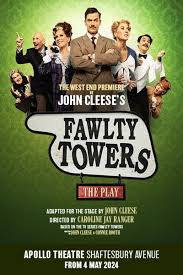
FAWLTY TOWERS - THE PLAY

The old adage that we prefer the familiar was never more apparent to me than last night when I watched the stage production of John Cleese’s Fawlty Towers at the Apollo Theatre on Shaftesbury Avenue. The audience, most of whom seemed of an age that first laughed at Basil between 1975 and 1979 when the TV show was originally broadcast, knew what was coming and were primed to laugh at all the right moments: Sybil on the warpath, Basil losing the plot, Mrs Richards’ deafness, Manuel’s shaky grasp of English, the talking moose, ‘Don’t mention the war’ and, most of all, the layer upon layer of confusion and misunderstanding that made Fawlty Towers a superlative farce. And it’s all been recreated to perfection.

        Now much is new, however. This stage production, overseen by Cleese but directed by Caroline Jay Ranger, seamlessly blends together three of the original half-hour sitcoms – The Hotel Inspector, Communication Problems and The Germans – into one 90-minute plus play that here and there has echoes from the other nine episodes in the series. At times there were even hints of Python’s silly walk and, when Basil yells ‘Polly’ at the long-suffering waitress played originally by his wife Connie Booth, I was reminded of Cleese in the pet shop where Michael Palin sold him a dead parrot. 

        Don’t mend anything that isn’t broken seems to have been the production’s prime concern, so the cast are mimics as much as actors. Adam Jackson-Smith is Basil, as ungainly and awkward as Basil/Cleese, a tall, thin man, with long legs who manages to contort himself into pretzels, agonising over a faux-pas, getting the wrong end of the stick and abusing Spanish waiter Manuel and his guests alike. Anna-Jane Casey is just as effective as Sybil, beehive in place, the clothes just right, ditto her shrill accent, especially on the phone to the unseen Audrey – ‘I know’ – or when berating her hapless husband. There were times when I thought Victoria Fox’s Polly really was the young Connie Booth, at least in the way she spoke, and Hemi Yeroham pitched Manuel just right, not quite as dumb as we might think. When he said ‘I know nothing’ the place erupted. The major’s bigoted dialogue has been softened, no doubt to acquiesce with 21st Century PC sensibilities, but he still hasn’t found the wallet that was nicked by ‘the woman he once knew’.

        Although there is a 20-minute interval, the three episodes overlap smoothly and some additional dialogue has been inserted to assist continuity. The action is fast-paced, with lines traded like ricochet fire at moments of high farce and it doesn’t pay to drift off. At the climax the whole house of cards tumbles into a riot of confusion as the fire alarm brings everyone – all the cast, including the two old ladies, the major brandishing a gun and the three hotel inspectors – to the dance, every one of them bewildered, bemused or furious at Fawlty Towers’ wretched proprietor.

        Though I knew almost all the jokes, I still laughed, as did my whole family, not least daughter Olivia visiting this week from the US. I can remember when, aged about 10, she used to watch our Fawlty Towers video box set in our house in London on rotation, memorising the dialogue to the extent that her and a couple of friends from her primary school actually staged an ad-hoc FT play of their own in our house. We shot a video of that and this weekend I’m going to seek it out and watch it again. Whatever weirdness has overtaken John Cleese in recent years, Fawlty Towers remains a comedy masterpiece, fun for all ages as the billboards used to say.


7.12.22

THE GOMSHALL MILL


Around about this time one year ago there was a great deal of wailing and gnashing of teeth in our little village. The Gomshall Mill, the historic pub on the main A25 road that links Guildford with Dorking, closed its doors for what many of us thought might be the last time. Just before Christmas, too. The Mill was a victim of Covid, of course, but an additional factor was its location over the River Tillingbourne which flows beneath it and, from time to time, backs up at the point where it enters the tunnel underneath and floods the ground floor.

        The building which houses the Mill dates back to the 11th Century, and it was still grinding flour until 1953. Inside, encased behind thick glass, you can see the old waterwheel that was once turned by the river, though in reality the Tillingbourne is nowadays a gentle stream less than six feet wide. Only in torrential rain does it back up, but that’s occurred three times since we moved to the village, with disastrous results for the Mill. Fortunately, we live above it. 

        Long before we moved here, the Mill was the village post office, then a tea shop run by a couple of elderly ladies. Later it became a pub and restaurant. When we arrived it was run by the Bluebeckers chain, then it was taken over by a London based company called Brunning & Price, which operates over 80 pubs around the UK. When they opted to throw in the towel last December, the doors were padlocked, a security firm installed cameras all around and up went a For Sale sign. Because we live close by, I opened up email communications with the company’s Operations Manager, name of Tamsyn, seeking to establish when and if a new owner had been found.

        About eight months elapsed. Two or three times, Tamsyn told me they were showing around prospective buyers. Two or three times, Tamsyn told me there were no takers yet. I spoke to one who was mooching around and bigged it up. I complained to Tamsyn that the Mill, once the pride of our village – there are brown signs on the roads approaching Gomshall drawing attention to it as a ‘historic building’ – was looking a bit derelict and that the back garden was badly overgrown. To her credit, gardeners were sent to tidy it up, but the weeds beneath the paving stones on the front patio gave the Mill an unloved, run-down look unbefitting a Grade II listed building. 

        I was told the Mill would be auctioned off last April but it never happened. Opposite it, on the same level, is a huge car park with room for perhaps 70 or 80 cars, and there were fears this might be sold separately. The phrase change of use was heard. It had an ominous ring. Then in July, Tamsyn emailed me again: “We are preparing it for sale. I believe it will be with a new owner imminently.” 

        The room in which I do my writing looks down on the Mill’s extensive back garden and not long after receiving that email I spotted two gents down there, sat at a table. I decided to join them. They eyed me suspiciously as I approached. “Are you going to buy it?” I asked. One of them, name of Julian, said maybe. I bigged it up again. 

The view from my office window, with the Tillingbourne running beneath The Mill

        In the event it never went to public auction. Julian Clarke’s company, New Dawn Pubs, bought the Mill at a price rumoured to be in the region on £720,000, which is a snip as three-bedroomed houses in this village can sell for more than that and the Mill is hardly small. The catch, of course, was that according to a local builder pal of mine it needed over £1m spending on it. The roof tiles were crumbling. One of the walls had cracks in it, and the interior was in dire need of some TLC. The kitchen equipment was probably old and playing up. 

        So, for the past four months I’ve looked down on all-hands-to-the-pump restoration work going on at our old Mill, and – praise be, as they say in Handmaids – it re-opened with a villagers-only party last week. Although work continues on the exterior, The Gomshall Mill is now up and running again.

        And while it’s lovely to have our pub back, what’s even nicer is reacquainting ourselves with the community spirit that the Mill’s closure somehow took away. Covid and no Mill had distanced us from friends and neighbours in our village but at the party in the newly opened pub, and when we called in for a drink last Friday, the atmosphere was warm and welcoming. It was also packed. We said hello to dozens of friends we know from the village but hadn’t spoken to for a while. Everyone was smiling. Everyone agreed that it was wonderful to have our pub back and that it looked fabulous. 

        Pubs are closing down left, right and centre these days which is a tragedy, not just for the licensed trade but for the communities they serve and which supports them. The Mill’s reopening exemplifies that old adage that Joni used for the lyrics in ‘Big Yellow Taxi’: You don’t know what you’ve got ‘til it’s gone. Thanks Julian and your partners for reopening our pub. Just in time for Christmas, too. 


16.7.19

CRICKET – Bats, Balls & Memories


My Lucky Cricket Ball

With the ODI World Cup in the bag and cricket in the headlines again, it seems appropriate to use Just Backdated to reminisce, not about The Who or Melody Maker for once but about the only sport I truly love. My fondness for cricket goes back to when I was old enough to hold a bat and bowl a ball. In Yorkshire, where I was raised, cricket was a religion, on a much higher level than football or rugby, at least in our house. Indeed, cricket was in my blood.

         As a young man my dad was handy with a bat and an impressive medium pace bowler. Invited to Headingley for trials with Yorkshire, his father forbade him from going. “No son of mine is earning his living with a bat and ball,” he admonished wisely, a quotation handed down to me like a mantra. So dad ended up playing for Idle CC in the ultra-competitive Bradford League. At the age of 22 he captained the Idle side that won the Priestley Cup, the league’s principal competition. By the time I was born he'd given up league cricket and was playing regularly for The Hawks CC, a wandering club that played throughout Yorkshire and beyond.
         For ten years, from the age of six to 16, dad and I attended the Scarborough Cricket Festival, occupying the same seats in the members’ stand that he and my grandfather had occupied for decades. I loved the carefree atmosphere of the Cricket Festival, the friendly way in which the matches were played, the brass band that performed in the afternoons, and the annual apple or orange bowled as likely as not by Fred Trueman after lunch during the first day of the Gentleman v Players match.
My dad’s parents lived in Scarborough, on Esplanade Road, where we stayed. Each morning during Festival week three generations of Charlesworths would drive to the North Marine Road Ground via the sea front and take our seats in time for the first ball bowled, me clutching a scorecard which I’d diligently fill in as play progressed. There were three three-day matches in those days, Gentlemen v. Players (Amateurs v Professionals), Yorkshire v. MCC and T.N. Pearces’ XI (which always included a few Test players) v. that season’s overseas touring side.
What made the whole Festival such great fun was that players past and present would stroll across the field from the pavilion to the marquees to take lunch and tea. Schoolboys like myself would lay in wait for them, and in this way I amassed an autograph book full of cricketing legends like Herbert Sutcliffe, Johnny Wardle, Norman Yardley, Maurice Leyland, Bill Edrich, Frank Tyson and Peter May, not to mention several championship-chasing Yorkshire sides from the Fifties and Sixties, led by Ray Illingworth or Brian Close. I still have that autograph book and on other pages there are the tourists, West Indians Clyde Walcott, Everton Weeks and Gary Sobers together as a trio on one page, on another the entire South African side from 1960, and on another a postcard sized picture of India, year unrecorded, with each player’s signature neatly written across their image.

Perhaps my most impressive group is the T. N. Pearce’s XI from the 73rd Festival. I had carefully cut the pictures of the players from the Scarborough evening paper, pasted them in the book and somehow got all 11 players to sign: P. E. Richardson, M. J. K. Smith, Godfrey Evans, F. S. Trueman, E. R. Dexter, Ken Barrington, Trevor Bailey, Colin Moss, Ray Illingworth, Harold Rhodes and one player whose name I can’t make out.

Top: Ted Dexter & Ken Barrington; below Godfrey Evans & Fred Trueman

At Scarborough dad turned out for a wandering side called Little Aston Stragglers who on the Sunday during festival week played an annual fixture against the West Riding Cricket Club at the Oriel, Scarborough’s ‘other’, smaller cricket ground. From the age I could hold a pencil I was recruited to score for the LA Stragglers. It broke my heart if ever I had to record a duck next to dad’s name.
         Scarborough’s South Bay skyline was dominated by the elegant Grand Hotel where many of the players stayed and where a Cricketers’ Room was set aside in which they could dine, away from prying eyes like my own. The walls of the Cricketers’ Room were adorned with photographs and prints stretching back to the beginning of the century. I was about 13 when my dad’s parents celebrated their diamond wedding in that room in 1961.
         As a member of Scarborough CC dad was entitled to drink with the players in the pavilion or marquees, and I spent hours outside these bars enjoying the cricket, sitting with my bottle (never a can!) of fizzy drink, my autograph book and scorecard to hand, daydreaming of great deeds on the pitch, admiring Godfrey Evans’ natural style behind the stumps, urging Ted Dexter on towards a quick fifty, marvelling at the way Freddie Trueman could throw a ball from the boundary edge straight into the keeper’s gloves above the bails.
         As well as the Scarborough Festival dad took me to many test and county games at Headingley and Old Trafford where he would point out the famous players of the day, and Hawks fixtures in which he took part himself. In the mid-Sixties dad went up against Brian Sellars for the Keighley & Craven seat on Yorkshire CCC Committee but lost the poll by five votes. Around that time he successfully smuggled me into the Kennington Oval Pavilion by claiming, with his collusion, that I was Yorkshire batsman Jackie Hampshire’s younger brother. There is a framed photo in our house, reproduced below, of dad with Frank Worrell, the great West Indian captain, which I treasure, not least because it reminds me there was never a trace of racism in our family. I can thank cricket for that. 


All that is long past now. The truth is that despite all this youthful enthusiasm for the game I was never much good at it. I tried, and dad even enrolled me at Headingly one summer for a course overseen by Arthur Mitchell, the stern Yorkshire coach, who wasn’t impressed by my efforts. During the years when I was on the staff of Melody Maker I lost touch with cricket, especially when I lived in New York, though I recall clearly an evening in a restaurant there with my sister who’d come to visit in the summer of 1976. For some reason we talked about cricket and were overheard by a middle-aged English couple on the next table. They joined us and we talked for hours. Like me, they were starved of cricket conversation.
         In the late Eighties, briefly, I re-assumed my cricketing life by turning out a few times for the Old Ruffians, a team made up from employees and friends of the Rough Trade record shop in Notting Hill Gate. We played in and around west London, often on a pitch that was below the elevated section of the M4 between Boston Manor and Brentford. Once we played at the Oval, when it was possible to hire a reduced form of the ground for £1,000 on a Sunday afternoon. Both teams chipped in £50 per player, and that included the scoreboard and access to the same changing rooms where the real cricketers strapped on their pads. What I remember most about the Old Ruffians games is our demon fast bowler Keith Allen who would bring his daughter Lily along, wheeling her around the boundary in a pushchair.
         Henceforth I became a spectator and, though in the Nineties I attended a few Test Matches at both Lords and the Oval, I’m nowadays glued to Sky, as I have been for the past month. I’m always happy to watch games in which I have no particular interest in who wins, just because I love to watch a great batsman play his strokes or a great bowler nip one back and catch the edge on a day when swing is in the air. I have always preferred the ebb and flow of cricket to any other sport; the diverse individual skills that contribute to an all-round team performance, an all-encompassing contest, even if it does take a bit longer than most to reach a result. 
         That aspect of cricket, the time it takes to conclude a game, used to bemuse my American friends back in the day. When I mentioned to any of them that a game between two cricketing nations went on for five days they were astounded, and when I pointed out that even after five days the game could end in a draw they thought I was taking the piss.
         Delighted though I was that England’s fabulous 50-over side won the World Cup on Sunday I thought that on the day New Zealand were the moral victors, but I temper this with the belief that England played better than any other side throughout the competition as a whole and, as a result, deserved to lift the trophy. Morgan’s cool leadership and six-hitting against Afghanistan was a joy, as were the opening platforms posted by Bairstow and Roy. Root is Mr Reliable, Buttler our sharpshooter. Archer is a stupendous find with tons of cricket ahead of him and the rest our bowling pack of Plunkett, Wood, Woakes and Rashid preyed like sharks. Then there was Stokes, no longer the hothead, whose keen eye for the way a game develops made him the key man in the side, most often with the bat but in the field too. His stupendous catch by the Oval boundary during the first game against South Africa set the tone for all that followed for me.
         And when in the middle stages of the competition England seemed to be faltering I delved beneath the stairs of our house, found my lucky cricket ball and put it within reach as I watched the TV. That’s it at the top of this post, and on the reverse is W. Walker, Keighley’, a sports shop where the Hawks CC, my dad's wandering side, bought their gear. It belonged to dad and every so often during the rest of England’s games I leaned over and grabbed it, cradling it for a few moments and wishing dad was watching the light blue England team with me.


My dad, sketched wearing the green and yellow blazer of Idle CC. 

24.1.19

SHILOH (2006-2019)


Shiloh, with Yours Truly and Olivia, Isle of Wight, summer 2008

Every time I peeled a carrot he’d come bounding into the kitchen and look up at me, waiting for the peelings, then watching me as I gathered them up and dropped them onto the mat by the back door. Then he’d scoff them, as fast as you like. It seemed to me as I watched him do this so many times over the years that he must have thought they’d vanish if he didn’t gobble them up quickly enough. What’s more he seemed to have a second sense as far as carrots were concerned. He might be sleeping on the mat by the front door, or on his own mat in the dining room, or under the table. He might even be outside if it was a warm day, sitting on the lawn or by the table on the patio. No matter where he was in the house or garden he knew instinctively when a carrot was taken from the fridge and about to be peeled, and there he’d be, looking up expectantly, licking his chops, his tail forever wagging.
         If I was cooking and didn’t have much to do for a few minutes I’d lean against the sink and daydream, and there he’d be. He knew it was the perfect opportunity for a head scratch, so he’d rub his nose against my knee and look up expectantly and when I looked down and began to stroke his head or play with the loose skin beneath his jowls or scratch behind his big floppy ears he’d make a sound that I guess is the doggy equivalent of a cat purring, a sigh of satisfaction, an acknowledgement that all was well in his little world. He felt safe and secure and loved and he wanted to thank me.
         I’ll be peeling another carrot or leaning against that sink again later today or tomorrow but for the first time in 12 years and six months he won’t be there watching me. Shiloh, our chocolate Labrador, passed away last night here in our house shortly after 1am. It was old age that did for him in the end, not the strained ligaments in his back legs that we thought might see him off a few years ago, nor the sores on his front legs that came from sitting around too much when he was too old to get up and move around a bit, nor the loud, hacking cough that sounded as if he was clearing his throat and was probably caused by eating grass on the village green.
         I’d gone to bed but Sam and Lisa were with him at the end. I thought he’d last a few more days, especially as yesterday afternoon Sam took him on to the green for what turned out to be his final mooch around, and he ate his usual meal at six. The vet had told me a week ago that the coming of the end would be marked by a loss of appetite and a complete inability to walk, so when the end did come it was a bit of a shock to me. Sam seemed to sense it though. When I went to bed I said goodnight to Shiloh and gave him a pat. Sam, who was sat on the floor stroking him, said I really ought to be saying goodbye. He was right.
         Lisa woke me just before 1.30. “Shiloh’s gone,” she said through her tears. “It’s all over.” I went downstairs and there he was, on his mat, on his side, perfectly still, his eyes open but unseeing, his tail no longer wagging. Lisa said he’d had a seizure that lasted about ten minutes, not nice to watch, and then he’d jerked his head to and fro, offered up a deep sigh and suddenly he was gone. I wept as I wrapped him up in an old duvet cover and with Sam’s help placed him gently on the floor of our garden shed. We all of us had a brandy to help with the sadness that sudden bereavement brings.
         I wept again when I went to the vets this morning to ask about the procedure. Telling the girl in the reception area was heart breaking, and I had to turn my back on her to gather myself. I was asked to take him to another vet’s office in Dorking so we laid him in the back of the car, still wrapped in the duvet cover. Sam gave his lifeless body a final stroke. Lisa came with me. I wept again as I told the vet in Dorking that we wanted his ashes returned to us so that we might scatter them on Leith Hill where we’d walked with him 100 times or more. I reached into the duvet cover to give his tummy one last tickle and watched as the vet and two assistants carried his body away, and we drove home in silence, both of us knowing that if we said anything we’d break down again.

We adopted Shiloh on a Sunday in August of 2006 from a farm in South Wales, driving from Shepherds Bush across the Severn Bridge to Usk to collect him. The farmer’s daughter bred chocolate Labradors and we were given a choice, a girl puppy or a boy puppy. They looked identical and Sam and Olivia couldn’t make up their minds, so we asked to see their parents and into this big untidy but ever so homely Welsh farmhouse kitchen, warmed by a huge old Aga, bounded their mum and dad. The dad, whose head was the size of a football, impressed us the most so we opted for the boy puppy, placing him in a cardboard box and taking him back to London with us. That night Olivia slept downstairs on a couch next to him lest he woke up whimpering because he didn’t know where he was. Four days later, as planned, we moved to the Surrey village where we still live, and where Shiloh would spend all but the first three months of his life.
        

In the cardboard box on the way back from Usk

         Shiloh was the first dog we’d owned as a family. Initially timid, he grew into a big, proud and fine-looking Lab with a glossy coat that really did look as though it was made from chocolate. He was fearless but as gentle as a lamb, fast and strong yet never one to pick fights with other dogs. Curiously he seemed unnerved by small dogs that yapped at him but unphased by bigger dogs or other animals. He barked only rarely, usually when someone was at the front door. He became our burglar alarm.
         He liked children and they loved him. Local children waiting for the school bus in the mornings liked to pet him and he made friends in the village. Parents knew he was a safe dog. He was loyal to a tee, scampering back and forth on walks to the extent that he walked twice as far as whichever of us was with him, and he always came running when we called his name. Shiloh became abbreviated to Shi. He never quite got the hang of fetching balls. He’d run after one as fast as lightning but when he found it he’d stay where he was, as if the object of the exercise was not to return with the ball but to remain with it so we’d know where it was. He made us laugh.
         Like all Labradors he had a limitless appetite. He’d eat pretty much anything all the time, including – once while I was walking him – a dead snake that got stuck in his throat. I can therefore state from personal experience of both situations that wrenching a dead and slimy snake from the mouth of a hungry Labrador is as character building as driving Keith Moon’s Rolls-Royce at night with its owner in the back, out of his head on brandy while The Beach Boys are playing at full volume.
         For many years I’d get up quite early on Sunday mornings, bundle him into the back of the car and take him to Newlands Corner or up Leith Hill, usually with my iPod in my pocket and earphones clamped to my head. Off with the leash and away he’d go, sniffing his way ahead of me, running back to me if I called him, panting, eager, always alert, that tail wagging away, a look of joy of his handsome face. In his prime he’d draw envious glances from other dog walkers. I was so proud of him. I loved the way he leaped up into the back of our car, a Honda Stream with a hatchback door that is quite high off the ground. He didn’t really need to take a running jump either. It was sad when in this last year or so he lost the strength in his back legs and was no longer able to do this, but we managed to get him in somehow. Then, as usual, he’d sit up in the back with his head between the rear seats, as close as possible to whoever was sitting there. This was the way he liked to travel, and we took him away on holiday with us sometimes, to Cornwall, the Isle of Wight and South Wales. He came with us to Brighton and Lancing many times, and liked nothing better than to wade into the sea after a tennis ball that he’d drop on the beach. He always seemed excited to be going away somewhere with us, loved being part of our family, to be with us, and we loved him back for it.
         Every Christmas Day the four of us and Shiloh would take a walk somewhere locally and when we found a spot with a nice view we’d set up a camera and take a picture, hopefully with Shiloh looking in the same direction as we were. Many of these pictures appeared on Facebook over the years. It was a struggle getting him into the car this last Christmas but I’m so glad we did. We took some pictures at Friday Street, in the same spot as we’d taken pictures years before when Shiloh was two or three years old. We have a little movie of Sam walking him near the Stephan Langton pub.

Sam with Shiloh, Friday Street, Christmas 2018

         ‘Walking him’ became a bit of trial recently. It is generally accepted that one human year is the equivalent of seven dog years and this means they grow up quickly and grow old quickly, and Shiloh’s rapid decline over the past few months was hard to watch. A walk to the petrol station with him to get my newspaper in the morning once took ten minutes but was now stretched to almost 30. I hated dragging him on his lead but when I stopped he stopped. Two weeks ago I stopped taking him and instead Sam, Lisa or myself took to sauntering out on to the green with him and letting him sniff around in the undergrowth under his own steam. He stopped taking an interest in other dogs too, and when I saw them running after a ball or a stick I thought back to when Shiloh too ran like the wind. He didn’t seem to mind though. He was happy to mooch around, glad of a change of scenery for 20 minutes. He was eager for a walk until the very end, still wagging his tail.
         That rapid decline was there to see not just in his legs but in his eyes which became rheumy and unfocused. Though he never lost his sight, I think he had difficulty getting his bearings. Sometimes on the green I’d take off his lead and he’d just stand there, wondering what to do, a bit lost on a patch of land he’d explored 1,000 times before. Labradors tend to look sad even when they’re not, but there was a deeper sadness in Shiloh’s watery eyes that we recognised but could do nothing about. Other dog walkers noticed it too, and asked me how old he was. When I told them he was well over 12 they knew – as I did – that he was reaching his time. I think he knew it too.
         So Shiloh, our faithful pup – Lisa always called him ‘pups’ even when he clearly wasn’t – has taken his leave of us and I’m glad now that it happened in the house he knew so well, surrounded by two of the four persons who loved and cared for him, and whom he loved and cared for more than anyone else. In a week or so Lisa, Sam, myself and, in spirit, Olivia (she lives in New York now) will take his ashes to the top of Leith Hill, to a spot where he once gobbled up a tasty ham sandwich that a careless but rather pissed-off hiker had left unattended, and watch as the dust from Shiloh’s remains flies up and away into the wind. And we’ll all of us weep one final time for our dear departed friend.