Showing posts with label The Who (Books). Show all posts

7.4.26

DEAR BOY: THE LIFE OF KEITH MOON

EVERYTHING YOU EVER WANTED TO KNOW 

ABOUT HOW THE BOOK CAME ABOUT

Of all the many hundreds of books I commissioned and edited for Omnibus Press during the 33 years I worked as the company’s Managing Editor, none gave me greater personal satisfaction than Dear Boy: The Life of Keith Moon by Tony Fletcher. There are many reasons for this. Firstly, it was a best-seller, spectacularly so by rock book standards; secondly, it was an exceptional book, beautifully written, researched in enormous detail and very long, especially bearing in mind that its subject died at the age of only 32; and thirdly – and perhaps most importantly – it treated the highs and lows of Keith Moon’s extraordinary life in equal measure, truly a ‘warts and all’ biography of the highest quality, as was reflected in innumerable positive reviews. 

There was one other reason, of course. The book would focus on The Who, the rock band I admired more than any other, about whom I had written two books myself and for whom I had worked as an archivist sourcing tracks for their 1994 box-set and subsequent upgraded catalogue CDs. Also, I had known Keith and interviewed him at length for Melody Maker back when I was a staff writer on the paper. My relationship with The Who might therefore have led some Who fans to assume that Dear Boy was in some way my initiative but it wasn’t. First and foremost, Dear Boy, the title and everything else, was Tony’s idea. 

        It was in early 1994 when Tony presented me with his lengthy proposal, a list of potential interviewees and how he was going to set about the project, complete with timeline, chapter breakdown and word count. It was his idea to publish it in the first week of September 1998, almost exactly 20 years to the day after Keith Moon’s death. Tony assumed, correctly, and I agreed, that this anniversary would stimulate media interest that might help promote his book but in order for this to happen it had to be delivered in plenty of time for it to go into production and be available in bookshops on the requisite date. To this end it was contracted four years before we planned to publish, Omnibus acquiring UK and Australasian rights, and Avon, under their Spike imprint, publishing in the USA where it was titled Moon: The Life & Death of a Rock Legend [1]. Now published in the US by Harper Collins, there are also German, French and Brazilian language editions, as well as a graphic novel, and 2026 sees its 28th year in print across different editions [2], the latest an Omnibus title in their ‘Remastered’ series due for publication on April 9. 

The US Edition

Back in 1995, the book’s meticulous advance planning gave Tony two years in which to complete his research; around 130 interviews with people who knew Keith, fellow musicians, Who staff, friends and lovers, music journalists, anyone and just about everyone whose paths crossed with that of The Who’s mercurial drummer. Naturally, his first port of call was the group: Entwistle said yes [3], Daltrey no [4], Townshend dithered, ultimately declining as he felt that dredging up memories of Keith might jeopardise his newly-found sobriety [5]. Former co-manager Chris Stamp said yes, as did Bill Curbishley who took over the Who’s management from Stamp and Kit Lambert in the mid-1970s. Perhaps more importantly, the three people who had lived with Keith as an adult – ex-wife Kim, subsequent girlfriend Annette Hunt, then Annette Walter-Lax, and personal assistant/driver Peter ‘Dougal’ Butler – all said yes.

From his home at the time in Manhattan, Tony, along with his then-wife Posie and their six-month-old son, moved to the UK for six months in 1996 so he could better conduct the European research. He travelled up and down the UK interviewing everyone he could get hold of, went to Ireland to meet Oliver Reed and visited Stockholm, twice, to interview Annette (who initially asked for payment, ultimately declined). Quite late in the day, back in the States, he spent a weekend in Austin, Texas, where Kim lived with her second husband, Faces/Small Faces keyboard player Ian ‘Mac’ McLagan. This was the only interview that Kim, who died in 2006, ever gave to anyone. Quite a few noted musicians were also interviewed, among them, in alphabetical order, Mick Avory, Ginger Baker, Jeff Beck, Alice Cooper, Ian Dury, Dave Edmunds, Bobby Elliott, Steve Ellis, Chris Farlowe, Steve Harley, Roy Harper, Bob Henrit, Bruce Johnson, Howard Kaylan, Jim Keltner, Corky Laing, Carlo Little, John Otway, Reg Presley, Viv Prince, Noel Redding, Dave Rowberry, John Sebastian, ‘Legs’ Larry Smith, Zak Starkey, Mark Volman and Joe Walsh. From the acting world came Ann-Margret, Larry Hagman, Karl Howman and Oliver Reed. Tony even tracked down all the members of The Beachcombers, the group for whom Keith played before he joined The Who. 

His research complete, Tony spent the best part of a year in the writing, delivering his manuscript 10 months before publication date, thus enabling me the luxury of ample time to edit and do whatever work was necessary before handing it over to our production department. He had hoped to finish the book by the summer of 1997, at which point he had a UK holiday booked, but when this didn’t happen I asked to read the chapters he had written thus far. So keen was I to read what Tony had written about Keith that I took a draft of this home on the Friday night after it arrived which, as it happened, ushered in the same weekend that Princess Diana died. I’d stayed up late glued to our home computer screen on Saturday night and well remember our five-year-old daughter Olivia waking me quite early on Sunday morning to complain that the cartoons she wanted to watch on TV had been supplanted by the sad news from Paris. That day we took Olivia and her two-year-old brother Sam to a sparsely-attended London Zoo where the name-plate on the cage of ‘Diana the Gorilla’ was covered over by a dark cloth to avoid offending royalists with tender sensibilities. 

But I digress. Once the complete text was delivered to me on Halloween, I quickly realised that Tony had produced something very special and decided to go all out on editing and production. I suggested one change to the chapter structure to which Tony complied [6] and brought all my reserves of Who knowledge to bear in making subtle changes here and there. I commissioned Richard Evans, the Who’s go-to graphic designer, to design the book’s jacket and Tony, Richard and myself spent an afternoon visiting big London bookshops to inspect covers of biographies that we thought the retail trade regarded as prestigious. The big seller at the time was Diana: Her True Story In Her Own Words by Andrew Morton which featured on its cover a black and white picture of the late princess against a white background, so we opted for something similar with a head and shoulders portrait of Keith [7] and an embossed title in gold lettering. For the insides I commissioned an artist friend of my wife to create a postage-stamp sized drawing of a snare drum flying over the moon to use at the start of each chapter, and a tiny jester’s hat, drum and wine bottle to indicate breaks in the text where asterisks are normally placed. Once the manuscript was typeset I commissioned my friend Johnny Rogan to prepare an index and, being the English language and rock scholar that he was, he suggested further amendments to the text to polish what I knew would be a jewel in Omnibus’ crown. 

I didn’t stint on the photo research either, and between them our staff researcher Nikki Russell, Tony and Richard came up with everything we needed; childhood pictures, Keith in pre-Who groups, Who shots, Keith with Kim and many others and several that illustrated particular instances in the text, 51 pictures in all across three eight-page sections. I also communicated my enthusiasm for the book to everyone else at Omnibus, not least sales manager Frank Warren, his PA Hilary Donlon and our Contracts Manager Andrew King, all of whom readily jumped on the Dear Boy bandwagon. “You were like a record company when it’s flying,” says Tony. “You had the set-up that would make writers want to be on your label. I recall a lovely publication lunch for all the staff at the restaurant where the Marquee used to be. You allowed me to order a Chateauneuf-du-Pape blanc that was both rare and expensive, and you’d have okayed a second bottle but that was the only one they had. I think we downgraded.”


Our hunch about the 20th anniversary of Keith’s death proved correct. In the month of Dear Boy’s publication Mojo magazine featured Keith on its cover, and our Rights Manager Helen Donlon somehow achieved serialisation in the Sunday Mail. Charles Shaar Murray’s extensive review occupied the whole of the front page of the Daily Telegraph’s arts section. In the week of publication we threw a launch party at The Borderline in Soho where we gave away Dear Boy t-shirts, and among those who attended were Dougal Butler, Richard Barnes (Pete Townshend’s one-time flatmate who coined the name ‘The Who’), former Who tour manager John ‘Wiggy’ Wolff, Doug Sandom, the drummer in The Detours whom Keith succeeded in the spring of 1964, and Paul Kemp, the drummer in Who tribute band Who’s Who. A spitting image of the real Keith, Paul managed to get a group of revellers thrown out of an after-hours bar later in the evening. “Keith would have approved,” notes Tony, who was among them. 

Furthermore – and much to our delight – on the Sunday before it arrived in the shops we were able to sell it at a Who fan convention held at the Astoria Theatre in central London, which 11 years later would be demolished to make way for a Crossrail station. The date was September 6, the day before the 20th anniversary of Keith’s death, and in many ways the convention acted as a tribute to him.

The queue of Who fans snaking past our trestle table to snap up Dear Boy remained in place throughout the entire afternoon. While UK fans who bought a copy got it one day early, many American fans who flew over for the convention got theirs three months early as the US edition wasn’t published there until the following January [8]. In the event many US fans bought several copies as Christmas presents for their Who fan friends back home, blithely overlooking how its weight might impact on their baggage allowance. Tony was on hand at the convention to read extracts from the stage and sign copies of his book, as did Kitty Moon, Keith’s mum, who also turned up, accompanied by Lesley, the younger of Keith’s two sisters.

CC and Tony at the convention, 
and a pile of empty boxes that once contained copies of Dear Boy.

In all we sold 400 copies of Dear Boy at £20 a throw directly to fans that day, and late in the evening – after the Who’s Who tribute band had performed – I took the tube home to Shepherds Bush clinging on to a plastic bag containing the best part of £8,000 in £10 and £20 notes. It was a fantastic result, a precursor to the book’s ongoing success, and dumping that bag of cash on my boss’ desk the following morning was as satisfying for me as everything else connected with Dear Boy, not least the subsequent realisation that it eventually outsold Thatchers official biography. 

And so we come to the 2026 edition, published as a pocket paperback, though at almost 600 pages it’s a bit too chunky to fit into anything but an XXL pocket. At the start there’s two new forewords, one by Tony and the other by Keith Moon’s daughter Mandy, now Amanda De Wolf. Mandy, who became a grandmother in 2023 and now lives in California, admits that she was only eight when she last saw her father and never really knew him, only his life and legacy as detailed in Dear Boy

        It’s slightly bizarre to realise that, had he lived, Keith would have become a great-grandfather at the absurdly early age of 77 – but then again absurdity clung to Keith Moon like moss to a stone – and evidently continues to do so 48 years after the Dear Boy’s death. 

------------------------

[1] The US publishers felt the title Dear Boy might lead some to believe it was a book aimed at a gay audience. 

[2] In 2005, Omnibus published a revised trade paperback edition with a new 20-page Afterword comprising material Tony gleaned from interviews with acquaintances of Moon who contacted him after the book’s initial publication.

[3] John gave Tony one his frankest ever interviews, revealing not only his love of Keith but his deep frustration at the stop-start nature of The Who’s career following Keith’s death, for which he blamed Townshend. 

[4] I don’t believe Roger grasped the scope the project. No doubt assuming Tony was planning to write a brief, sensationalist paperback full of scandalous stories, he was approached and declined several times and was probably shocked by the eventual appearance of a 576-page hardback that in his opinion didn’t portray him as he would have preferred. In an interview with Record Collector magazine shortly after Dear Boy’s publication he suggested the book was merely the recollections of ‘alcoholics and drug addicts’. This prompted me to write to Record Collector pointing out that of the Who’s inner circle of six (Townshend, Daltrey, Entwistle, Moon, Lambert and Stamp), he was the only one who wasn’t an alcoholic or drug addict at one time or another. It later transpired that Roger felt its publication might impact unfavourably on his commercial interests in a film he planned to make about Keith, a film which, incidentally, has yet to go into production despite having gone through multiple scripts and prospective directors and lead actors. Incidentally, Dear Boy was optioned almost immediately on publication as source material for a movie, and when Roger was interviewed by Sky News some years ago a copy of Dear Boy was prominently displayed on a shelf behind his head. 

[5] Pete faxed Tony to the effect that he, ‘no longer had anything to say about Keith that is kind’. Shortly before the book went to press Tony heard that Pete apparently regretted his decision, which is exactly what those close to him intimated would happen. A few weeks after its publication, backstage at the Shepherds Bush Empire following a solo show, Pete told me that Tony ‘should be very proud of the book he had written’. 

[6] The dramatic opening to Chapter 27 was initially towards the end of Chapter 26. I felt it warranted a more prominent position. 

[7] The photograph of Keith on the cover of Dear Boy was taken by David Magnus in 1965. 

[8] The US publishers actually requested that I delay our publication so that it coincided with theirs, but I was having none of it.

(Thanks to Tony for help with this post. tonyfletcher.substack.com )


9.6.25

THE WHO ALBUM BY ALBUM by Dante DiCarlo

In the manner of Revolution In The Head, Ian McDonald’s acclaimed book analysing the music of The Beatles, Dante DiCarlo attempts something along similar lines for The Who, and while his writing style falls somewhat short of McDonald, this is a workmanlike effort at evaluating The Who’s 14 studio albums, track by track, 168 songs in all. It helps that DiCarlo is a guitarist himself, thus enabling him to analyse the songs from a musician’s standpoint, recording which keys Pete Townshend plays in, D being his preference as anyone who’s ever essayed ‘Substitute’ surely knows, and chord progressions. 

To a certain extent this book renders my own Complete Guide To The Music Of The Who (1994 & 2004, the update written with Ed Hanel) redundant, though DiCarlo omits live albums and compilations, thus disregarding those singles (like ‘I Can’t Explain’, ‘Anyway Anyhow Anywhere’, ‘Substitute’ and a handful of others) that appear only on collections of hits, tracks on the Ready Steady Who EP and ‘bonus’ tracks that have appeared on certain compilations and reissues. Most, however, get a mention in the text that prefaces each LP, especially those that somehow align with Townshend’s various musical concepts. My Who music guide was one in a series of 46 books designed in the shape of CD cases and, through necessity, was considerably more concise than Album By Album, even it did include live LPs and compilations, of which there are now too many to count. Album By Album contains far more detail, not just in the scrutiny of the actual songs but in the background essays that introduce each LP. 

So, beginning with ‘Out In The Street’ from My Generation (1965) and ending about 200 pages later with ‘She Rocked My World’ from WHO (2019) we get the low down on The Who’s recorded oeuvre, most of it positive though DiCarlo doesn’t shy away from critical assessments, mostly, as might be expected, on tracks from the post-Moon LPs. Those songs that might be regarded as landmarks in the group’s career – ‘My Generation’, ‘Pinball Wizard’ and ‘Won’t Get Fooled Again’, for example – get the five-star treatment, with up to three pages of worthwhile analysis.  

        DiCarlo was born in 1983 and thus missed out on The Who’s classic period and with this in mind he’s written a book aimed at newer fans of The Who, by which I mean those who’ve picked up on the group after Keith left us in 1978 and possibly also John Entwistle in 2002. For such Who fans this is a valuable guide to their legacy and to the way their long career has panned out. Older fans won’t find much here that they don’t already know if they’ve paid attention along the way and read all the books but DiCarlo has done his research well and produced an accurate, interesting summary of the group’s output. 

Of course, 168 songs (plus maybe a dozen or so that don’t make the book) in what is now a 60-year career is by no means prolific. The Beatles recorded 213 songs, 188 of which they wrote themselves, in eight years, a work-rate that exposes The Who as shiftless slackers. But that doesn’t consider The Who’s brilliance as a live act, which is what really attracted me to them towards the end of the 1960s, turned me into a rabid fan during the 1970s and has kept me banging on about them for years. This, for me, is where their true greatness lies. Perhaps, therefore, a follow-up book might consider their live legacy, contrasting and comparing all their many concert releases, even though the songs they perform haven’t changed that much over the last 40 years. 

Album By Album contains 16 pages of colour photos, many taken by the author, the vast majority from the new millennium. It’s 220 pages long with a useful index and costs £25 (£19.85 on Amazon). 


12.4.25

THEIR GENERATION: THE WHO IN AMERICA 1967-69

Because they looked so good on stage, there is no shortage of Who picture books and this latest one – with photographs by Tom Wright and accompanying text by Andy Neill – is a welcome addition to my creaking bookshelf. The first one I bought, in 1973, simply called The Who, with pictures by Jeff Stein & Chris Johnston, has been joined over the years by about a dozen more, and many of them have met with the group’s approval to the extent that they have contributed in some way, as is the case here. “Tom was a chronicler, with an eye for the passing moment,” writes Pete Townshend in his introduction, “and it’s a joy to be able to share all these passing moments with you all today.”

Andy Neill spent an afternoon with Pete last year sifting through Tom’s pictures, and his running commentary, alongside Andy’s typically accurate and info-packed captions, makes for not only a visual feast but also an entertaining read. 

The Who have many reasons to be grateful to Tom Wright. A contemporary of Townshend at Ealing Art College in 1962, Tom introduced him to marijuana and a host of great American R&B and blues artists. Equally importantly, he would go on to become the group’s American tour manager and unofficial photographer, and many of his photographs from The Who’s earliest US tours are seen for the first time in this book. 

It was Tom’s sister Antoinette who put her brother in touch with The Who again. She’d heard on the radio that the group was supporting Herman’s Hermits on a show in Florida and she urged him to call Townshend. “Tom was reluctant to bother Pete, so my best friend and I started calling every hotel in the area until we found one where The Who were staying and left a message for Pete: ‘Call Tom Wright at this number. I’m here in Tampa.’ Pete called back quickly. He told Tom he’d been searching everywhere for him.” 

In 2025, with The Who esteemed as mighty legends of rock, pioneers in the art of performance and superstars both alive and dead, it seems absurd to recall that in the summer of 1967, on their first American tour, they were the support act for the far more popular Herman’s Hermits. With 11 top ten hits behind them when the tour started – The Who had one – Herman and his boys were riding the crest of wave, drawing predominantly female teenagers for whom The Who were distinctly odd, especially when they closed their brief sets by inflicting damage to their guitars, drums and amplifiers. 

         That first tour began on July 13 in Calgary, Canada, and closed on September 9 in Honolulu, Hawaii, a ten-week coast-to-coast jaunt on which they often played two - sometimes three - shows in one day. It was a gruelling experience and probably not worth the effort. “It got us around America,” said Roger Daltrey, “but it did us no good at all.”      

Some shows were in large arenas of major cities while others were booked into theatre-size auditoriums with the occasional outdoor state fair thrown in. The Who played for about 30 to 40 minutes on most dates, concluding their set with smashed guitars and smoke bombs that left audiences either stunned or ecstatic. 

Tom Wright was working as an underwater photographer when he joined The Who at St Petersburg in Florida. “The Who came to Florida and that was the end of my underwater photography career,” he says. “These young kids would be yelling, ‘Where’s Herman, we want Herman’ and then The Who would start playing before the curtain came up,” he told Who biographer Richard Barnes. “When the curtain came up they would be really rocking and everybody was just moving about, like Roger would be running around and Pete would be swinging his arm and hammering the guitar and Moonie would be kicking ass. And people were in shock. The band didn’t stop between numbers or they’d quit playing for just a couple a couple of seconds, but it would be just long enough and BOOM into the next number.”

This was the period in The Who’s career when wrecking their equipment at the end of a set was a regular occurrence. “It was spellbinding,” adds Tom.  “A lot of times there was no clapping whatsoever, just dead silence. People in the front row were just sitting there with their mouths open, stunned.” 

Tom would go on to tour manage The Who in America for the band’s spring 1968 tour – their first as headliners, photographing them along the way, on stage, in recording studios, in their coach and in their hotels. They opened the tour on February 21 in San Jose, California, and while in the Golden State made a madcap, stop-start promotional film for ‘Call Me Lightning’. Tom was on hand to photograph the group in tin helmets and fooling around with an explosive detonator. The tour was extended into the first week of April and visited the new psychedelic ballrooms which were ideal for The Who to present themselves as leaders of the new rock movement.

A second US tour began on June 28, again on the West Coast, before heading east and back again, closing on August 30 after visiting over 30 US cities. Tom was no longer working on the road with The Who, but he did photograph them at a memorable show at the Singer Bowl, where they were co-billed with The Doors. After relocating from Florida to New York, in late 1968 Wright accepted a position as manager of the Grande Ballroom in Detroit, one of the era’s most important rock venues. 

The tours that Tom photographed laid the foundation for The Who’s eventual capture of an American tour circuit they helped create. This didn’t exist during the first British Invasion of America, the one led by The Beatles and Rolling Stones, and it came about as pop became rock, with audiences beginning to listen to groups whose music was no longer aimed at teenage girls who screamed like banshees. During Tom’s tenure as The Who’s tour manager and in-house photographer the group pioneered a new concept of rock performance, ushering in an era that continues to this day. As the music they played became more and more sophisticated their shows became longer and more expressive.

Just as they had done in the UK, The Who blazed a trail in America through the potency of their live shows. There was no run of chart-topping US singles or historic appearances on The Ed Sullivan Show. They didn’t so much crash down Uncle Sam’s doors as slide in through a gap after the doors had been left ajar by those that preceded them, but the hard work they put in meant that in the fullness of time they would become the stadium filling juggernaut whose career continues to this day. 

Wright’s pictures of The Who on stage, in studios where they stopped off to record, in hotel and dressing rooms and in the coach that acted as a home on wheels, capture a fascinating but often forgotten period in the journey of one of the UK’s greatest ever rock bands.  

Published by Omnibus Press, Their Generation has 176 pages, more great Who photographs than you can shake a stick at and costs £30 (£23.55 on Amazon).


2.1.25

ROGER DALTREY – FOUR PHANTOM BIOGRAPHIES

Midway through December I came across a “biography” of Roger Daltrey by “James Patterson” on Amazon. What struck me was that the photograph on the cover was not Roger, albeit of a young man with blond curly hair leaning towards a microphone on a stand, and it occurred to me that the image might have been created by AI. Sample text, too, looked suspicious to me, largely because it was insufferably bland and unctuously sycophantic. 

        I drew attention to this book to three friends of mine, all dedicated and knowledgeable Who fans, all of whom agreed with my conclusions. One of them was Ed Hanel whose home on the Hawaiian island Kailua accommodates what might just be the biggest collection of Who records, books and miscellanea anywhere in the world. It is Ed’s custom to obtain absolutely anything and everything Who related – regardless of quality – to add to his collection but it came as a bit of a surprise to me that in buying a copy of this book, he came across no fewer than three further “biographies” of Roger, each of which seemed to him – and me – to be of dubious origin. So, as a service to Who fans everywhere I am posting Ed’s comments here on Just Backdated.

        Over to you Ed. 


FOUR ROGER DALTREY BOOKS RELEASED 23 December, 2024.

EACH MERITS ONE STAR


Roger Daltrey Biography: Discovering the Legend of Rock Stage by “Adam Young” 

No publisher, sold on Amazon. Last page Bar Code: 14795988R00085. Amazon indicates that the book was originally published 24 November, 2023.

        Largely direct quotes, sometimes with minor changes, from Roger Daltrey’s autobiography, Thanks A Lot Mr Kibblewhite. For example: Roger’s “Chapter One: The Flannel Shirt” opens with, “On a muggy Florida night in March 2007, Pete and I walked out onto the stage at the Ford Amphitheatre in Tampa.” This becomes “Chapter One: The Flannel Shirt”, opening with “Pete and I walked out onto the stage at the Ford Amphitheatre in Tampa on a hot Florida night in March 2007.”  The text doesn’t get any better or any more original.

        The book’s text ends with excerpts from Chapter 16 of Roger’s book. In effect, the book ends in the mid-1980’s, referencing Live Aid 1985 and noting, incorrectly just as Roger did, “That was the last of The Who for nearly a decade.” Accordingly, the book completely ignores the last 40 years of Roger’s life.


The Legend Of Roger Daltreys (sic): Great Vocals And The Struggle For Self-Expression by “Betty Jo LeClair”

No publisher, sold on Amazon. Last page Bar Code: 14795989R00085.  Amazon indicates the book was originally published on 17 June, 2023.

        Largely direct quotes from Thanks A Lot Mr Kibblewhite, sometimes with minor changes. For example, Roger’s book ends with an acknowledgement, thanking Mr Kibblewhite, “And I really mean that.” This book inexplicably changes Roger’s words to, “Mr. Kibblewhite, I am quite grateful to you.” In Chapter 19 “Brothers”, the text begins by skipping several pages of Roger’s text, then quotes Roger for several pages only to stop mid-page. At the top of the next page, the text repeats several pages (Pp. 128/9). 


The Voice That Changed Music: The Story of Roger Daltrey and His Rock Revolution, by “James Patterson” 

According to Amazon, Mr. Patterson is a published writer. No publisher, sold on Amazon. Last Page Bar Code: 1479203R00049. Amazon indicates the book was originally published on 3 November, 2024.

        The cover picture is not Roger. Additional pictures in the book are dubious at best. The text reads like notes collected for a book project at the initial research stage. For example, “After this, Daltrey’s solo career underwent a major turning point with Rough Mix ( 1977) (sic), a joint project with Pete Townshend.” A little later on, we read, “This release [Under A Raging Moon] contained the smash track ‘Parting Should Be Painless’ and had a more polished rock feel” (Pp. 38/39). Basic editing should have caught both mistakes. Roger had no role on Rough Mix and ‘Parting Should Be Painless’ is found instead on the album of the same name. Because the text is confused about Rough Mix in several references, it may be useful to clarify that Pete’s partner on this project was Ronnie Lane.

        There is a segment that addresses Paul McCartney’s releases, with no relation or connection to Roger (Pp.48-50).


Roger Daltrey Biography For Curious Kids by “Leo Whittaker”

Published by Little Big Giant, sold on Amazon. Last page Bar Code: 14796674R00066. Amazon indicates that the book was originally published 5 August, 2024.

        The cover is an animated figure that looks like a Halloween Mask, with no relationship to Roger’s appearance. Written as a children’s book. Chapters end with a “Key Takeway” such as: “Teamwork can help you achieve success” or, “Don’t be afraid to explore and find new things you love.”

        Unfortunately, there are glaring mistakes. For example, we are told that the first public performance of Tommy took place at a “massive venue” (P. 55). The first public performance is generally considered as occurring at the Institute of Technology, Bolton, UK, on 22 April, 1969. The first widely reported performance took place on 1 May at Ronnie Scott’s Jazz Club, on Frith Street in Londons Soho. Neither venue could be remotely considered as massive. 

  Furthermore (P. 75), we read, “In Tommy [the movie], Roger played the role of the ‘Hawker’, a character who sold everything from toys to dreams.” It would be hard to cram more misinformation into one sentence. The only role for Roger in any version of Tommy is, of course, the lead character, Tommy Walker. The hawker is a pimp who offers up a woman as a cure for Tommy’s woes, perhaps not an appropriate aspect to include in a children’s book, albeit rather amusing when reflecting on the chapter’s Key Takeway: “Trying new things can lead to exciting adventures” (P. 79). 

SUMMARY

The plagiarism in two of the books and the lack of proper fact checking or editing in all four are disappointing at best. None should be considered as appropriate reviews of Roger’s career.

        The versions of these four books appear to be run off at the same time, with the same date (“23 December 2024”) and the same last page format. For reference, I received my copies here in Hawaii on 24 December, 2024, after ordering them several weeks earlier.  


22.7.24

WHO KNOWS – THE MAKING OF A ROCK MOVIE by Tony Klinger

Who fans that take an interest in such matters may have read elsewhere that certain issues clouded the production of The Kids Are Alright, the documentary film on the group that was released to cinemas and on video in 1979. With impeccable timing but perhaps inadvertently, this well-received biopic served as a tribute to drummer Keith Moon whose death the previous year brought closure to what many look upon as The Who’s classic period. These issues are hinted at in the introduction to this book which suggests, heaven forbid, that raised voices could be heard at TKAA-related meetings in the offices of Trinifold, The Who’s Soho-based management company, and one of them, heaven forbid, may have belonged to Bill Curbishley, the group’s manager, not a man to react kindly to anything that affronts his pro-active, protective and occasionally combative nature. Another raised voice was no doubt that of Tony Klinger, the author of this book, the much put-upon film-maker brought in by Curbishley and The Who to help make their movie. 

        Disagreements between all those involved in TKAA take centre stage in a rather unsettling but nevertheless insightful book. On the DVD and video I own, Klinger is credited as TKAA’s producer, as is Curbishley, and was therefore privy to everything that went down before and during its creation. Luckily for us, he didn’t sign an NDA, so he chose to bare his soul, initially in a book titled, for some absurd reason, Twilight Of The Gods, published in 2009, republished as The Who And I in 2017. This is the third edition of the same book, much revised, published now by the author, the implication being that for the first time here is the truth, the whole truth and nothing but the truth, some of which may have been withheld from earlier editions.* 

        Klinger is an experienced film-maker whose credits go back to working on the original Avengers TV series and several excellent movies, among them Get Carter, an all-time favourite of mine. His first brush with The Who came in late 1976 when he was commissioned to produce a promotional video for Roger Daltrey’s solo single ‘One Of The Boys’, which brought him to the attention of Curbishley who was seeking someone to produce and/or direct the documentary on The Who that became TKAA. To his misfortune, Klinger’s arrival in Who central in early 1977 coincided with a period of unrest and uncertainty surrounding the group. Having toured prodigiously during 1975 and ’76, they were now idle, collectively at least, with no immediate plans for the future. Pete Townshend had begun to compose songs that would appear on Who Are You, which wouldn’t be released until 1978, Daltrey was keen to pursue a career as an actor, John Entwistle was moodily weighing up his options and Moon was living in California, adrift in an ocean of alcohol. On behalf of the group, Curbishley had just completed the purchase of Shepperton film studios south west of London, his intention to broaden The Who’s interest in films and utilise them as a storage and rehearsal space.                                                                                                                                                      Klinger’s first move was to bring in his film-maker friend Sydney Rose to assist with production. This didn’t sit well with Curbishley, which might explain why Rose’s Christian name is misspelt with an i in the credits, a rather shabby slight. Curbishley drew Klinger’s attention to Jeff Stein, an American Who fan who’d already researched archive film footage of the band for no other reason than his enthusiasm for and love of The Who. Stein’s photographs of the group, along with those by his collaborator Chris Johnson, appeared in a delightful photo-study they published 1973, to my knowledge only the second ever Who book (which I treasure), and this no doubt helped him establish his friendly rapport with Townshend. Stein demanded that his friend Ed Rothkowitz be appointed TKAA’s editor, which didn’t sit well with Klinger. And herein lies the problem: too many cooks, each with their own agenda and unwilling or unable to communicate openly with one another, spoiling the broth.

        In the end, of course, the broth turned out to be very tasty indeed but not before Klinger experienced the stuff of nightmares in his dealings with the band, Curbishley and Stein, all of whom seemed at times to be operating at cross purposes. In a nutshell, having found himself more or less at odds with everyone over staffing, budgeting and how the film should look, Klinger believed, perhaps justifiably in light of his greater experience in film-making, that he was right and they were wrong, so he screamed and shouted and, eventually, walked. Only at the very end was he brought back into the fold and then under a cloud that lingers to this day. 

        Along the way, we get heaps of fly-on-the-wall reports of ‘difficult’ meetings, in which Curbishley comes across as a bit of a bully, and finely drawn but far from flattering pen portraits of Townshend, Daltrey, Entwistle and Moon; respectively duplicitous, hot-headed, broody and nuts. We visit Malibu where Klinger and his men get a full-on dose of Moon at his most obdurate, alternately blind drunk or rabidly libidinous with girls galore, clearly not long for this world, and a cameo appearance by his next door neighbours, tough guy actor Steve McQueen and wife Ali MacGraw. We visit Stow-on-the-Wold where a sulky Entwistle is also uncooperative – “Extracting conversation from him was like drawing teeth” – and Burwash on the Kent-Sussex border where Daltrey occupies the local manor house but declines to be filmed with his private helicopter lest it damage his working-man-made-good image. 

        Despite its tongue-in-cheek cover – the author sat on paving stones, draped in a Union Jack in emulation of the Who photo used to promote TKAA, its sub-title set in the same typeface – I found the book’s brutal honesty enlightening but a bit depressing. Much as Klinger strongly admires the Who’s music and the power they radiate on stage, he feels they let him down. “We needed one hundred percent of The Who’s artistic involvement and moral commitment, not purely monetary support; I never felt we had it,” he writes towards the end of his book. “If Pete wanted to go for something, Roger would be pulling in the other direction and the opposite held true. … the band’s commitment to each other, let alone the film, was stretched paper-thin… [they] didn’t know what came next either, nor did their management, lawyers or record company. It had evolved in a way that none of us could have desired or foreseen except in our darkest nightmares.” 

        Biographical details of The Who throughout are sketchy and not always 100% accurate, and the author’s jaundiced opinions on the members of The Who are, of course, coloured by his own regrettable experiences. To a certain extent I know what he’s getting at – I too have experienced The Who at close quarters and had business dealings with them** – but I can’t help but think that at times he’s overegging the pudding. Nevertheless, the book’s original publisher showed the manuscript to them and “got the all clear”, according to the author. If so, it speaks wonders for The Who’s lifelong commitment to letting it all hang out, as evidenced in so many other Who-related books. 

        Who Knows – The Making Of A Rock Movie is illustrated with photographs by Danny Clifford, many taken during the production of TKAA, has 250 pages, no index and costs £14.99 on Amazon. 

-----

* I can neither confirm nor refute this as I am unfamiliar with the two previous editions.

** I found Pete, Roger and John strangely indifferent to the project when I worked with them on the 1994 4-CD box set 30 Years Of Maximum R&B and several subsequent upgraded CDs. Bill Curbishley, on the other hand, was always helpful and as keen as mustard, and no client has ever paid me more generously or promptly than Bill did for these records. 


24.4.24

KING MOD: The Story of Peter Meaden, The Who and the Birth of a British Subculture by Steve Turner

In July of 1963 Peter Meaden returned to the UK from a sojourn in Spain to discover that his erstwhile friend and sometimes business partner Andrew Oldham had become the manager of The Rolling Stones, a group rapidly in the ascendant in the wake of The Beatles. He wasn’t pleased. Although nothing had been formally agreed, Peter believed that any enterprise in which Oldham was involved would involve him too, but there was no role for him in the management of the Stones. 

“Peter took his revenge by having 2,000 stickers made up offering the sexual services of an experienced madam,” writes Steve Turner in King Mod, his biography/appreciation of the man who turned The Who into High Numbers, “with Andrew’s business phone as the contact number, and posting them in central London public conveniences. This successfully tied up the office phone for three weeks.”

This is but one of many entertaining yarns in this unusual book. The first 133 pages of King Mod comprise a well-researched, eminently readable and heavily illustrated biography of Meaden, opening with his birth in 1941 and covering his entire life, with and without The Who, up to his death by his own hand in 1978. The next 80 pages are given over to an unabridged transcription of the series of notable interviews that Turner conducted with Meaden, beginning in May, 1975, initially for A Decade Of The Who, a songbook with additional editorial features published in 1977, though the interviews that appeared therein were drastically reduced. Further extracts from it were subsequently published in NME, then in A Sharper Word, an anthology of Mod writing that came out in 1999, and six years later in an NME Originals magazine on Mod. 

        The heart of the book, the interviews with Meaden, reveal him to be as garrulous as he was fascinating, and in King Mod they are published in their wild and wonderful entirety for the first time. They emphasise not just Meaden’s utter dedication to the Mod cause – and impeccable taste in all things Mod – but his chaotic nature, his inability to focus, how his enthusiasm invariably trumps reality. Extensive footnotes help make sense of it all, not least because some of what Meaden says seems well OTT to me – like 50,000 fans trying to get into a Who gig in Brighton in 1964?  

Of all the characters that fell under The Who’s spell in the early sixties, none paid a higher price for their devotion than Meaden, King Mod to his admirers. You can read about him in the early pages of Who biographies, that period when under his influence they called themselves The High Numbers and recorded ‘I’m The Face’, their very first single, but after that he more or less disappears from the picture, ousted by Kit Lambert and Chris Stamp who gave him £500 to go away. The truth is he probably never had a written agreement to manage them anyway. He simply ‘advised’ them after an introduction via his hairdresser. He certainly wasn’t a businessman, as the book makes clear. But The Who, and Pete Townshend in particular, never forgot Meaden’s early contribution to their image and, along with later manager Bill Curbishley, did their best to help him in the mid-seventies, by which time drugs, notably LSD, had taken their toll on his already fragile psyche. 

It’s an Icarus-like tale. Like a few other enlightened pioneers of the post-war generation, Meaden escaped his provincial, deathly colourless, family life but flew too close to the sun in his quest to discover its converse, influencing the zeitgeist as he travelled yet somehow losing the plot when confronted with everyday life. 

        The book closes with a heartfelt postscript that places Meaden’s accomplishments, such as they were, in context, not just in his lifetime but how Mod continues to influence popular music. The interview, Turner believes – and I agree with him – is a significant cultural document. “It gives an unprecedented look into the mind of a man who was the most influential mod in the early-to-mid Sixties,” he writes, “and who managed for the first time to forge a link between important British youth subculture and what was to become a major rock band.” 

        Essential reading if you really want to understand where The Who came from. And, by the way, Oldham must have forgiven him for that telephone number prank as he’s contributed a foreword to King Mod


19.3.24

TEENAGE WASTELAND: The Who at Winterland 1968 & 1976 by Edoardo Genzolini


The impact of The Who in their glory years continues to inspire books about the period of their long career when their contribution to the evolution of rock music is now etched in stone, fondly remembered, never bettered, a criterion to which others might aspire but very few attain. The Who’s seat at this exclusive table of excellence stems largely from the concerts they performed between the years demarcated by this books title – in 1968 they assumed the title of ‘most exciting rock band in the world’, a position they retained, by and large, until the closing months of 1976 when they played their final shows with Keith Moon on drums.

It is fitting, then, that uberfan Edoardo Genzolini’s second Who book – the first was his Concert Memories From The Classic Years 1964-1976* – should focus not just on this period but also on the city of San Francisco where, for better or worse, The Who played some of their greatest and most memorable concerts. 

There were three San Francisco shows in February, 1968, the first on the 22nd at the Fillmore West, the other two at Winterland on the 23rd  & 24th, and almost 250 pictures from all three shows, on stage and off, together with detailed analysis of each individual show, with comments from many of those present, take up just over half this book’s 256 pages. “The Who embodied the quintessence of the rock and roll ethos,” writes Genzolini of the group in 1968, “caught in the middle of a visible transformation, divided between the pop icons that used to be and the band they were becoming, The Who were bringing out an essence that could not be found elsewhere, not even of their latest release The Who Sell Out, but right here on stage, live. The Who embodied the rock and roll essence and glorified their frustrations, playing and singing their hearts and guts out, as if there were no tomorrow.”

The pictures bear this out. No group was ever as photogenic as The Who and they didn’t even have to try. It was simply down to the palpable sense of urgency in the way they presented themselves on stage, which is where they knew their future lay. In just about every picture from 1968 they look like they mean business, as if their future depends on what they’re doing right now, in the moment. They knew they were damn good too, and as their confidence grew, so did their audiences, and a bond was created between the two as they honed their skills on stage and the fans looked on in amazement, ever more secure in the knowledge that The Who were unique, special, something they would hold on to for years to come. 

        “The Who came on with total flash!” says Michael Lazarus Scott, one of many fans who recall their experiences of these shows. Pete windmilling his Fender, wearing a gold-spangled coat and ruffled shirt. Moon the Loon all over his circus-painted drum kit, mugging it up and going from perfect cadence, twirling, throwing, and catching sticks, into complete utter chaos and back again. The most astounding and entertaining drummer I have ever seen. The Ox, stalwart like a rock, playing lead bass in his black suit. Roger was before his masculine, curly-haired Tommy look. Tonight, he was resplendent with piled-high bouffant curls and what looked like a gold matador outfit. … This concert made me a Who fan for life.”

        There is an interval between the photo-led coverage of 1968 and 1976, and in it are discussed the West Coast premiere of Tommy, at the Fillmore West in June 1969, shows at the Civic Auditorium in December, 1971, from which several recordings have been released, and the now infamous show at the Cow Palace in November, 1973, when Moon collapsed and was replaced at Townshend’s invitation by a member of the audience.

        Moving on to Winterland 1976, we find another 160 or more photos of the band on stage at shows on March 27 and 28, some of the best being what I would call ‘aerial’ shots of Pete, his legs tucked up and bent at the knee, defying gravity for a few seconds after hammering home an open chord. This was a more mature Who with a wider breadth of material from which to programme their set but they were as focused as ever, effortlessly drilled, still energetic, still the most exciting rock experience on the planet. No wonder there were 43,000 ticket applications for just two shows at the 5,400 seat venue. “They could have sold eight times as many,” reported the San Francisco Examiner.

        “[When I listen to The Who]…. I am hurtling through the universe… soaring through musical space and travelling like a rocket through time, immersed in the Who experience that is like no other…” writes Sansara-Nirvana Murphey, a photographer, many of whose pictures appear in this final section of the book, “… blending into and around the notes and crashing forward recklessly like a train smashing through barriers, dancing with abandonment, losing myself in a great overwhelming wave of sound and sensation, and remembering how great it was to be a part of something bigger then ourselves.”

        Which is as good a description I’ve ever read anywhere of what it must have felt like to have actually been Pete, Roger, John or Keith performing the concerts so compellingly described and photographed in Edoardo Genzolini’s book. Another treat for Who fans and another reminder for those, like me, who were lucky enough to see this extraordinary group in their prime. 

*https://justbackdated.blogspot.com/2022/10/the-who-concert-memories-from-classic.html


26.10.22

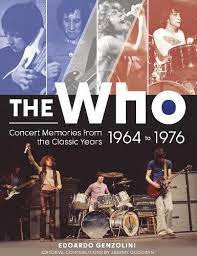
THE WHO - Concert Memories From the Classic Years 1964 to 1976 by Edoardo Genzolini


Memories of The Who in their prime do not f-f-fade away. They linger in the minds of those lucky enough to have seen them during the period covered by this 304-page, large format book, now translated into English from its original Italian; yet another shining testament to the lasting impact the group had on fans and a reminder of how genuinely inspiring they were to behold.

        Edoardo Genzolini was certainly inspired, so much so that he’s spent half a lifetime conceiving his book, his inspiration seeing their performance in the Woodstock movie at the age of 13. But the effect The Who had on him was more profound than simply enjoying their landmark Woodstock set on celluloid. He connected with The Who emotionally as well as physically, and his book stands as a tribute from both the heart and the head. I think it’s his way of simply saying thank you to them, for the music, the memories and the lasting influence they’ve had on his life.  

        To this end Genzolini writes introductions to each chapter that cover what The Who did, or tried to do, or wanted to do, in the years covered by the book, expanding on how their ambition somehow went beyond simply making records and performing concerts. Each intro is followed by first person accounts of shows, some by crew members who worked at theatres where The Who performed or fans who were present, a few of whom helped in some way, or somehow got backstage or to a hotel where the band was staying, just to say hello. Most such encounters are described in fascinating, personal detail, with one-on-one conversations repeated verbatim, some profound, some trivial, some hilarious. Many accounts reflect the characters of the individual members and how open they were to chatting with fans, and the impact this openness had on them, and it is clear from them all that close encounters with Pete, Roger, John and Keith are not easily forgotten. 

        Most of these accounts are illustrated by scores of pictures, many hitherto unseen, mostly black & white but some colour, of The Who on stage or its members backstage, often accompanied by the fans themselves. The quality of the photos varies from professional standard to amateur snaps taken with cheap cameras, but to have so many, upwards of 450, I hadn’t seen before, is a genuine treat, regardless of quality. Turning the pages, I was reminded of Jeff Stein and Chris Johnson’s 1973 photo book, simply titled The Who, another labour of love I greatly admired, though Concert Memories is a far more ambitious undertaking. 

        Although this book purports cover the years 1964-1976, there is an inevitable emphasis on the middle period, the years 1968, ’69, ’70, ’71 and ’73, that many consider to be The Who’s zenith. Of the shows described, some are among the most important The Who ever played – Woodstock, the IOW and both Fillmores in 1969 (there’s a whole chapter on Bill Graham and his Fillmores East and West), Leeds and Tanglewood in 1970, the Oval in 1971 – but all are very special in their own way to those who were there. 

        In a book as large as this it’s difficult to pick highlights but I chuckled at the story told by Christine Curry from Detroit whose friend Cindy went to the hotel where The Who were staying after their show at the Grande Ballroom on March 9, 1968, and spent the night with Keith Moon. “She told me that while she was in bed with him, he talked to his wife on the phone!” reports Christine. Then again, there’s Sally Mann Romano’s account of how in 1968 she left the Whiskey in LA with John and Keith in a rented Porsche, only for Keith, who was at the wheel, to abandon it at an intersection with the engine still running, apparently because he felt they could get to his hotel quicker on foot.

        Among the pictures are two from stage at the Anaheim Convention Centre, on September 8, 1967, which the author claims to be the only known shots of John smashing a bass, while Dennis Quinn tells how Pete dropped a white Fender Stratocaster into his hands from the stage at the Fillmore East in New York on April 5, 1968. One fan reports breathlessly that Roger permitted him to try on his tasselled outfit backstage. 

        There are several reports from the May 1969 shows at New York’s Fillmore, including the one where fire broke out next door, the notorious incident that resulted in Pete spending a night in jail for bashing a plain clothes cop with his guitar. “[The following night]… the tension in the Fillmore before The Who walked out onstage was unreal,” reports Mark Saull. “The energy was like something I’ve never experienced before or since. The Who were so powerful and intense it was intimidating. I remember looking at people in the audience, standing with their fists clenched, gritting their teeth like they were on a thrill ride. [The Who] looked 10 feet tall.”

        While many of the most profound anecdotes are to be found from the 1969-70 era, one from a Quadrophenia show in 1973 stands out. Guy Perry reports that at the Cow Palace, San Francisco, on November 20, 1973 – the show where Keith collapsed and had to be replaced by Scott Halpin – Pete, determined, no doubt, to compensate for his errant drummer, executed… “thirty-plus consecutive windmills during ‘Naked Eye’, an astonishing moment.” 

        These are but a tiny fraction of the delicious memories recalled, every one of them a testament to how unforgettable The Who were in their prime. 

        The book closes with reports from the “Day On The Green” shows in Oakland on October 9, 1976, and a handful of pics from Seattle Coliseum a few days later. Finally, legendary Who disciple “Irish” Jack Lyon writes movingly about how he flew to London on hearing of Keith Moon’s death, his reaction to the news and the atmosphere in Who central during this unhappy time. At the start of the book Jack had written about The Who’s last night at the Goldhawk Social Club in Shepherds Bush in 1965*, so his closing tribute to The Who’s drummer adds a touch a symmetry to a book that Pete himself writes admiringly about on the front cover flap.

        I am happy to add my own recommendation too. Published in hardback by Schiffer Publishing, The Who: Concert Memories isn’t the cheapest Who book on the market – the RRP on the back is $59.99, and in the UK Amazon are offering it for around £40 – but it’s among the very best, lovingly compiled by a true fan for true fans, those who understood the power of The Who and their music, and what it still means to those, like me, who experienced it when this wonderful group made music and performed shows that were unrivalled in rock. 


*Jack’s piece about The Who’s last night at the Goldhawk was actually commissioned by me for use in the booklet accompanying The Who: 30 Years of Maximum R&B, the 1994 4-CD box set I co-produced. At the time Pete felt it was unsuitable because of its depiction of violence. 


30.7.22

TOM WRIGHT

Tom in 1962, when he was at Ealing Art School with Pete

News has come through that legendary Who photographer and tour manager Tom Wright has died in the US. 

        The Who have many reasons to be grateful to Tom. A contemporary of Pete Townshend at Ealing Art College in 1962, he introduced Pete to marijuana and a host of great American R&B and blues artists. When he skipped the country to avoid a drug charge he left behind a wondrous record collection that Pete snaffled and which became the impetus for The Who’s switch from pop and C&W to Maximum R&B. 

        Equally importantly, Tom would go on to become the group’s first American tour manager and unofficial photographer, and many of his photographs from The Who’s earliest US tours have been reproduced in countless books and magazines.  

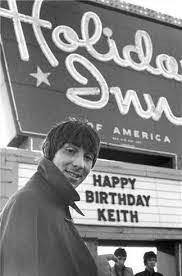
        Among the most famous was of Keith Moon alongside the Holiday Inn sign at Flint, Michigan, the scene of his infamous 21st birthday party. 

“Pete telegrammed me [in 1967] to say The Who were coming to the US to tour with the British pop band Herman’s Hermits,” said Tom. “They’d be in Florida in a week… and when I got there Pete suggested I come on tour with them and shoot photographs of the band. So here I was, 23-years-old, camera around my neck, passport in my back pocket, boarding a chartered plane because Herman’s Hermits were so big, they rated it.”

In 2022, with The Who esteemed as mighty legends of rock, pioneers in the art of performance and superstars both alive and dead, it seems absurd to recall that in the summer of 1967, on their first American tour, they were the support act for the far more popular Herman’s Hermits. With 11 top ten hits behind them when the tour started – The Who had only one – Herman and his boys were riding out the crest of the British Invasion wave, drawing predominantly female audiences for whom The Who were distinctly odd, especially when they closed their brief sets by inflicting serious damage to their guitars, drums and amplifiers. 

         Tom was on board for almost all of that first tour. It began on July 13 in Calgary, Canada, and closed on September 9 in Honolulu, a nine-week coast-to-coast jaunt on which they often played two shows in one day. It was a gruelling experience and probably not worth the effort. “It got us around America,” said Roger Daltrey, “but it did us no good at all.”       

Tom was working as an underwater photographer when he joined The Who at St Petersburg in Florida. “The Who came to Florida and that was the end of my underwater photography career,” he says. “These young kids would be yelling, ‘Where’s Herman, we want Herman’ and then The Who would start playing before the curtain came up,” he told Who biographer Richard Barnes. “When the curtain came up, they would be really rocking and everybody was just moving about, like Roger would be running around and Pete would be swinging his arm and hammering the guitar and Moonie would be kicking ass. And people were in shock. The band didn’t stop between numbers... or they’d quit playing for just a couple a couple of seconds, but it would be just long enough and BOOM into the next number.”

Toms shot of The Who at the Fillmore East, New York, April 5, 1968

        This was the period in The Who’s career when wrecking their equipment at the end of a set was a regular occurrence. “It was spellbinding,” adds Tom.  “A lot of times there was no clapping whatsoever, just dead silence. People in the front row were just sitting there with their mouths open, stunned.”

Tom would go on to tour manage The Who in America for two tours during 1968, photographing them along the way, on stage, in recording studios, in their coach and at hotels. He quit in late 1968 after accepting a position as manager of the Grande Ballroom in Detroit, one of the era’s most important rock venues. 

The tours that Tom photographed laid the foundation for The Who’s eventual capture of an American tour circuit they helped create. This hardly existed during the first British Invasion of America, the one led by The Beatles and Rolling Stones, and it developed as pop became rock, with audiences beginning to listen seriously to groups whose music was no longer aimed predominantly at teenage girls. During Tom’s tenure as The Who’s tour manager the group pioneered a new concept of rock performance, with the music they played becoming more and more sophisticated as their shows became longer and more expressive. They also became more photogenic.

The following year The Who opened their first headlining US tour on February 21 in San Jose, California, and while in the Golden State made a madcap, stop-start promotional film for ‘Call Me Lightning’, a song released as a single in the US and completed at Gold Star Studios in Los Angeles around this time. Tom was on hand to photograph the group in tin helmets and fooling around with an explosive detonator.  


        Just as they done in the UK, The Who blazed a trail across America through the potency of their live shows and Tom was on hand to watch it all happen. Unlike the British pop bands that preceded them, there was no run of chart-topping US singles or historic appearances on The Ed Sullivan Show, and nor did they reduce teenage girls to screaming banshees as they flew from city to city. They didn’t so much crash down Uncle Sam’s gates as slide in through a gap after the doors had been left ajar by the others, but the hard work they put in ensured that in the fullness of time The Who would become a stadium-filling juggernaut in the seventies and beyond. 

Tom Wright’s pictures of The Who in America captured a fascinating but often-overlooked period in the journey of one of the UK’s greatest ever rock bands.  

Tom’s book Roadwork: Rock’n’Roll Turned Inside Out, published in the UK by Omnibus Press as Raising Hell On The Rock ‘N Roll Highway, features an intro by Pete which I posted on Just Backdated here: https://justbackdated.blogspot.com/2015/03/raising-hell-petes-introduction-to-tom.html

An Ealing Art School reunion


17.3.21

A BAND WITH BUILT-IN HATE: THE WHO FROM POP ART TO PUNK by Peter Stanfield


Alone among their contemporaries in the UK, The Who attracted a handful of fans and at least one influential critic who viewed them not just as a lively pop group but as a performance art project conceived by Pete Townshend, aided and abetted by co-manager Kit Lambert. This component of their being, exemplified by their clothes, the auto-destruction and the tone of their early records and interviews, is scrutinised here; not so much a biography as a rather academic thesis on The Who’s role in the cultural environment of the sixties that produced social realism in the cinema, Peter Blake’s pop art, Mary Quant’s mini skirt, Blow Up, great pop music and all the rest of what made the decade swing. 

        The critic in question, of course, is Nik Cohn who believed that the best pop was transient, a sudden explosion followed by nothing else, much like the climax to a Who concert. Long careers and earnest expressions in pop were anathema to Cohn whose acclaimed 1969 book Pop From The Beginning expanded on this theory, arguing that once good taste triumphed over trash it was all over. Still best known for his story in New York magazine that formed the basis of the movie Saturday Night Fever, Cohn wrote a provocative music column for Queen magazine in the sixties, and the point is made that unlike the music press Queen did not rely on record company advertising to stay afloat, thus permitting Cohn to adopt a ‘critical honesty’ he might not have enjoyed elsewhere. Such honesty appealed greatly to Lambert and Townshend, both of whom disdained the hypocritical, PR-driven showbiz culture that infected pop. 

        Insofar as he loved to demolish sacred cows, Cohn’s writings reflected the same lapse in deference to authority as shown by the Mods and Rockers clashing on Margate beach or Mandy Rice-Davies’ famous ‘Well he would, wouldn’t he?’ response during Stephen Ward’s trial. In The Who, and Townshend in particular, Cohn found his champions, so it’s no surprise that he gets almost as much space as the group in A Band With Built-In Hate.

        Thanks to Townshend and Lambert, The Who were arty, clever, stylish, revolutionary and, with Keith Moon’s gleeful help, subversive. ‘Attitude as style, style as attitude’ was Lambert’s dictum and Stanfield, Emeritus Professor of Film at Kent University, sets out his credentials in the book’s first chapter, an impressive essay on how social realism dramatically changed film-making and so enthused Lambert and his more pragmatic business partner Chris Stamp. Furthermore, he intriguingly draws attention to The Who’s seldom-seen film début, Carousella (1965) in which they appear, for a few seconds, as background colour in a short X-rated documentary about Soho strippers. 

        Such in-depth research warmed me to his book. Stanfield is no less impressive on Mods and Pop Art, both of which were adopted and abandoned by The Who in 1965 and 1966, and on their early singles, which he examines forensically, and with great insight, in Chapter 3. He’s also impressed by their LP artwork. “There is nothing po-faced, pretentious or obscure about this sleeve,” he writes about Alan Aldridge’s cover for A Quick One. “It is glossy, colourful, superficial, humorous, self-depreciating, commercial and fun. It is Pop!” He’s equally enthused about Sell Out, but quotes others, notably Cohn, over his own opinions.

        It’s slightly droll to imagine that, unbeknownst to the other three, Townshend envisaged The Who as an extension of his studies at Ealing Art College and might even have abandoned the group once he brought the experiment to a conclusion. ”Obsolescence was a given in [Townshend’s] concept of the band,” writes Stanfield at one point, adding weight to the theory. If true, Townshend clearly decided at some point to carry on with the band, no doubt because he realised he could make a decent living from it and/or because it would have been churlish to let the others down. 

        Either way, Stansfield’s book loses some of its purpose, at least as far as The Who are concerned, once these objectives have been achieved. From around the midpoint he devotes as much space to what is going on around them, and to lengthy passages about Cohn’s Pop From The Beginning and, to a lesser extent, his 1967 novel, I Am Still The Greatest Says Johnny Angelo, about the rise and fall of the titular pop star. Thereafter he deals with Tommy, and Cohn’s role in its conception, and how it brought The Who into the mainstream. Discussion on Leeds and Who’s Next follow but unlike in the first three chapters Stansfield relies more on quoting other critics – whose opinions I’d read before – than offering his own take which is a shame, because I enjoyed what he had to say earlier. Much of the chapter on Next is about politics, youth cults and rock revivalism, somewhat tangential to The Who, who by this time were rock superstars and of less interest to critics favoured by the author whose mission was by and large to seek out the new. Much of the final chapter is about punk and The Whos role as founders. Oddly, there is little mention of Meher Baba’s influence on Townshend, none at all of his confrontational columns in Melody Maker and scant appreciation of the excitement generated by The Who’s stage shows, nor of their skills, when they were in their pomp.

Nevertheless, Stanfield is probably right when in his Conclusion he writes, [what]... had originally driven The Who, the desire to flaunt convention, to remake one’s world, to refuse the easy way, to contest what it means to be a pop product… had all started to come to an end… around the time of Quadrophenia.” And he’s definitely right when, later in this concluding chapter, he asserts, “Whether they liked it or not The Who were now in the business of making heritage products, selling their fans the comfort of consuming the already experienced.” Still, as Cohn put it, and Stanfield concludes his book, “The Who played longer, harder, and straighter, for the people than anyone else,” a view with which I have always concurred.

With 280 pages, A Band With Built-In Hate: The Who From Pop Art To Punk is an easy but by no means breezy read, well researched and notated, and illustrated thoughtfully throughout in black and white. Just published, it brings together some significant criticism of The Who, connecting them with all manner of cultural references, and is a valuable addition to my ever-expanding Who library. That The Who continue to be so well-served by knowledgeable authors is a tribute to their importance.