Showing posts with label The Who. Show all posts

15.4.26

THE WHO: Playhouse Theatre 1967

Still unable to resist the allure of a Who LP I hadn’t seen before, I gave in to temptation the other week and parted with £15 at a record fair in Cranleigh for this 12” vinyl disc on the Expensive Woodlands Recordings label. It comprises 12 tracks purported to have been recorded live in 1967 at the 1,200-capacity Playhouse Theatre on Northumberland Avenue close to the Embankment tube station in Central London. It was probably a mistake. 

        No such gig took place, at least not according to Anyway, Anyhow, Anywhere by Andy Neill & Matt Kent and the (almost as reliable) Who Concert File by Joe McMichael and ‘Irish’ Jack Lyons, though the theatre was used by the BBC for recording radio sessions between 1951 and 1976. This led me to believe that the songs that appear on the LP were recorded for shows on Radio One or its predecessor the Light Programme, as confirmed when I played the record which, as it happened, was more than somewhat warped, though by no means all were recorded at the Playhouse Theatre. No details beyond the song’s titles appear on the disc or its sleeve, which is a gatefold featuring this group shot, photographer unknown, on the front cover and photo taken on stage at the Monterey festival across the fold-out interior. 

        From side 1, ‘Run Run Run’, ‘Boris The Spider’, ‘Happy Jack’ and ‘See My Way’, were recorded at the Playhouse (on 17 January, 1967), and are followed by ‘Pictures Of Lily’ and ‘A Quick One (While He’s Away)’, recorded at De Lane Lea Studios on 15 October, 1967. All six tracks are included on the BBC Sessions CD released in 1999. 

        Side 2, however, features six tracks recorded for the BBC not included on the Sessions CD, though one of them, ‘Happy Jack’, is a repeat, albeit a slightly different mix. The remainder I heard before on a cassette tape I was given many years ago by George McManus, then the back catalogue marketing manager at Polydor, who was seeking information from me about The Who’s BBC tracks, and which I wrote about here: https://justbackdated.blogspot.com/2015/07/the-who-bbc-sessions_17.html

        The other five on side 2 are ‘I Can’t Reach You’, ‘I Can See For Miles’, ‘Summertime Blues’, ‘So Sad About Us’ and ‘My Generation’, none of which were included on the Sessions CD, no doubt because – as I reported in that post of 17 July, 2015 – they are virtually identical to the studio recordings. The performances are exemplary, as you would expect, and there are some slight changes to the mix, including a more prominent bass here and there, which suggests John might have been asked to oversee remixing the tracks for BBC use. The reasons for this are explained in my earlier post. 

        I still have the C90 cassette that George, who died in 2014, gave me, and it includes all the tracks on this LP, which means I spent £15 on something I already had – not the first time in regard to The Who. Still, it looks nice alongside my other Who vinyl records of questionable legality. 


24.8.25

THE WHO: Live At The Oval

September 18, 1971, a Saturday, was a lovely autumn day, perfect in every way. At lunchtime in Kennington, just south of the River Thames, the sun shone down on a vast horde of rock fans streaming from Oval Underground Station and making their way along Harleyford Street to the cricket ground that since 1845 has been the home of Surrey CCC. Some were running, hurrying along to secure a spot near the front; for that evening, as dusk fell, the greatest live rock group in the world would perform on a rickety stand long since demolished. Like the game of cricket itself, with its many formats and multi-coloured strips, the Oval is much redeveloped since that night but it remains the traditional venue for the final, often deciding, Test Match in five-game series involving England and one of the cricket-playing nations that take turns to visit our shores each summer. For this reason, it is often the scene of noisy celebrations. 

The group who played at the Oval that night certainly provoked a noisy celebration and, it could be said, is much redeveloped too, this imposed upon them by the passing of two members. Furthermore, the music they play, both at the Oval and currently on what is likely to be their final American tour, is somehow traditional too. Their best-known songs have joined the body of work that is the cornerstone of rock music, just as the sonatas and symphonies by the great composers are the cornerstone of its classical equivalent. Nine songs performed that night at the Oval were performed last week when the two surviving members of the group, along with six others, opened their ‘Song Is Over’ tour in Florida. 

It was and is, of course, The Who: Pete Townshend, Roger Daltrey, John Entwistle and Keith Moon, Londoners all, and in 1971 they were at the peak of their powers. The previous month had seen the release of Who’s Next, regarded by many as their finest achievement, and it’s likely that the 40,000 who turned out that autumn day remains the largest crowd ever seen at the Oval, for sponsorship reasons now known as the Kia Oval. It’s official capacity, even today, is only 27,500. At the time it was the biggest crowd ever assembled to watch The Who in their home town. 

I was among them, covering the event for Melody Maker. In the 16 months since I’d joined the paper I’d done my best to ingratiate myself with The Who and their support team for the simple reason that I thought they were the best band in the world, and by the time of this concert I was sufficiently friendly with their acting manager Peter Rudge that he’d given me an on-stage pass so I could stand alongside the band, on John’s side, with my plus one which happened that day to be my sister. I watched and reviewed the show from this privileged position but, being so close, the music didn’t sound as clear as it would have done from out front. It never does. Still, it sounded a lot better than The Faces who preceded The Who on stage, this because The Who used a brand-new and very expensive PA system that wasn’t made available to the other acts on the bill. On hearing how The Who sounded, Rod Stewart left early, muttering indignantly to himself. 

My 'priority' pass for The Who's Oval show. 
 

I was aware that the concert was being recorded. The Pye mobile studio truck was parked at the rear of the stand where the temporary stage had been built, cables were everywhere and recording engineers were scurrying about, but I was told later – much later, in fact, not until I was involved in selecting tracks for the 4-CD Who box set 30 Years Of Maximum R&B in 1993 – that the tapes were unusable, evidently something to do with the positioning of microphones. Modern technology is a wonderful thing, however, and the tapes have been resurrected, so, for the past 48 hours I’ve been listening to The Who at the Oval as if I’d been one of those scurrying from the tube station to get close to the band. And it’s a damn near flawless performance, a perfect snapshot of The Who in their prime, spurred on by that reckless spirit of adventure that characterised them in this, their imperial phase. 

The Who had spent most of the previous month touring America, playing mostly arenas, so they were at Olympic fitness. Still, they rehearsed with their new PA and lighting rig at the Granada Cinema in Wandsworth during early September, concentrating on the newer songs from Who’s Next, and the set they played at the Oval was almost identical to those performed on the US tour, a judicious mix of old and new, the kind of set they would perform until the new became the old much later in their career. 

Because of the need to switch sound systems there was a long delay before The Who arrived on stage, and when they did they opened up with a spontaneous jam, probably to test the PA, its assumed title ‘So Glad To See Ya’, taken from Roger’s improvised lyric. Satisfied with the sound, they launched into ‘Summertime Blues’, a safe starter, to get themselves in the mood, John and Roger already displaying top form, Keith warming up and Pete a bit reckless, as he was wont to be. John’s song ‘My Wife’ followed, a steamroller, chockfull of power chords, Keith steady, John in good voice, Pete more disciplined, switching from block chords to lead runs as the song cruised towards its end; Roger, underused, hanging grimly on, keepin’ on movin’ as he sings when John steps back. “The Ox,” he announces at the close.

The tempo yielded for the more melodic ‘Love Ain’t For Keepin’’, another new song, shorter than most, with unforeseen harmonies in mid song, before a couple of trusted favourites ‘I Can’t Explain’ and ‘Substitute’, the former’s quick solo a blistering assault, the latter a tight, brief showcase for The Who’s harmonic flair. Roger introduced ‘Bargain’, a relatively complex song performed with ease, before the more melodious ‘Behind Blue Eyes’, equally assured, arpeggios cleanly picked. 

‘Won’t Get Fooled Again’, the fifth Who’s Next song of the night, followed, a lengthy, tight reading that was edited for their recent single, accompanied by the pre-recorded synthesiser track that reins the group in to a certain extent and heralds its dramatic climax. The semi-public Young Vic rehearsals aside, this would have been the first occasion on which fans could hear this latest, up-to-the-minute addition to The Who’s instrumental arsenal. The other, equally famous, synthesiser-based Who’s Next song, ‘Baba O’Riley’, would not be introduced into The Who’s set until later in the year.  

‘Baby Don’t You Do It’, a power-driven take on a Marvin Gaye Motown song, allows John and Keith to display their chops, punctuated by Pete’s improvised guitar licks. It was no secret that at this time of their evolution their guitarist smoothed his passage with gulps from a brandy bottle – as John would do later from ‘water’ bottles attached to his microphone stand – and it’s my contention that this enabled both to ride roughshod at times, freeing themselves to play as flexibly as they chose, to leap into the unknown, on numbers like ‘Baby Don’t You Do It’ and, later in this show, ‘Naked Eye’ and ‘Magic Bus’. Because today’s audiences invariably demand to hear only what they recognise, such spontaneity is rarely heard now. This indulgence might also explain Pete’s rather undisciplined comments during the show, with references to silly mid-on, his smart new white outfit and how he’d give his guitar away at the close, sounding a bit like intemperate rants.

Two selections from Tommy, ‘Pinball Wizard’ and ‘See Me Feel Me’/’Listening To You’, followed, both crowd pleasers, the latter especially electric as the Tommy hymn doubles back on itself, gaining momentum as it charges forward. At this point in the show the huge Klieg spotlights behind the back line were switched on, their beams illuminating the scene – and what a glorious sight it was from the stage: 40,000 delirious Who fans waving ecstatically as Roger sang about how listening to them inspires the music they hear. 

Seconds after it ended Pete yelled ‘My Generation’, and they launched into a brisk take on their rabble-rousing statement of independence, a brutal riposte to Tommy’s fanciful optimism. This segues into ‘Naked Eye’, heard no doubt for the first time by many present, a long, undulating, dramatic piece of highs and lows, and finally ‘Magic Bus’, another lengthy, bouncy crowd-pleaser, the groups take on Bo Diddley, that ends with a traditional Who smash up. “Inevitably Townshend’s guitar – a brand new Gibson bought for the day – was sacrificed to the crowd,” I wrote in the following week’s Melody MakerHe hammered it to pieces with the mic stand and took a flying leap into his stack. The wreckage was thrown to the crowd as Moon stood up and literally walked through his drum kit.”

The Melody Maker headline on my show review. 

It was a fitting climax to one of The Who’s greatest ever shows, now available for all to hear; shame movie cameras weren’t covering it too. 

Unusually, The Who Live At The Oval is released by Universal Music, The Who’s US label, and for this reason is a tad more expensive than their releases on Polydor. The package contains a 20-page booklet with top notch sleeve notes by Andy Neill, lots of pictures taken on the day and an explanation of how and why the recording was finally upgraded for public consumption. 


19.10.23

WHO'S EXHAUSTED? Is "Too Much of Everything"... too much?

I have known Tony Fletcher since the mid-1980s when he wrote his first book for Omnibus Press, on Echo & The Bunnymen. He's since written many more, of course, among them Dear Boy: The Life Of Keith Moon, also published by Omnibus, which many regard as among the greatest rock biographies in print. Most recently Tony has posted some of the interviews he did for Dear Boy on Substack, which can be accessed here: https://tonyfletcher.substack.com/

Tony has also written a great review of the recent Who's Next Super Deluxe box set which he has suggested might find a home on Just Backdated, so with his approval I have posted it below (web link:https://tonyfletcher.substack.com/p/whos-exhausted). 


Back when I was writing Dear Boy, tracking down rare recordings by The Who was detective work, and I loved it. On the days that someone would send me a cassette in the mail of something never officially released, I’d have an extra spring in my step. Alternate versions were a bonus elitist treat, though I had a more humbling discovery when I found a collection of just about every UK Who 7” single ever at a shop in Newquay, bought the lot – they were fairly priced and in excellent condition - and quickly discovered that the “I’m A Boy” and “I Can See For Miles” that I had grown up with on the seminal compilation Meaty Beaty Big and Bouncy were not, in fact, the original 7” versions.

After the book was published, tapes started showing up more regularly. A very good person with a very generous heart and possibly the most extensive collection of Who live recordings on the planet took it upon himself, as a mark of gratitude for my contribution to Whodom, to send me VHS tapes of rare shows, including Tanglewood 1970, and the San Francisco Cow Palace 1973, legendary filmed concerts both, though for very different reasons. But then he moved onto CDs, and my mailbox started to groan under the weight of new packages containing home-burned live Who discs. While it was wonderful to feel so appreciated, I eventually had to beg him to stop; even in my late 30s, I knew that there just weren’t enough eight-minute blocks left in my life to listen to yet another live version of “Won’t Get Fooled Again”…

…Which is probably how even the most ardent of Who fans felt upon seeing that a new Who’s Next/Life House (Super Deluxe) package was to drop in mid-September, with a 10-CD plus BluRay plus 172 page graphic novel plus 100-page extensive liner notes book with contributions from Pete Townshend but of course as well as from Andy Neill and Matt Kent, plus various so-called souvenir paraphernalia for those who have around $250-$300 to spare, and with all nine-and-a-half hours of music nonetheless provided on the streaming platforms for those of us who don’t. Me, I have spent a lot of money on the Who over the years – contrary to what you my think, the limits of my relationship with the group is that I occasionally get access to their own block of prime-seating concert tickets, which of course comes at a prime-seating price – and I balked at the prospect of shelling out this kind of lump sum for physical copies of bonus recordings that I may or may not already own, even if there was the prospect that somewhere within that 172-page graphic novel and 100 pages of liner notes, we might all now finally discover what Lifehouse was meant to be all about.

Certainly, nobody but Townshend himself knew at the time, and it was incumbent upon producer Glyn Johns to insist to the band’s composer and all-round genius visionary that he climb down from his lofty ambition of a cosmic rock opera to topple Tommy and instead, with his bandmates’ full-throttled endorsement and encouragement, get on with selecting and recording the best dozen or so songs from an extensive catalogue of demos and abandoned Kit Lambert productions in New York (more of which later), go into Olympic Studios in London for a fresh session, and see where it left them.

Where did it leave them? Only with the Greatest Rock Album Ever, of course. Just nine songs eventually, clocking in at what was then a maximum hi-fidelity LP’s length of 43 minutes and 45 seconds. Nothing superfluous, no bonus cuts, no over-riding concept, not even a gatefold sleeve, just a  picture of four blokes pissing against an obelisk and with it, a new blueprint for rock. We should leave it there in turn.

But we won’t. Because naturally, and if only because The Who means more to me than any other band on earth, I have waded through all eight hours and 45 minutes of new Super Deluxe bonus material, and found that sure enough, amidst the music that was never intended for original release, and amidst all that which has trickled out on other previous Deluxe packages though now assembled in correct contextual place, there are enough absolute gems to merit a 12-song playlist –a Single Bonus CD if you can find one that will run 84 minutes. (The Spotify playlist follows at the end of this article.) My thanks to the person who sent me Andy Neill’s extensive track-by-track notes for six of the nine additional discs, which has helped me dig down and cherry-pick from the following categories:

1: Pete Townshend demos: For the most part, Townshend was a consummate enough songwriter and musician that he typically supplied the band with completely finished arrangements, requiring of the rhythm section only that they improve upon his rudimentary playing – and being that the rhythm section was John Entwistle and Keith Moon that wasn’t a tall order. When it came to the vocals, however, there was always the awkward truth that Townshend was (and remains) a superb singer, and that for many listeners, his softer, more yearning tone, if not always preferable to Roger Daltrey’s, certainly supplied the crucial counter to the front man’s classic roar. Where would “Baba O’Riley” truly be, for example, without Pete singing the “teenage wasteland” breakdown?

Indeed, for all those who refer to that song as “Teenage Wasteland” because it seems so obviously the song’s natural title, it turns out that Pete originally felt the same way. Intriguingly, his early demo of the song that would become Who’s Next’s opening track starts not with the defining organ refrain, but piano and acoustic guitar, the “Out here in the fields” opening verse afforded an entirely different melody, as is that eventual middle section “Don’t cry, don’t raise your eye…” Indeed, the song is halfway through its seven-minute workout before we finally get a recognizable Who’s Next melody – the “Sally take my hand” line. Until then, it is effectively a different song entirely, albeit one with familiar lyrics.

Only later did Townshend develop the metronomic, arpeggiated refrain on his Lowry organ (not on an ARP synthesizer as commonly believed) that would become one of the most recognizable riffs of all time. And when he did, he blissed out on it – wouldn’t you? - laying it down as a 13-minute instrumental entitled “Baba O’Riley” that is mind-blowing for being so far ahead of its time, Townshend toying with EQ filters about twenty years before the first techno DJs and artists took such ideas onto the nightclub dance floors.

Listening to the two demos back-to-back, as I place them on my playlist though they come at opposite ends of CD2 on the Super Deluxe package, offers a fascinating insight into the songwriting process, for at a certain point it obviously occurred to Townshend to set the former composition to the latter’s arrangement, change tunes accordingly, and edit that lengthy bliss-out into something more closely resembling a rock song. The rest, as they say, was history.

Also on these two discs is a beautiful, and remarkably complete demo of what was then simply called “Too Much,” a song performed live at the time of the sessions, duly recorded for Who’s Next, but not released (as “Too Much of Anything”) until Odds And Sods in 1974. In case you didn’t already know or merely guess as much, the song’s concluding chorus line “Too Much of Everything… is too much for me” served to inspire this article’s subtitle.

Pete’s early demo of “Behind Blue Eyes” also merits inclusion because of its tenderness and for how, my earlier comment about finished arrangements aside, the song does not kick into fourth gear with the famous middle section (“When my fist clenches…”), but rather continues in the same gentle vein, Pete harmonizing with himself where Daltrey later soared solo. Historically, it is hard to argue against a Who’s Next rock rendition that formed part of the 1970s rock canon and my own musical education with it, but there are reasons to claim that this is a more emotional and satisfying rendition.

2: Unreleased Songs: There’s an obvious temptation to say that if Townshend’s songs weren’t good enough to make it into the studio or live show at the time, they probably weren’t good enough, period, and in the cases of “Mary,” “Greyhound Girl” and perhaps even “There’s a Fortune In Those Hills,” I am tempted to agree. But “Finally Over” – not to be confused with “The Song Is Over” – is an absolute treasure, proof that Pete Townshend’s toenail clippings are better than most songwriters’ career masterpieces and, perhaps, an opportunity missed.

3: Record Plant recordings: This is the supposedly disastrous week-long session in New York, with manager/producer Kit Lambert ostensibly at the controls but emotionally AWOL. Again, the argument against releasing this these cuts (though many already have seen light of day on earlier Deluxe packages) is that if the Who rejected them at the time, why subject us to their confessed failures this far down the line? And it’s true, most of these preserved takes – the pick of the week’s crop, according to the sleeve notes - are inferior to Who’s Next, lacking cohesion, concentration and drive.

Nonetheless, I actually prefer this rendition of “Love Ain’t For Keeping” with Leslie West on lead guitar along with an uncredited organ player from Patti LaBelle’s band: it’s harder, more direct, less frivolous, evidently benefiting from being recorded live-to-tape.

Ditto “I’m In Tune” as it was then known, for similar reasons. Additionally, there’s a particular melodic vitality to John Entwistle’s bass playing on these New York sessions that I would argue is superior to the eventual recordings at Olympic Studios in London. Compare this cut with the “Getting In Tune” from Who’s Next and tell me you don’t agree.

4: Alternate edits: There’s a good reason that most songs have vocals on them, and there’s an equally good reason that some are edited down. Still, for those of us who came of age marveling at the majesty of Nicky Hopkin’s piano playing, being afforded a version of “The Song Is Over” stripped of all vocals allows that majesty to shine with all due regality. And for those like me – and admittedly there may not be many – whose first exposure to The Who was the 1972 single “Join Together” and who then was subjected to a ten-year quest to find a physical copy of the non-LP 45, having an extra 90 seconds of music here makes up for lost time. A little.

“Join Together,” btw, was just the third in a series of once-a-year non-LP singles that started with “The Seeker” in 1970, added “Let’s See Action” in ‘71 and concluded with “Relay” in ‘73, though you can factor in “Long Live Rock” too, which was recorded in the same period and eventually released in 1979 to promote the documentary The Kids Are Alright. All five A-sides and their generally excellent B-sides are included here in various official and bonus forms. “Join Together” is still the only Who cut I have ever dared to DJ for a nightclub dancefloor – and only once at that; where was the 13-minute “Baba O’Riley” instrumental when I needed it?

5: Live recordings. By this point in their unending career, we the dedicated followers of fashion have surely had enough official Who live recordings to take us through not just the rest of this life but the next one, too. Nonetheless, four of the nine bonus CDs here are culled from two distinct, lengthy concerts. The first was at the Young Vic Theatre in Waterloo, London – not the rehearsal shows with which Townshend originally hoped to cement his vision of audience engagement, but rather one consigned to tape via the Stones’ 16-track mobile studio on April 26, 1971, halfway through the recording process as an attempt to document their current state of play. Reviews I’ve read of the box set have repeated Andy Neill’s sleeve note assertion that the performances are “tentative” and to an extent that is true, but the actual arrangements are far more developed already by this point than that might lead you to believe, and the fact that they have not yet reached the Epic, Classic Rock status is occasionally a winning argument.

As proof, I offer up both “Naked Eye” – a song that just failed to make the album at the time – and, perhaps controversially, “Won’t Get Fooled Again.” I really like this version: it is more relaxed, loose, and raw than it would soon become, not yet acknowledged by an arena-sized audience as an Anthem of a Generation, and there is a reason to adopt it as a personal keepsake going forwards; the definitive studio recording version will show up on your local classic rock station soon enough anyway.

The last two CDs are given over to a concert at the Civic Auditorium in San Francisco eight months later, on December 13 1971, parts of which have been released officially over the years, and which in its entirety here is already being held aloft as a peak period piece, The Who at their early-1970s unrivalled in-concert best. It’s hard to disagree – the band are absolutely on fire  and for all that I have had a copy of this concert on the aforementioned gifted CDs for the last 25 years or so, it turns out mine was only a truncated edit of the show, absent much of Tommy (which is not relevant to this particular conversation) and the truly incendiary nine-minute version of Holland-Dozier-Holland’s “Baby Don’t You Do It.” A live staple at the time, and one that showed up on the back of “Join Together” in deftly edited fashion, it serves to remind everyone that for all the legend around the writing, recording and performing of Who’s Next/Life House, at heart The Who were an R&B band brought up on Black American music, and that nobody, but nobody, butchered it – in the most professional sense of this vegan’s reluctant used of the verb – better.

And with this, we can only hope that The Life House Song Cycle Saga is, indeed, finally over. Whatever Lifehouse was imagined to be, and however much Pete Townshend may have felt his inability to capture it at the time represented some sort of Epic Fail, he can now hopefully retire in the knowledge that he put everything out there eventually, 172-page graphic novel and all. His extensive efforts at the time to rewire popular music were hardly in vain: not only did they give us Who’s Next, the Greatest Rock Album Ever, but a series of non-album A-sides and B-sides equally unrivalled during the early 1970s. Along the way, The Who transformed additionally into the Greatest Live Band Ever as well, and it’s to the Super Deluxe package’s ultimate acclaim that, despite its frighteningly obsessive and overwrought breadth and depth, it renders these claims not so much of a subjective opinion as an objective fact.

Tony Fletcher, October 2023.

[i] Of the various reviews I have read to help me along, Alexis Petridis on Super Deluxe Edition – yes, there is a website of that name – sums up the confusion surrounding Lifehouse best. “Retold in the box set’s 100-page book, the saga of Life House’s making is so extraordinarily convoluted and confused, so filled with cross-purposes, misunderstanding and – occasionally – straightforward sabotage, that this writer confesses he ended up frantically taking notes: not as preparation for this review, but just in a desperate attempt to try and keep up with what was going on… The best moment in the book may come when Townshend furiously protests that “when people say I didn’t know what the fuck I was talking about, what they’re actually doing is revealing their own complete idiocy because the idea is SO FUCKING SIMPLE”, which, with all due respect, sounds remarkably like something you’d say if you had succeeded in completely confusing yourself.”


10.10.23

THIS GUITAR HAS SECONDS TO LIVE: A People’s History Of The Who by Richard Houghton

It’s a poster, a t-shirt and now a book cover. This Guitar Has Seconds To Live is the name bestowed upon a famous photograph taken at an infamous Who concert. The photographer was Nigel Dickson who was on hand at the Odeon Theatre in Newcastle on November 5, 1973, Bonfire Night no less, to witness a Pete Townshend meltdown of colossal proportions. Incensed at the failure of the Quadrophenia backing takes to function to his liking, Pete demolished everything in sight, tapes included, and assaulted long-suffering soundman Bobby Pridden, causing a 25-minute stoppage before the concert resumed, Quadrophenia abandoned.

Also on hand were Who fans Bill Monks, Peter Smith, Jim Robson, Ian Potts, Colin Petersen, Brian Dickinson, Brian Goulden and John Robson, all of whom offer their accounts of the concert and its aftermath in this book, which is in fact a new edition of Richard Houghton’s The Who: I Was There, published by Red Planet in 2017 and reviewed on Just Backdated here: https://justbackdated.blogspot.com/2017/06/the-who-i-was-there-by-richard-houghton.html

Of all the fans, the most loquacious is Peter Smith who reports that during Quadrophenia, “[They] got as far as ‘5.15’ [about half way through – CC] when things started to go wrong. The backing tapes they used to play along with weren’t working correctly, and apparently not at all during ‘5.15’. Pete went crazy, totally losing it. From upstairs we could see him shouting at someone to the side of the stage; he then started punching the guy and smashed his guitar to the floor of the stage. He started ripping wires out of their equipment. Roger, John and Keith were just staring at him, wondering what on earth he was doing. The theatre obviously realised that something was going seriously wrong, and they dropped the big white safety curtain.

“We sat in darkness for 15 or 20 minutes until the band reappeared. The Who launched into ‘Magic Bus’ followed by a lengthy jam and finished by playing ‘My Generation’ for a second time. Pete was in a wild, strange mood, swearing at us all, calling us ‘fucking bastards’. I recall being very upset with him and shouting back at him, as did many others. He then smashed his Gibson guitar, threw one of his amps to the ground and Keith crashed through his drums, knocking them all over the stage. They received thunderous applause as they left the stage.

“It had been a strange, surreal and brilliant night. We went home on the train, everyone talking about what they had just witnessed.”

By all accounts Bob Pridden walked out of the theatre after the incident, hotly pursued by manager Bill Curbishley and lighting man John Wolff who persuaded him to return. To add insult to injury, Pridden was obliged to stump up for a new Gibson Les Paul because he was the only one in the entourage with sufficient cash on him to buy one from a Newcastle instrument shop. 

The following night Pete and Keith appeared on the local TV show Look North, confirming that the two other shows booked at the Newcastle Odeon would go ahead as planned. Pete was a bit sheepish and didn’t say much but when Keith was asked if he felt that fans were disappointed, he replied: “Well, nobody asked for their money back, did they?”

The new, retitled edition of The Who: I Was There is much improved, a large format hardback with 368 pages, printed on art paper which enhances the photographs, many of them carried forward from the old book. 


28.9.23

THE WHO IN ROME, PALASPORT, September 14, 1972.

Around 51 years ago this month The Who were playing concerts in Europe on a tour that saw them attract 400,000 to a concert in Paris, their biggest ever audience. Aside from that show, it was a low-key tour, with several days off between cities and all bar Keith flew home to the UK between shows. Keith and Dougal drove around Europe from show to show, looking for trouble I suppose. 

I caught up with them in Rome, on the last date of the tour, and there are two things I remember from this trip. After the show Keith, Dougal and myself took a taxi around Rome looking for female company in a club or a bar, but found nothing, and wound up back at the hotel a bit disappointed. The following day there was a mix-up with the plane tickets. They’d flown me out first class, very nice of them, but the first-class section was overbooked for the return, and I was relegated to coach. Pete thought this was very funny. “Melody Maker writers are second-class citizens,” I recall him saying, much to the amusement of John and Roger. 

        Below is my report as it appeared in MM, verbatim. I actually sat on the stage, up on a platform behind John's speakers, and wasn't to know that the sound in the hall was pretty bad, and that this was why Pete smashed his guitar. The picture above is the cover of a bootleg of the show I found on the internet, but I haven't heard it. Nor do I know if the photo on the front is from that night in Rome. The picture below is a cropped scan of the page from MM. Much of what I write about The Who these days is written with hindsight, but this isn't. 


Pete Townshend shed his white kaftan and slumped in an angular fashion across the dressing room table. Red braces upheld his baggy white trousers which were both soiled and stretched at the knees. A small white Meher Baba badge stood out against his tanned skin.

He gulped some brandy and pointed an accusing finger at sound engineer Bob Pridden. “I’m gonna cut your thumbs off,” he threatened.

Alan Smith, Townshend’s own roadie, came towards us with an unopened bottle of expensive Napoleon brandy. He dropped the bottle which smashed into a thousand pieces at Townshend’s feet. Townshend laughed and shook hands with an American kid who had somehow crashed through into the dressing room.

“It was great show. I know those kids out there didn’t like it but I thought it was fantastic,” said the young American. Townshend smiled and acknowledged the compliment. The young American babbled a bit about being a guitarist himself. He asked for some tips, then asked for a job as a roadie with The Who.

“We have a road team of ten and they are the best in the world,” replied Townshend.

Bob Pridden knew his thumbs were secure after all.

“I always cut Bob’s thumbs off at the end of a tour but they usually grow in time for the next one,” Townshend told me.

All this took place in Rome last Thursday when The Who wound up a three-week European tour, their first in three years. They played a massive sports hall in this ancient city and attracted an audience of around 10,000 Italian rock fans who sat impassively throughout the kind of set that most groups would swap their PAs for. It didn’t satisfy Pete Townshend but nothing but the best ever does. 

Roger Daltrey didn’t like the sound in the hall and John Entwistle was fed up with travelling around anyway. Only Keith Moon seemed happy enough about the outcome of the tour. 

It was the group’s first visit to Rome in a long time so reputation alone must have attracted those fans. Who’s Next sold only 7,000 copies in Italy. Tommy fared better and consequently drew a better reception from those peaceful Romans but it was all rather low key for a group of The Who’s stature. 

“They are always like that in Rome,” the young Italian promoter told me later that night. “All they want to do is listen. That is because they have never seen The Who before and won’t see them again in a long time. They wanted to make the best of it. If The Who plays again next week there will be a riot because these kids know they are good. They don’t want to show it too much in case the police stopped the concert or future concerts. “

He was speaking loudly because Entwistle and Moon were within earshot. But you can bet your shirt that whether they heard or not, The Who won’t be playing Rome again next week.

It seems an almost unbelievable situation: fans are unable to demonstrate their appreciation of an act for fear of arrest and future banning of rock show. Imagine, just for example, if some upholder of the law banned rock concerts at London’s Rainbow because a band succeeded in drawing fans from their seats to stamp, clap and cheer. 

In the north of Italy demonstrations like this during and after concerts have had these consequences. These Romans have obviously learned their lesson.

But back to The Who, who haven’t played in Britain now since the opening of the Rainbow last November. They won’t be playing in England for a while either, until they’ve finished their next album so that a new stage act can be presented. It seems unlikely this will be before the end of the year. And there are tentative plans for an American West Coast tour next February with a possible trip to Japan thrown in.

It was virtually the same act from The Who in Rome as it was 12 months ago in England. Point the accusing finger of “same old stuff” if you like, but remember many Europeans haven’t seen The Who in ages, so for many it would be a first-time experience anyway. 

It’s as good as it always is – a combination of violent excitement, near perfect sound and those power-packed Who songs. 

Townshend is the most fluid mover I’ve seen since those Olympic gymnasts. He twists and turns and spirals around, leaping from one side of the stage to another, spinning his arm like a propeller from start to finish. He falls over, somersaults and crashes to his knees like a man on a trampoline. 

Someday he’ll go head first into his stacks of speakers, break both legs and an arm but that’s his style and he couldn’t change it if he tried. He has to be the ultimate in visual rock guitarists.

At Rome only one new song was included in the set – ‘Relay’ , a Townshend rocker in the accepted Who style. The rest were as familiar as the Coronation Street theme tune: ‘Can’t Explain’ (which has to be the best ever opener), ‘Summertime Blues’, a selection from Who’s Next, ‘Magic Bus’ (which died a rather tragic death), ‘Pinball’ and ‘See Me Feel Me’ from Tommy, and the inevitable ‘My Generation’ for closing.

Townshend smashed his guitar into fragments – the first break of the tour – at the end and the Italian fans didn’t know what had hit them. He swung it wildly at Moon’s kit, and took three heavy blows against the stage floor before the instrument succumbed. The body left the neck and the whole mangled mess arrived in the front row. The police moved in and the ovation was stifled as a result. No one wants a truncheon across the skull no matter how good a band performs.

The Who were disappointed in the gig and it showed. It was nobody’s fault but if the blame has be credited to something, then doubtless the group themselves are more than just a teeny bit tired of playing the same numbers for so long despite the demand for them.

On a different scale, it’s not unlike the man at the car factory who spends all day every day screwing door knobs on car doors. A monotony has crept in and a selection of new material would help the group overcome the lethargy that arises from playing the same songs over and over again.

The Who are so good they could probably put their shows over with their eyes shut. The inevitable problem arises: what next for The Who?

Well, Townshend has just completed work on the orchestral version of Tommy which, among others, features Maggie Bell and Steve Winwood. He’s writing more material for The Who which they will soon be recording for their next album.

John Entwistle has completed his second solo album and in a week’s time he’s off to the States for three weeks to promote the album in America. His first solo album was vastly more successful in the States than over here and his single ‘My Size’, which failed to make any impression here, was a big seller in the States, especially in Los Angeles where fans thought it was a Who single.

Roger Daltrey is also working on a solo album which, knowing Roger’s personal tastes, is likely to me marked step away from the Who’s style. I predict an almost acoustic sound for his record.

Keith Moon, following in the footsteps of Ringo Starr, is getting himself involved in films and we can soon expect to see his grinning face on the big screen in some obscure comic role. A serious acting role really isn’t on for Keith Moon.


23.9.23

THE WHO – Civic Arena, San Francisco, December 13, 1971

Back in 1993, charged with compiling tracks for what became 30 Years Of Maximum R&B, The Who’s 4-CD box set, I was offered (and eagerly accepted) a live version of ‘Bargain’, recorded at this show. In an essay for Crawdaddy magazine shortly after the set was released in 1995, I wrote that ‘Bargain’ was the best reflection of The Who at their finest on the whole box set. “This is a truly stupendous performance, fluent, confident, full of highs, a perfect example of The Who at the peak of their ability, reckless yet somehow still in control, flowing with their music, relishing their skills.”

This version of ‘Bargain’ had already been made available on MCA’s Who’s Missing, released in 1985, while two other songs performed at this concert, John’s ‘My Wife’ and Don Nix’s ‘Goin’ Down’, a spontaneous closing jam, appeared on Two’s Missing a couple of years later. I ought to have pressed for more from the show for 30 Years, just as I pressed for a whole live Tommy as a fifth CD, but I had a hunch there was a covert strategy to hold back material so that it might be used on future re-issues at some unspecified date. Then again, it might be that the estate of Bill Graham, whose BG Productions promoted the Civic Arena shows, had tried to claim ownership of the recordings, as they had with other concerts, and this issue needed to be settled before the entire concert could be released. 

Whatever the ins and outs of the matter, it has now been made available on two CDs among the ten included in the Who’s Next 50th Anniversary super-deluxe box set, just released by Polydor and costing a whopping £224.99 on The Who’s own website, with slight price variations elsewhere.

The Who’s 25-day American tour at the end of 1971 holds special memories for me as I was present at the opening date, at Charlotte, North Carolina, on November 20, on what was my first ever visit to the USA, and I have written about this elsewhere on this blog. The two concerts in San Francisco on December 12 and 13 followed 15 others across the South and West Coast of America, with the tour concluding on December 15 in Seattle. I am reliably informed that contrary to what it might state elsewhere, the show on the two discs in the bells and whistles Who’s Next is from the 13th and not the 12th; also that the live ‘Bargain’ on 30 Years was from the 13th, and not from the 12th, as stated in the track listing. 

But all this is academic. What really matters is that The Who were on the form of their lives that December, the greatest rock band in the world performing the greatest music they ever made, a combination of brilliant songs from Who’s Next and Tommy sprinkled with bits of their past and a hint of the future. They were also cresting a wave of Stateside popularity, so a massive anticipatory ovation greets Bill Graham as he introduces the group in typically sonorous tones, like a Master of Ceremonies announcing distinguished guests at a VIP banquet, pausing for effect between each name: “Four of the greats and four very nice people,” he says. “On bass, Mister John Entwistle, … on vocals, Mister Roger Daltrey, … on drums, Mister Keith Moon (which, inevitably, prompts a flourish around the kit), … on guitar, the king, Mister Peter Townshend. The Who.”

Within seconds the staccato chords of ‘I Can’t Explain’ ring out loud and clear, like a hammer on an anvil, and they’re off, electrifying their fans as only The Who could in those days. Roger sounds angry on an angry song; John’s lines complement Pete’s chords; Keith sounds like an automatic rifle on the chorus. ‘Substitute’ follows, tight and snappy, and somehow even better, the combined vocal attack in perfect sync. All four are on top form tonight and know it. Roger introduces ‘Summertime Blues’, a belter, as ever, similar to Leeds except Pete solos mainly above the 12th fret, high frequency, and ‘My Wife’, “by our bass player, affectionately known as The Ox”, which explodes after the second verse, Roger repeatedly yelling “Keep on moving” and “Oh, she’s coming” as Pete solos and Keith goes manic. After another verse this whole eruption is repeated, only this time they step back to idle for a moment, clearly improvising, enjoying the moment, then tumble back in for another bout of sheer pandemonium. It is a portent of things to come. At just over six minutes ‘My Wife’ is the longest work out so far. Prolonged cheers ensue.

“Here’s a song [for] which we use a tape to put a synthesiser sound on stage,” announces Roger. “It was a lot easier than getting someone to play it. We couldn’t handle that, getting someone else. Anyway, Pete plays the synthesiser on the tape so it’s just like playing with two Petes if you like. [In the background, you can just hear Keith yelling, ‘One’s enough!’] It’s a great song. I really like this one. The lead track off Who’s Next, ‘Baba O’Riley’.”

By my reckoning this is the first live version of this Who staple, as performed by them, ever officially released and there’s a freshness to it here not found elsewhere, especially in Roger’s vocals and the moment when Pete urges us not to cry as it’s “only teenage wasteland”. The crunch chords sound like bells and the accelerating harp coda last just over a minute before arriving at a sudden, unexpected, well-drilled stop. Perfect. 

It’s Pete turn to talk. “No sooner have we taken you up than we’re gonna take you down again, very slowly,” he says. “This is a cameo, if you like, of a Who performance. It starts off nice and easy and ends up sort of bouncing all over the stage. We start off without Keith Moon and end up with him.”

This is the cue for some horseplay from the drummer, the light-hearted repartee that so often took the edge off Pete’s intensity, furnishing The Who with a skittish sense of humour rarely found in rock groups of their stature. “All right then I’ll piss off,” we can hear Keith muttering. 

        “I wasn’t trying to get rid of you or anything,” retorts Pete. 

        “It’s been nice working with you,” adds Keith, acting pissed off. “I’ll see you later.”

“It’s called ‘Behind Blue Eyes’,” says Pete before telling the audience that the set for tonight has been changed, presumably from the previous night. Knowing full well that Who fans would be attending both nights, he seems to delight in second-guessing them. Perhaps inspired by Moon’s quips, he adds: “It’s special but it’s all rehearsed, you know. We work out these dance steps, me and Roger, for hours.”

There follows one of the loveliest versions of one of The Who’s loveliest songs I’ve ever heard. As in ‘Baba’, Roger is pitch perfect, moving effortlessly from the purity of the verses to the tough middle section and back again. Pete’s hammering on and off during the arpeggios is clean as a whistle and when Keith re-joins the group their focus is pin sharp. 

And so, we come to ‘Bargain’, “a song about what you get from being here,” says Pete. “If you’re alive, whether you’re rich or you’re poor, if you’re up or you’re down. If you’re alive, you’re getting a bargain.” 

I wrote about this performance of ‘Bargain’ at length in my essay for Crawdaddy, and I can’t improve on it, so here we go again. During the opening chords Pete gleefully shouts something off mike which is difficult to make out, but it sounds like a call to arms that simply enhances the anticipation. Roger leaps in over Pete’s rumbling guitar before the song’s real highlight, the emotional contrast between Roger and Pete’s separate vocal lines. I especially love the way Pete’s keening vocal refrain is counterbalanced by John’s lovely bass melody and how Pete yells ‘pick me up’ at the top of his voice after his final line. Keith and John take up the challenge in a thrilling bass and drum rumble that launches Pete into a magnificent solo. The song itself, like many that Pete was writing at the time (including – most notably – the climax to Tommy), is a prayer of yearning in which the singer prostrates himself before the blessed one – ”I’d pay any price just to get you,” sings Roger – while in his refrain Pete admits his inadequacy: “I know I am nothing without you”. In some ways it’s possible to mistake ‘Bargain’ for a love song, but when you get your head around the idea that it really is a hymn (to Meher Baba, Pete’s spiritual guru), then it becomes all the more impressive. Then there’s that extended coda, one of The Who’s on-stage trademarks, in which the song appears to be over until Pete launches into a series of fragile chords before finding his way into another riff, taking the others if not by surprise then at least by the lead as he pounds on, carried along by the momentum, confident that the band are on such good form at this moment that it would be a crime to stop just because the song is at an end. Quite wonderful. Then there’s another roar from the crowd.

Up and down. Dark and light. Earnest and comic. “If you were here last night you will have noticed my knees trick,” says Pete as the cheers die down. “If you’re wondering why I’ve got such funny shaped knees it’s because I’m wearing knee pads, so I don’t agitate the fractured knee cap.”

“Have it off,” yells Keith. “Amputate.”

Next up is ‘Won’t Get Fooled Again’, mid-set in 1971, again as fresh as you can imagine, sharp and precise, another triumph for Roger, the ensemble playing along with the synthesiser track faultless, Keith an almighty presence both before and after the synth interlude. Roger’s roar at the climax is leonine. In a review of the deluxe Who’s Next in Mojo, Mark Blake wrote of this reading of ‘WGFA’ that it “sounds like The Who achieving the transcendental lift-off that Townshend claimed they managed on a good night, and also suggests drummer Keith Moon might spontaneously combust.” He’s not wrong.

More humour. Pete tells us his Doc Marten shoes have bouncy soles. “High jumpers should wear these,” he adds. “What are we doing now? This one is an old tune we used to do when we very first started, and it would be very nice to think there was at least one person here who saw us in London at the Marquee Club and maybe heard us play this number. We played a lot of Tamla Motown stuff in those days. It was very hip, trendy to play Tamla Motown. We used to play ‘Heatwave’, ‘Dancing In The Street’ and this one. Roger will tell you what it is while I change my guitar. I have to use a special Tamla Motown type guitar.”

“For a change,” says Roger, “we actually feature Mister Keith Moon.” This is the cue for a bit more silliness until Keith charges into ‘Baby Don’t You Do It’, a fierce work-out on the Tamla song recorded by Marvin Gaye, highlighted by Keith’s energetic drumming throughout, Roger’s strident vocals and The Who’s unique ability to turn soul into furious rock at the drop of a hat. Playing off one another as no other band can, there’s some lovely bass work from John, and Pete’s buzz-saw guitar solo towards the end is terrific. During a furious ‘head for home’ climax Pete, John and Keith play their hearts out with Roger hollering to be heard above the din. Then, just to stress the point, there’s a false ending and the band rev up yet again, only for Roger to have the last word. An edit of this recording would become the B-side of ‘Join Together’ the following year.

“Let’s have an English song now,” yells Pete as Roger blows his harmonica. “We’re gonna sell you something. We’re gonna sell you a bus… a magic bus. You’re gonna have to pay us… but it’s worth it.” Keith taps the blocks, John thumps away on one note, playing his bass like a drum, and Pete gives us what Charles Shaar Murray once described as a masterclass in rhythm guitar. At 17 minutes ‘Magic Bus’ is far and away the longest individual song of the night, retaining its tense Bo Diddley tempo and the preposterous horse-trading banter between Roger and Pete until the ten-minute mark when Keith switches to his kit and all hell breaks loose. Then, just when you think it’s all over, it’s not. A false ending is followed by another coda: Roger back on the harp, accompanied only by Keith’s rolls with Pete improvising more lyrics, all building to another breath-taking extended finish. 

After all that most bands would be taking a bow and heading for the dressing room, perhaps returning after two minutes for an encore. Not The Who. It’s time for Tommy. Professor Keith Moon is introduced as the conductor. “Daltrey, stop drinking on stage,” he yells. “John, stand still you ruffian.”

“He’s breathing,” says Pete.

Keith: “I’ve told him not to move on stage.” 

Pete: “Actually I’ve seen him moving in hotel rooms.”

Keith: “He gets up to turn the television on and off.”

Pete: “He picks the phone up. Room service…”

Keith: “Hot tuna sandwich.”

After a count in from Keith – “three million, four million” – The Who launch into the ‘Overture’ from Tommy, played with its usual panache, followed by Pete’s unaccompanied solo guitar piece, much of it improvised, leading into the intro to ‘Amazing Journey’. This is followed by the instrumental ‘Sparks’ on which, for the first and only time, the guitar mix seems too low, at least for the first two or three passes until the octave drops sweep in. A minute later it’s all back on balance, and the three instrumentalists are up and away, sailing head-on into the ‘Underture’ storm with Keith leading the charge for a full four minutes. The audience erupt at the end. 

        After a breather ‘Pinball’ arrives, Pete’s furious strumming punctuated by John’s stabbing bass, another hell-for-leather ride leading to ‘See Me Feel Me’, the spiralling Tommy hymn which, as ever, raises the roof as The Who pay tribute to their audience, climbing mountains and seeing the glory, a truly majestic performance.

        But it’s not over yet. “It feels good to see you standing up,” says Pete. “This one is where we drive you back into your seats again. ‘My Generation’ – are you in it?”

        And off they go yet again, into their biggest, most sacred hit, a faster version that on record, Roger screaming the lyrics, John rattling off the bass solo, Pete finding a riff in his solo, then another, then another while everyone follows him into unchartered territory until John and Keith cotton on to where he’s going and gamely follow while Roger sings whatever comes into his head. After eight minutes it settles and Pete works his way into the nagging riff of ‘Naked Eye’ which Roger sings beautifully, the other three straining at the leash until, as in so many other songs tonight, the structure breaks open to allow more free-form soloing which this time morphs into the bluesy ‘Going Down’, after which the concert finally ends. The combined length of ‘My Generation’, ‘Naked Eye’ and ‘Going Down’, all segued together, is almost 24 minutes, this on top of the 90 minutes plus beforehand. It goes without saying that the final climax is explosive, electrifying. I have no idea how long the cheering continued as only a minute can be heard on this recording. There would have been no encore. 

* * *

Sometimes, just occasionally, even though there’s pictures of them as young men on the walls of my home, I forget how great The Who once were; when they were young and pioneering, forever moving forward, lighting a path that no other group of their era could tread. For my money, The Who in 1971 left every other group on the planet in their wake. For a few glorious years they were simply untouchable, playing out of their skulls night after night, the greatest rock concerts ever. I’m not that enamoured of the recent activities of Pete and Roger, though I don’t blame them for carrying the torch, playing their music in whatever form they choose to present it these days for those that still want to hear it played on stage. They are musicians and that’s what musicians do. I’m just not that interested any more. 

What I am still interested in, however, and still delirious about, are Who recordings like this 1971 San Francisco Civic Auditorium concert, just as I was over the Moon about that 1968 New York Fillmore show. My review of that, by the way, has had almost 50,000 hits, far and away the most of any posts on Just Backdated. So, I’m not alone in feeling this way.  

It’s been fun writing again about The Who I loved so much. 


(The photo at the top of this post was taken by Jim Marshall at the San Francisco concert on December 12, 1971.)

17.1.23

JEM RECORDS CELEBRATES PETE TOWNSHEND


Musical Anglophilia in the USA was rife when I lived in New York way back when. It revealed itself in magazines like Trouser Press, the first Beatles fan convention ever to be held anywhere and High Numbers t-shirts on sale outside Madison Square Garden when The Who played there in 1974, and it’s pleasing to note it’s still alive and well. This Jem Records album, released last October, exemplifies the ongoing depth of fondness for Pete Townshend’s songs among bands a generation or two down the line from him, Roger, John and Keith. 

        If the virtue of an album of covers can be measured at all, then surely it hinges on two issues: the enthusiasm with which the artists tackle the songs and the imagination displayed in their interpretations. On the first count I’ll give this record 100% and on the second 75%. Not all the 10 bands on the 14-track CD elect to add their own design to the originals, but those that do invariably trump the ones that stick to The Who’s own arrangements. All of them, however, relish in the opportunity to pay tribute to a songwriter they greatly admire and a band whose pioneering spirit no doubt inspired them. It’s the sound of respect, and love too. 

        The record opens back to front, by which I mean Lisa Mychols and her band Super 8 opt to begin ‘Baba O’Riley’ with the melody and tempo of the violin solo heard normally at the end, over the synthesiser loop, played here on guitar or mandolin, very quickly, so much so it sounds a bit like a plucked harp, at least until the power chord that launches the first verse, ‘Out here in the fields…’.  It’s great to hear it sung by a girl, melodically, double-tracked after the ‘Don’t cry…’ refrain, so it sounds like a choir, the way Abba might have recorded it, and for the best part of one minute the coda cunningly resolves into the chorus of ‘Who Are You’, vocals crossed with the violin part until, like The Who, it reaches a crest then stops. Whoever sequenced this album took their cue from The Who, who were no fools to chose ‘Baba’ as Whos Nexts opener.

        ‘I’m Free’ by the Grip Weeds begins with four shaky chords played in the style of Link Wray before the main riff clangs in, and sounds much like The Who, only a bit more metallic, until a guitar solo thats out on a limb. For the most part it’s played straight, as is ‘Let My Love Open The Door’ by The Midnight Callers, apart from a spiky little riff between verses. So, too, is ‘The Seeker’ by Nick Piunti, all crashing guitars amid a fat, wall-of-sound production. 

        The plane crash solo before the ‘It’s a girl Mrs Walker…’ refrain lifts The Anderson’ Council’s version of ‘Glow Girl’, giving it an unexpected but welcome twist, as does the similarly untamed ending. This contrasts markedly with ‘I Can’t Explain’, Lisa Mychols & Super 8’s second contribution. As with ‘Baba’, they take the song well out of Who territory, instilling it with a cool, jazzy feel that reminds me of Peggy Lee singing ‘Fever’. It’s mostly acoustic, with finger snapping and a bluesy harmonica joining in at the end, and a trace of electric guitar, all nicely low-key.

        Jonathan Pushkar follows party lines on ‘The Kids Are Alright’, perfect power pop, while The Gold Needles, a British band, enhance ‘So Sad About Us’ with a brass section, possibly synthed, to emphasise the neat little up-and-down riff that’s always a pleasure to hear. 

        On their second contribution The Grip Weeds take on the onerous task of covering ‘A Quick One’ in all its complexity, with a few nice variations too, all from their singing guitarist Rick Reil. I liked the newly-constructed, chiming solo after the first section, the smooth slide in the ‘Soon Be Home’ bit and Beatle-ish guitar line – a hint of George’s part in ‘And You Bird Can Sing’ – that precedes the next part, sung here by Kristin Pinell, their secret weapon, hitherto largely unheard but appropriate since these lines are surely meant to be sung by she who sat on Ivor’s lap. Closing with what was once known as a rave up, I have no doubt the group had enormous fun recording ‘A Quick One’. My only complaint is singer Rick over emoting a bit on the spoken parts. 

        The Weeklings, whose day job is a Beatles tribute act, sound anything but weak in ‘I Can See For Miles’. Perhaps wisely, they opt to stay true to The Who’s magic blueprint, with drummer Joe Bellia channelling his inner Moon to perfection. The Anderson Council return with ‘Mary Ann With The Shaky Hand’, prefacing their arrangement with a full-tilt choral intro before stepping back to contrast the verses, sang over a nicely played solo guitar, with full-tilt choruses. As they did on ‘Glow Girl’, they add a newly-conceived but far from unwelcome guitar part and close out with the choral idea they used at the start. 

        Richard Barone is more laid back than Roger on ‘Let’s See Action’, no bad thing, and his words are echoed more or less throughout, the whole concept adding a bit more gravitas to a song I always felt was a bit of a throwaway. A synthesiser line threads its way into this version, replacing Pete’s guitar part. 

        The Gold Needles return for a suitably psychedelic take of ‘The Good’s Gone’ that reminded me of Syd’s Pink Floyd, and the album closes with an unlikely mash-up of ‘Substitute’ and ‘Won’t Get Fooled Again’ by Airport 77, who call it ‘Substifool’. It works, too, with the synthesiser riff threaded in here and there, Roger’s shout making an unlikely appearance half way through, and John’s bass part high in the mix at the close. 

        Finally, at the very end, we have a pretty good Keith impersonator yelling “Jem Records” in the same style the real Keith once yelled “Track Records” for Sell Out. A nice touch. 


26.10.22

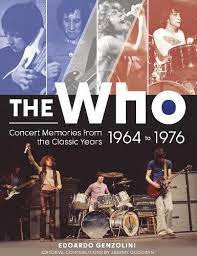
THE WHO - Concert Memories From the Classic Years 1964 to 1976 by Edoardo Genzolini


Memories of The Who in their prime do not f-f-fade away. They linger in the minds of those lucky enough to have seen them during the period covered by this 304-page, large format book, now translated into English from its original Italian; yet another shining testament to the lasting impact the group had on fans and a reminder of how genuinely inspiring they were to behold.

        Edoardo Genzolini was certainly inspired, so much so that he’s spent half a lifetime conceiving his book, his inspiration seeing their performance in the Woodstock movie at the age of 13. But the effect The Who had on him was more profound than simply enjoying their landmark Woodstock set on celluloid. He connected with The Who emotionally as well as physically, and his book stands as a tribute from both the heart and the head. I think it’s his way of simply saying thank you to them, for the music, the memories and the lasting influence they’ve had on his life.  

        To this end Genzolini writes introductions to each chapter that cover what The Who did, or tried to do, or wanted to do, in the years covered by the book, expanding on how their ambition somehow went beyond simply making records and performing concerts. Each intro is followed by first person accounts of shows, some by crew members who worked at theatres where The Who performed or fans who were present, a few of whom helped in some way, or somehow got backstage or to a hotel where the band was staying, just to say hello. Most such encounters are described in fascinating, personal detail, with one-on-one conversations repeated verbatim, some profound, some trivial, some hilarious. Many accounts reflect the characters of the individual members and how open they were to chatting with fans, and the impact this openness had on them, and it is clear from them all that close encounters with Pete, Roger, John and Keith are not easily forgotten. 

        Most of these accounts are illustrated by scores of pictures, many hitherto unseen, mostly black & white but some colour, of The Who on stage or its members backstage, often accompanied by the fans themselves. The quality of the photos varies from professional standard to amateur snaps taken with cheap cameras, but to have so many, upwards of 450, I hadn’t seen before, is a genuine treat, regardless of quality. Turning the pages, I was reminded of Jeff Stein and Chris Johnson’s 1973 photo book, simply titled The Who, another labour of love I greatly admired, though Concert Memories is a far more ambitious undertaking. 

        Although this book purports cover the years 1964-1976, there is an inevitable emphasis on the middle period, the years 1968, ’69, ’70, ’71 and ’73, that many consider to be The Who’s zenith. Of the shows described, some are among the most important The Who ever played – Woodstock, the IOW and both Fillmores in 1969 (there’s a whole chapter on Bill Graham and his Fillmores East and West), Leeds and Tanglewood in 1970, the Oval in 1971 – but all are very special in their own way to those who were there. 

        In a book as large as this it’s difficult to pick highlights but I chuckled at the story told by Christine Curry from Detroit whose friend Cindy went to the hotel where The Who were staying after their show at the Grande Ballroom on March 9, 1968, and spent the night with Keith Moon. “She told me that while she was in bed with him, he talked to his wife on the phone!” reports Christine. Then again, there’s Sally Mann Romano’s account of how in 1968 she left the Whiskey in LA with John and Keith in a rented Porsche, only for Keith, who was at the wheel, to abandon it at an intersection with the engine still running, apparently because he felt they could get to his hotel quicker on foot.

        Among the pictures are two from stage at the Anaheim Convention Centre, on September 8, 1967, which the author claims to be the only known shots of John smashing a bass, while Dennis Quinn tells how Pete dropped a white Fender Stratocaster into his hands from the stage at the Fillmore East in New York on April 5, 1968. One fan reports breathlessly that Roger permitted him to try on his tasselled outfit backstage. 

        There are several reports from the May 1969 shows at New York’s Fillmore, including the one where fire broke out next door, the notorious incident that resulted in Pete spending a night in jail for bashing a plain clothes cop with his guitar. “[The following night]… the tension in the Fillmore before The Who walked out onstage was unreal,” reports Mark Saull. “The energy was like something I’ve never experienced before or since. The Who were so powerful and intense it was intimidating. I remember looking at people in the audience, standing with their fists clenched, gritting their teeth like they were on a thrill ride. [The Who] looked 10 feet tall.”

        While many of the most profound anecdotes are to be found from the 1969-70 era, one from a Quadrophenia show in 1973 stands out. Guy Perry reports that at the Cow Palace, San Francisco, on November 20, 1973 – the show where Keith collapsed and had to be replaced by Scott Halpin – Pete, determined, no doubt, to compensate for his errant drummer, executed… “thirty-plus consecutive windmills during ‘Naked Eye’, an astonishing moment.” 

        These are but a tiny fraction of the delicious memories recalled, every one of them a testament to how unforgettable The Who were in their prime. 

        The book closes with reports from the “Day On The Green” shows in Oakland on October 9, 1976, and a handful of pics from Seattle Coliseum a few days later. Finally, legendary Who disciple “Irish” Jack Lyon writes movingly about how he flew to London on hearing of Keith Moon’s death, his reaction to the news and the atmosphere in Who central during this unhappy time. At the start of the book Jack had written about The Who’s last night at the Goldhawk Social Club in Shepherds Bush in 1965*, so his closing tribute to The Who’s drummer adds a touch a symmetry to a book that Pete himself writes admiringly about on the front cover flap.

        I am happy to add my own recommendation too. Published in hardback by Schiffer Publishing, The Who: Concert Memories isn’t the cheapest Who book on the market – the RRP on the back is $59.99, and in the UK Amazon are offering it for around £40 – but it’s among the very best, lovingly compiled by a true fan for true fans, those who understood the power of The Who and their music, and what it still means to those, like me, who experienced it when this wonderful group made music and performed shows that were unrivalled in rock. 


*Jack’s piece about The Who’s last night at the Goldhawk was actually commissioned by me for use in the booklet accompanying The Who: 30 Years of Maximum R&B, the 1994 4-CD box set I co-produced. At the time Pete felt it was unsuitable because of its depiction of violence. 


30.7.22

TOM WRIGHT

Tom in 1962, when he was at Ealing Art School with Pete

News has come through that legendary Who photographer and tour manager Tom Wright has died in the US. 

        The Who have many reasons to be grateful to Tom. A contemporary of Pete Townshend at Ealing Art College in 1962, he introduced Pete to marijuana and a host of great American R&B and blues artists. When he skipped the country to avoid a drug charge he left behind a wondrous record collection that Pete snaffled and which became the impetus for The Who’s switch from pop and C&W to Maximum R&B. 

        Equally importantly, Tom would go on to become the group’s first American tour manager and unofficial photographer, and many of his photographs from The Who’s earliest US tours have been reproduced in countless books and magazines.  

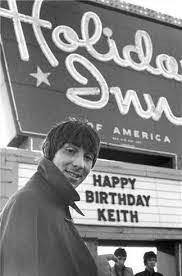
        Among the most famous was of Keith Moon alongside the Holiday Inn sign at Flint, Michigan, the scene of his infamous 21st birthday party. 

“Pete telegrammed me [in 1967] to say The Who were coming to the US to tour with the British pop band Herman’s Hermits,” said Tom. “They’d be in Florida in a week… and when I got there Pete suggested I come on tour with them and shoot photographs of the band. So here I was, 23-years-old, camera around my neck, passport in my back pocket, boarding a chartered plane because Herman’s Hermits were so big, they rated it.”

In 2022, with The Who esteemed as mighty legends of rock, pioneers in the art of performance and superstars both alive and dead, it seems absurd to recall that in the summer of 1967, on their first American tour, they were the support act for the far more popular Herman’s Hermits. With 11 top ten hits behind them when the tour started – The Who had only one – Herman and his boys were riding out the crest of the British Invasion wave, drawing predominantly female audiences for whom The Who were distinctly odd, especially when they closed their brief sets by inflicting serious damage to their guitars, drums and amplifiers. 

         Tom was on board for almost all of that first tour. It began on July 13 in Calgary, Canada, and closed on September 9 in Honolulu, a nine-week coast-to-coast jaunt on which they often played two shows in one day. It was a gruelling experience and probably not worth the effort. “It got us around America,” said Roger Daltrey, “but it did us no good at all.”       

Tom was working as an underwater photographer when he joined The Who at St Petersburg in Florida. “The Who came to Florida and that was the end of my underwater photography career,” he says. “These young kids would be yelling, ‘Where’s Herman, we want Herman’ and then The Who would start playing before the curtain came up,” he told Who biographer Richard Barnes. “When the curtain came up, they would be really rocking and everybody was just moving about, like Roger would be running around and Pete would be swinging his arm and hammering the guitar and Moonie would be kicking ass. And people were in shock. The band didn’t stop between numbers... or they’d quit playing for just a couple a couple of seconds, but it would be just long enough and BOOM into the next number.”

Toms shot of The Who at the Fillmore East, New York, April 5, 1968

        This was the period in The Who’s career when wrecking their equipment at the end of a set was a regular occurrence. “It was spellbinding,” adds Tom.  “A lot of times there was no clapping whatsoever, just dead silence. People in the front row were just sitting there with their mouths open, stunned.”

Tom would go on to tour manage The Who in America for two tours during 1968, photographing them along the way, on stage, in recording studios, in their coach and at hotels. He quit in late 1968 after accepting a position as manager of the Grande Ballroom in Detroit, one of the era’s most important rock venues. 

The tours that Tom photographed laid the foundation for The Who’s eventual capture of an American tour circuit they helped create. This hardly existed during the first British Invasion of America, the one led by The Beatles and Rolling Stones, and it developed as pop became rock, with audiences beginning to listen seriously to groups whose music was no longer aimed predominantly at teenage girls. During Tom’s tenure as The Who’s tour manager the group pioneered a new concept of rock performance, with the music they played becoming more and more sophisticated as their shows became longer and more expressive. They also became more photogenic.

The following year The Who opened their first headlining US tour on February 21 in San Jose, California, and while in the Golden State made a madcap, stop-start promotional film for ‘Call Me Lightning’, a song released as a single in the US and completed at Gold Star Studios in Los Angeles around this time. Tom was on hand to photograph the group in tin helmets and fooling around with an explosive detonator.  


        Just as they done in the UK, The Who blazed a trail across America through the potency of their live shows and Tom was on hand to watch it all happen. Unlike the British pop bands that preceded them, there was no run of chart-topping US singles or historic appearances on The Ed Sullivan Show, and nor did they reduce teenage girls to screaming banshees as they flew from city to city. They didn’t so much crash down Uncle Sam’s gates as slide in through a gap after the doors had been left ajar by the others, but the hard work they put in ensured that in the fullness of time The Who would become a stadium-filling juggernaut in the seventies and beyond. 

Tom Wright’s pictures of The Who in America captured a fascinating but often-overlooked period in the journey of one of the UK’s greatest ever rock bands.  

Tom’s book Roadwork: Rock’n’Roll Turned Inside Out, published in the UK by Omnibus Press as Raising Hell On The Rock ‘N Roll Highway, features an intro by Pete which I posted on Just Backdated here: https://justbackdated.blogspot.com/2015/03/raising-hell-petes-introduction-to-tom.html

An Ealing Art School reunion