Showing posts with label Deep Purple. Show all posts

17.4.25

DEEP PURPLE RECORD COLLECTOR SPECIAL

In his infinite wisdom, Joel McIver saw fit to interview me about my book on the band for Record Collector’s Deep Purple Special that he edited and which is on sale this week. 

        Joel and I go back to 2000 when he persuaded me that Omnibus ought to publish a book on Extreme Metal, written by him. Not being a particular fan of this genre, I was skeptical at first but decided to give it a shot, and I’m glad I did. Joel went on to become my go-to author for books on the noisier, more confrontational, end of rock, 36 at the last count, and he now contributes obituaries to the Guardian whenever a metal musician bites the dust. 

        Joel’s best-known book is Justice For All: The Truth About Metallica, first published in 2004, which has been translated into nine languages. “Very professional,” said drummer Lars Ulrich. “I get asked to sign copies of this book all over the world.” What’s more, Joel has it on good authority that Lou Reed bought a copy of the book to read before embarking on his collaboration with Metallica that resulted in the 2011 album Lulu.  


        This is a transcript of my interview with Joel for the DP special, which can be bought at:  https://recordcollectormag.com/rc-specials/record-collector-presents-deep-purple. 

How did you first encounter the members of Deep Purple, Chris? 

The first time I saw Deep Purple was at Bedford City’s football ground in the summer of 1970. Until that point, I was unfamiliar from them, apart from the song ‘Hush’, which I’d heard just like everybody had. I met them backstage, and I saw the show, and I thought they were really good. 

Which of them impressed you most? 

Ritchie Blackmore was particularly impressive. I played a bit of guitar myself so I could recognise a good player. It was obvious to me, watching him, that he’d had some formal training. I thought ‘God, what a terrific guitarist – he ought to be in the same league as Clapton, Beck and Page’. Every note he played was perfect. Not long after that I did an interview with Ritchie, and he told me that he’d had lessons from Big Jim Sullivan, the famous 60s session guy who played on everybody’s hit records. It was obvious that Jon Lord had been classically trained as well. 

What happened next? 

I got to know them after that, and I saw them seven or eight times over the next two or three years. I went to Paris with them and on a tour in America, where I learned that Ritchie was a bit of a mischievous character. He played tricks and liked to spook people out with horror stories. I thought he was a really interesting fellow, but he had a chip on his shoulder because he wasn’t regarded in the same league as the Claptons and Becks and Pages. Somehow, he wasn’t quite up there, but he deserved to be. We had dinner one night – him and a girlfriend, and me and my girlfriend – and he told me that the only two guitarists he thought were better than him were Jimi Hendrix and Albert Lee. He knew he was as good as Page and the others, and much better than Pete Townshend, although he didn’t have the rhythmic flair that Townshend had.

Why wasn’t he regarded as up there with the greats? 

It may have had something to do with tastes and fashions. For all their skills, Deep Purple were never particularly fashionable. I recently discussed this aspect of them with Roger Glover, and he said, ‘I know we weren’t fashionable – that’s why we’re still going. If you’re fashionable, you’re in fashion, and then you’re out of fashion’. 

Did you know Purple’s managers? 

I got to know John Coletta quite well. Tony Edwards was the money man, and a stay-at-home guy who did the admin, whereas John went on the road. He was a friendly enough guy, but I always felt he was a bit out of his depth, especially dealing with Blackmore. 

Was Purple basically an investment project by Edwards and Coletta? 

To a certain extent, but it wasn’t until I wrote my book about them that I discovered the truth about how they were financed in the beginning. They needed £15,000 to get off the ground [the equivalent of around £270k today], and Tony Edwards had £5,000 to put in because he had a family clothing business. Coletta didn’t have £5,000, but he had a friend who lived near him in Brighton who was an antique dealer, and he had £10,000 to put in. Unfortunately, it turned out that this antique dealer had a lock-up full of stolen goods, and he was eventually arrested and went to prison. Fortunately, Deep Purple had made some money thanks to ‘Hush’ being a hit in America. They kept this story quiet, as you would imagine, and I didn’t find out about it until I did my book in the 80s. 

How did the first edition of your book come about? 

I got in touch with Coletta, who managed Whitesnake at that time, and I said to him, ‘Would you co-operate with me on a book on Deep Purple?’ We agreed that Purple would receive a royalty on its sales and through Coletta, I managed to interview most of the members of the previous line-ups. The exceptions were Tommy Bolin, who had died; Rod Evans, because no-one knew where he was; and Blackmore, who completely blanked me, which surprised me. Coverdale said he’d do the interview, but then I got a phone call from some very unpleasant tour manager or PA, demanding conditions that I refused to accept. 

Were the others happy to be involved? 

They were. I interviewed Ian Paice at his home, and Gillan in a hotel in London, and Roger Glover and Glenn Hughes – both of whom lived in America at the time – kindly answered my questions into a tape recorder. I couldn’t find Nick Simper, but Simon Robinson at the Deep Purple Appreciation Society had done a long interview with Nick that he let me use in the book. 

And Jon Lord? 

Jon was an unbelievably nice guy – very accommodating, friendly and affable. I spent a night at his house near Henley, and we went out for dinner with his wife Vickie and Ian Paice and his wife Jacky who was the identical twin of Jon’s wife. After that, I did the interview, way into the night: we stayed up until two or three in the morning, drinking whiskey and talking. I really got him to open up about everything, and it was just great, because he didn’t hold back at all. 

That must have been refreshing. 

Well, at that point, no-one knew that there would be a future for the Purps, so there was nothing to lose by telling it like it was. He told me what he liked and what he didn’t like about the band – everything he could remember. It was Jon who told me the story about the investor who went to jail: afterwards I checked the local newspaper in Brighton, where it had happened, and found the guy’s name. 

Lord was a fascinating man, wasn’t he? 

He was. Did you know that after he retired, he used to go on the road with John Mortimer, who was a neighbour of his? Mortimer was the writer of Rumpole Of The Bailey, and he would go on book tours and talk about Rumpole for the audiences. Jon would go with him and tinkle away on the piano while Mortimer was telling a story. I didn’t discover this until after he died. 

Did the band like your book? 

Everybody loved it, I think, apart from Ritchie, because I told a few stories about him in it. There’s a Japanese edition which is very rare, because there was a fire at the printers in Japan and all the plates were destroyed, this being many years before digital publishing. As I say, I did the book on the assumption that Deep Purple would never reform. I had no idea that they would get back together a year after the book came out. That surprised me, but it didn’t make any difference to the book.

Rufus Stone have recently published an updated edition of Deep Purple: The Visual History, available in several luxury versions.

They’ve done a beautiful job of it, with a Standard Edition and a Deluxe Collector’s edition. Both of them are great – I’m really pleased with them. There’s loads more pictures, a completely new design. 

You’re now working with Roger Glover on his autobiography. How’s it going?

I’ve been working with him on it for three years now. We’re up to the reunion in 1984. I’ve learned a hell of a lot of interesting stuff. For example, when he was ousted from the band in 1973, it was devastating, because he’d finally found a great band and he was making good money and really enjoying himself. It came out of the blue, because there’d been no animosity, whereas there had been some animosity with Gillan, so in his case they knew it was coming. Roger told me that, after the last gig he did with Purple, Ritchie came up to him and said, ‘Look, no hard feelings, mate. It’s nothing personal: I did it for the band’. Roger said he accepted that, and he didn’t blame Ritchie, but he did blame Paice and Lord, because they didn’t say anything like that – which is why he went off to work with Rainbow. He still had a great deal of admiration for Ritchie, and he still does.

What are your thoughts on Purple’s current Mark IX line-up?

Simon McBride is really good. I went to see them play at the O2 Arena in London just after he’d taken over from Steve Morse. Ian Gillan charted a boat to take all the wives and families and friends to the O2: we all sailed down the Thames, drinking from an open bar, and when we arrived at the back of the arena they ferried us inside in coaches. We hung out backstage and watched the gig, and then went back on the boat. That’s the kind of band that Purple are.

The interview is followed by an extract from my book about the group’s ill-fated visit to Indonesia in early 1976. 


23.6.23

DEEP PURPLE: THE VISUAL HISTORY

This month sees the publication of a new edition of my book Deep Purple: The Illustrated Biography, first published in 1983. It has a new title, Deep Purple 1968-1976: The Visual History, to indicate that it covers only the first eight years of a career that is ongoing. 

There are many changes and it’s taken a long time – since 2018 – to get to this point. Most importantly, the new edition has 486 pages, as opposed to the original 96, and has been completely redesigned with over 500 new pictures, many published for the first time, among them a series from the 1972 concerts in Tokyo and Osaka where their big-selling Live In Japan LP was recorded. Furthermore, the text had been re-edited by myself, with some additions, some subtle changes, and new Introduction and Aftermath chapters. 

There was an early discussion as to whether I could actually update my book to the present day but this was deemed unfeasible, not least because any update would need to cover over 40 years of additional Purple activity, and to do so in the same detail as the original book would be unrealistic. In the event, I limited myself to the new intro and 3,500-word postscript that briefly brings the DP story up to date. 

The book is available two cased formats, Standard and Deluxe, the latter (pictured above) limited to 500 copies with all sorts of goodies and signed by David Coverdale, Ian Gillan, Roger Glover, Glenn Hughes, Ian Paice and Nick Simper. A promotional video for the book can be accessed here: https://www.youtube.com/watch?v=X_SfFs6LmdI&t=2s

    Here’s my new introduction: 


Introduction to 2023 Edition

In 1982 I was commissioned by Omnibus Press to write a biography of Deep Purple, a group with whom I’d become familiar during the early seventies as a staff writer on Melody Maker. I had seen them perform several times, both in the UK and France, and on tour in the US, and interviewed all the members of the ‘classic’ line-up. As a result, I got to know them and their management quite well, so I approached them for assistance, which was largely forthcoming. At that stage in Deep Purple’s story the group was defunct and there were no plans to reform, so my book covered only the years 1968-1976, which in the event turned out to be the first phase of a career that endures to this day. 

        The first edition of the book was illustrated throughout with photographs of the group’s four line-ups and reproductions of documents pertaining to their career. It was published in 1983 with a Japanese edition following two years later and, though I say it myself, Deep Purple – The Illustrated Biography became the standard narrative on the band’s formative years and ascent to fame. Much to my surprise, a year after the book’s publication the ‘classic’ line-up of the group did reform. This was the line-up that I referred to in my book as Deep Purple Mark II, the one that enjoyed the greatest success, comprising guitarist Ritchie Blackmore, keyboard player Jon Lord, drummer Ian Paice, bassist Roger Glover and singer Ian Gillan, but as in times past personality clashes created an instability that led to personnel changes and in the decades that followed other musicians came and went. 

        The sad death of co-founder Jon Lord in 2012 might have been expected to extinguish the Deep Purple flame but at the time of writing the group is still operating, with Paice, Glover and Gillan performing and recording with Don Airey on keyboards and, on guitar, Simon McBride who took over after Steve Morse left for personal reasons in 2022. Since 1997 Ritchie Blackmore has led Blackmore’s Night, a folk-rock group specialising in folk and Renaissance music that features his wife Candice Night on vocals. They dress in period costume and often appear at venues where Medieval Fayres are held, sometimes at ancient castles and stately homes. 

        Back in 1982, charged with the task of researching the book, my first port of call was the offices of HEC Enterprises at 25 Newman Street in London’s West End where John Coletta, the group’s original co-manager, looked after the affairs of Whitesnake, one of the many spin-off groups that Deep Purple would hatch. He agreed to help me and I also approached their second co-manager, Tony Edwards, who then ran Safari Records, and he too agreed to help. The two managers both gave me enlightening interviews while a third, who was purely an investor, left the partnership early in the game and was deemed by them to be irrelevant to the group’s story. John Coletta passed away in 2006 and Tony Edwards in 2010.

        Coletta’s new partner was Rob Cooksey, who had been Deep Purple’s tour manager, and both helped me contact Jon Lord, Ian Paice, Ian Gillan, Roger Glover and his successor on bass Glenn Hughes, all of whom agreed to be interviewed, the latter two answering written questions into a tape recorder and mailing me recorded cassettes. For reasons known only to himself Ritchie Blackmore declined to cooperate which disappointed me because during the period when I followed the group avidly he and I always seemed to get along quite well. A planned interview with David Coverdale never happened because his disagreeable tour manager wanted to set conditions that I found unacceptable. As well as Coletta and Edwards, I spoke to DP record producers Derek Lawrence and Martin Birch, and three members of the group’s road crew, Cooksey, Ian Hansford and Mick Angus. David ‘Screaming Lord’ Sutch, who died in 1999, gave me the low down on Blackmore’s early career, and I spoke with a few others who’d observed them closely. Original singer Rod Evans proved untraceable, latter day guitarist Tommy Bolin had passed away, and I was indebted to Simon Robinson of the Deep Purple Appreciation Society for allowing me to quote at will from a long and wide-ranging interview with original bassist Nick Simper.

        No one vetted my final manuscript and, thanks largely to Jon Lord’s sincerity and willingness to tell it like it was, the book was and remains remarkably candid, far more so than most ‘authorised’ biographies of the era, perhaps because at the time no one thought Deep Purple had an afterlife beyond the split in 1976 and there was therefore nothing to lose by holding back information that at one time might have been deemed confidential. (Among the book’s more startling revelations was a complete gig list which, because it was supplied to me by the group’s meticulous accountant, also included the fees paid to the group for almost every show they performed.) As it happened there was an afterlife to Deep Purple that has lasted until the present day. Many fans of the group as they are configured today might be unfamiliar with their illustrious beginnings and I hope this new edition of my book will enlighten them.

        For the record, this edition has been re-edited by myself, reworked here and there and benefits from new information culled from documents pertaining to the business affairs of HEC Enterprises. Such documents confirm that just because a musician no longer records or performs with a group doesn’t mean they’ve left in the ‘legal’ sense, so the comings and goings within the ranks of Deep Purple in 1973 and 1975 caused endless behind the scenes business problems for the directors of HEC, and that as a result some members of the band benefitted from their success far more than others. 

        For their help with this edition, which includes an extensively re-written aftermath at the end, I would like to thank Roger Glover, Mark Smith, Drew Thompson, Simon Robinson and Joel McIver. 

        Deep Purple 1968-1976: The Visual History is dedicated to the memory of my late friend Jon Lord, a fine musician and true gentleman whose graciousness towards me during my research for this book made it what it was and, I hope, still is. 

Chris Charlesworth, October, 2022


21.10.22

DEEP PURPLE - LONDON O2, October 20, 2022


To the 02 by riverboat, courtesy of my old friends Deep Purple, though only three survive from the group I covered extensively for Melody Maker between 1970 and 1976 and whose semi-authorised* biography I wrote in 1982. At that time the group had split and had no plans to reconvene but two years later the line-up I termed DP Mark II – organist Jon Lord, guitarist Ritchie Blackmore, drummer Ian Paice, singer Ian Gillan and bassist Roger Glover – reformed and hit the road again to promote a new album, Perfect Strangers. Since then the Purple franchise has been more or less permanently active and released a dozen more albums – two more than the group I used to write about – though Blackmore quit for good in 1993 and, sadly, Lord died in 2012, having retired amicably from the group a decade earlier.
Now touring for the first time since 2019, Paice, Gillan and Glover are joined on keyboards by Don Airey, whose CV reads like a roll call of heavy rock and has been on board since Lord’s retirement, and recently appointed guitarist Simon McBride has replaced Steve Morse who bowed out earlier this year for personal reasons. 
So, much has changed since I last saw Deep Purple at Radio City Music Hall in New York in January 1976, yet the distinctive character of the group remains unequivocally the same. The emphasis is still on soloing, predominantly guitar and keyboards, and songs that are stretched beyond recognition from the studio versions, be they well-seasoned nuggets from the catalogue of the group that plied their trade long ago, or newer pieces with which I am less familiar. The difference between the old and the new in a live setting is a greater emphasis on discipline, no doubt due to the length of time they’ve spent playing together or, simply, more rehearsal, and in a sharper, crunchier, more contemporary stage sound afforded no doubt by superior 21st century amplification. 
As befitting the only member of the group to have played in all of its line-ups, Ian Paice forsakes a drum podium and positions himself centre stage and more upfront, on the same level as everyone else. From the audiences sightline, Don Airey’s multi-layered keyboard set-up is to the right of him; Roger Glover, far more mobile than the stationary metronome he once was, is on the left of the stage; Simon McBride is on the right; with Ian Gillan in the centre when called upon to sing, a less arduous role in Purple than in most groups of their stature. 
As in times past, Deep Purple’s arrival on stage is heralded by a blaring classical piece full of drama, this one by Holst, until the lights flash and they launch their first London show since 2017 – ironically part of their ‘Long Goodbye’ tour – with ‘Highway Star’, segueing smoothly into ‘Pictures Of Home’ and ‘No Need To Shout’, all without a break. Not until the fourth song, ‘Nothing At All’, does Gillan address the large crowd who’ve been on their feet since he arrived on stage, ambling on last from the gap between the speaker cabinets behind Paice’s drums, which affords him a handy egress on those occasions when his services aren’t required. 
Don Airey on his extravagant variety of keyboards and synthesisers and the much younger, and slimmer, Simon McBride on guitar are given free rein in much the same way as Lord and Blackmore once were, with virtually every song in the evening’s set offering them opportunities to solo over and above the set pieces where they are left alone on stage to grandstand their ample skills. 
        In McBride’s case this came before ‘Uncommon Man’, dedicated by Gillan to Jon Lord, and began with a display of muted tone control effects that made his guitar sound like a cello before he reverted to the more nimble-fingered stuff that DP fans expect. A dab hand at those incisive power chords and manipulating FX foot pedals, there can be no doubt he’s a worthy replacement for the more experienced Morse and, indeed, could probably give their original guitarist a run for his money in the speed, string-bending and harmonic departments. With his trim haircut and tight Levis, he looks good too, a sleek and snappy player who oozes confidence in a demanding role. 
        Airey had the stage to himself in the prelude to ‘Perfect Strangers’ later in the set and showed himself to be equally well-equipped to step into the shoes of his predecessor. With hints of Phantom of The Opera-ish doom and glissandos galore, and a touch of JS Bach, or maybe Ludwig Van, he attacks the many tiers of electric keys at his disposal with the air of an assured maestro, conjuring up all manner of commotion on his synth yet not without some sly humour. At one point, to the delight of the crowd, he tinkled out ‘Maybe It’s Because I’m A Londoner’. 
        Ian Paice does not solo in the accepted sense but many of the songs include drum breaks and sharp modifications in tempo that require him to take a commanding role. He is as tireless as ever, the same bundle of energy at 74 as he was at 24, his hair now almost white, worn in a straggly ponytail. His namesake on vocals is still a handsome devil and, though he no longer screams in the manner he once did, his singing is more measured these days, with perhaps a shade less range but certainly more depth. His bluesy treatment of ‘When A Blind Man Cries’, the only song in the set where Purple took their foot off the accelerator, was a highlight for this reviewer.
        After Space Truckin’, delivered with persuasive, unflagging relish, the pre-encore closer was the inevitable ‘Smoke On The Water’, prefaced by a bit of noodling before McBride took up centre stage to play that riff, as piercing as it was precise, the signal for a thousand mobile phones to be held aloft. On the screen behind the band, on which graphics had been shown the whole time, a pack of cards was dealt amidst visions of smoke from the burning casino that floated over Lake Geneva all those years ago. On the cards we saw the faces of DP past and present, their old guitarist the jester, someone’s tongue firmly in cheek. 
        They came back to play ‘Hush’, that early US hit single never performed during the era when I first encountered them, followed by Glover’s bass solo, deftly handled alongside Paice, and, at the very end, ‘Black Night’, the 1970 UK number two hit that took them by surprise, paving the way for their elevation to rocks top table. Im happy to report theyre still supping from it after all these years. 

---

* Five out of the ten ex-Purple musicians co-operated in the book (of the others, one blanked me, three were uncontactable and one had died), together with managers, producers and a few roadies. 

31.12.21

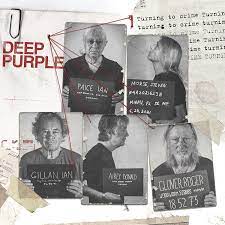
DEEP PURPLE – Turning To Crime


Obliged by Covid-19 to self-isolate and therefore work individually – as opposed to writing new material together in the studio, their customary procedure – Deep Purple early this year opted to record an album of covers, with each member of the group transmitting their contributions to the Anarchy Remote Studio, a digital facility in cyberspace where producer Bob Ezrin assembled the parts like a jigsaw. The result is Turning To Crime, a 12-track CD of songs “that shaped us over the years”, according to a brief note on the accompanying booklet. In reality it’s more than 12, for it concludes with a five-song medley, among which is Led Zeppelin’s ‘Dazed And Confused’, of which more later.

        Unless I’m mistaken, the last cover version recorded by DP was ‘Lalena’, by Donovan, which appeared on their largely ignored third LP, simply titled Deep Purple, in 1969. Prior to that the first DP group had recorded plenty of covers, not least their debut US hit ‘Hush’, by Joe South, and others by Neil Diamond, Lennon & McCartney and whoever claims to have written ‘Hey Joe’. Once they got into their stride, however, original material prevailed, and this coincided with singer Ian Gillan and bassist Roger Glover joining the core trio of organist Jon Lord, guitarist Ritchie Blackmore and drummer Ian Paice. This quintet, which in my 1983 biography of the group I refer to as DP Mark II, enjoyed enormous success and is still widely regarded as the ‘classic’ line up. 

        Gillan, Glover and Paice remain today, joined on guitar by Steve Morse and on keyboards by Don Airey. With Paice now the only member of the group to have played in its every incarnation since DP formed in 1968, Morse and Airey are by no means newcomers. The former has been with them since 1994, replacing the eternally capricious Blackmore, and the latter came on board in 2002 when Lord, their statesman-like elder, retired from rock to concentrate on serious music. Sadly, he died in 2012. 

        The choice of material on Turning To Crime throws up plenty of surprises and a handful of songs that might be expected. Among the latter is the opener, Love’s ‘7 And 7 Is’, at one second shy of two and half minutes the album’s shortest track but by many mph the fastest. Its inclusion offers strong evidence of where DP were coming from by the time they recorded their breakthrough LP In Rock, the relentless pace (no pun intended) of the drums leading the way over a thumping beat, crunch guitar and indecipherable lyrics, DP’s version differing from the original only in that they chuck in characteristic guitar and organ solos and omit Love’s thunderous explosion and Arthur Lee’s slow blues-based coda.

        Ian Gillan long ago betrayed his influences in the lyrics to ‘Speed King’, which referenced Little Richard who was knocking around New Orleans in 1957 when Huey ‘Piano’ Smith recorded ‘Rockin’ Pneumonia And The Boogie Woogie Flu’ there. This paean to chest ailments given the rockn’roll cure offers Don Airey a chance to show off his honky-tonk chops, and to cheekily incorporate the riff from ‘Smoke On the Water’ into one of his solos. Freed from the need to sprint, Ian Paice shows himself to be a fine and steady rock’n’roll stickman. He has some previous on this kind of material, having been a member of Paul McCartney’s ‘Rock and Roll Band’, playing alongside David Gilmour, Mick Green, Pete Wingfield and Chris Hall, not to mention the former Beatle, at the Cavern in Liverpool in 1999.  

        A reverent take on Fleetwood Mac’s ‘Oh Well’ follows, fairly true to the original, with about a minute of the haunting ‘Part 2’ coda slapped on the end. Next up is ‘Jenny Take A Ride’, by Mitch Ryder & The Detroit Wheels, its opening section perhaps better known as ‘CC Rider’, much performed by Elvis, which morphs into ‘Jenny, Jenny’ whom Mitch invites to take a ride, before slipping back to ‘CC’. This is great boozy bar band music, the kind of thing that Springsteen favours for encores, so here we have DP channelling with some distinction hitherto unrealised E Street Band leanings. 

        ‘Watching The River Flow’, an anomaly in Dylan’s catalogue in that it was a one-off blues-based single, seems like an unlikely cover and may have been suggested by Bob Ezrin who joins Gillan on vocals. There’s a hint of gospel in DP’s version which in an oblique way pays tribute to the full-on sound of Leon Russell, who played on Dylan’s original, and his Mad Dogs & Englishmen retinue, not least in the 30-second keyboard sign off. 

        We’re back in New Orleans for ‘Let The Good Times Roll’, which sounds to me like it could have come from the soundtrack to Kid Creole, Elvis’ fourth (and best) movie. Joined by saxophone and trumpet, DP take it at a medium pace, with a bluesy guitar solo and churchy keyboards adding to the southern fried flavour, Airey switching to honky-tonk at one point thought the brass is never down in the mix. 

        Taking on Little Feat is a fearsomely bold move but Don Airey has Bill Payne’s tinkly keyboard part off pat, and the whole band swing their way through ‘Dixie Chicken’ respectably enough. Morse is great on the slide solo, and my only gripe is that Ian Gillan’s Brit voice sounds a bit strained next to Lowell’s sly, loose-limbed, shuffle delivery. Still, it’s refreshing to learn that DP were influenced by one of my favourite American bands, and I tip my hat to Morse for the solo at the close.

In the never-ending discussion as to the origins of heavy metal, or hard rock as it was before Black Sabbath became Paranoid, The Yardbirds’ ‘Shapes Of Things’ merits a sub-section of its own, and although Jeff Beck was in the group when it was originally recorded, its composition is actually credited to Keith Relf, Jim McCarty and Paul Samwell-Smith. Still, it’s a minor psychedelic masterpiece, with Beck’s guitar hovering between distortion and the mysterious East, and lyrics that pre-empt the present-day climate crisis. DP take it at a slightly slower pace than The Yardbirds, but are dutifully reverent in their approach, though Morse, ever anxious to inject something distinctive, gets a long solo before the whole thing grinds to a suitably rave-up style halt.

Hearing Lonnie Donegan’s version of ‘Rock Island Line’ on the radio when he was about 10 led to Roger Glover becoming who he is now, so it’s no surprise that he shares the vocals, leading on the first verse, with his old Episode Six partner Ian Gillan on ‘The Battle Of New Orleans’, a hit for Lonnie in 1959, and probably the least likely cover on Turning To Crime. Joined by violin and accordion, no one in a million years would guess this hoe-down romp was Deep Purple.

‘Lucifer’, a Bob Seger song from 1970 when he led a group called The System, is the only track here with which I was unfamiliar, a mid-tempo rocker typical of the Silver Bullet work that brought him no little success as the seventies progressed. DP give it their all, but of greater merit is their take on Cream’s ‘White Room’, a far more interesting song. Another dose of psychedelia with a hint of discord on the vocals and slabs of twisty guitar, DP match Eric, Jack and Ginger bar for bar, no mean feat. 

Finally, we reach what DP call ‘Caught In The Act’, their medley of five songs, the first four instrumentals, with Gillan joining in only on ‘Gimme Some Lovin’’, Steve Winwood’s tour de force when he was the star attraction in The Spencer Davis Group. Airey opens the show, a ragtime figure leading into Freddie King’s bluesy ‘Going Down’, which leaps into ‘Green Onions’, funky and straight like the MGs until Morse adds some twists, then ‘Hot ‘Lanta’, on which DP somehow manage to sound awfully like The Allman Brothers jamming away on stage. Next up is an instrumental of Zep’s ‘Dazed And Confused’, opening not with the familiar descending bass line but a passage from later, then the descent before  instruments take over the call and response. This leads neatly into the enormous ‘Gimme Some Lovin’’ riff, played well, and after two and a half minutes the whole business grinds to a halt, a few drum beats the last thing we hear. What fun they must have had. 

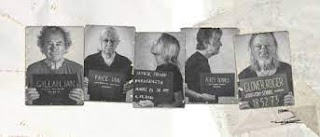
Also available is a 40-minute DVD The Making Of Turning To Crime, which is precisely what the title says, those responsible having concluded it was a crime for a group of DP’s stature to record an album of covers. This perhaps explains why on the sleeve they are photographed as if in a police line-up, every one of their mug shots resembling the sort of threatening ne’er do wells you’d cross the road to avoid.

When Covid is over, will they play these songs on stage? 


22.1.18

DEEP PURPLE, November 1970


I am at present engaged in revising my 1983 biography of Deep Purple for publication in a different format later this year. Here's a story from the book that I decided to expand, all 100% true.
        It is late 1970 and Deep Purple are enjoying their first taste of genuine success. 

Touring continued for the remainder of the year, with trips to France, Scandinavia and Germany slotted in between UK shows that included universities and seaside towns. The French trip, which I covered for Melody Maker, was hastily rearranged to exclude a club where fire had recently broken out with tragic results, and a prestigious show at the Paris Olympia on November 1 was followed by an impromptu performance at the Gibus Club whose enterprising owner had somewhat cheekily advertised an appearance by Deep Purple that hadn’t been agreed, let alone contracted. 
The club’s manager met with a furious John Coletta backstage at the Olympia but Purple’s manager, unwilling to disappoint scores of French fans, was backed into a corner. The group didn’t seem to mind, though, and free food and drink was provided for the whole Purple entourage in exchange for a short set that comprised old rock’n’roll 12-bar songs like ‘Tutti Frutti’ and ‘Lucille’ that were simple to play. Though the club was packed, it is doubtful whether the increased attendance compensated for the unlimited supply of beer, wine and champagne, not to mention fillet mignon, that was consumed by a party numbering a dozen or more. 
After the feast Ritchie and I left the Gibus to check out the Rock’n’Roll Circus, the Paris rock club that would become notorious as the place where Jim Morrison was last seen alive. We finally left the club in the early hours, by which time we had become attached to a couple of agreeable French girls but much to our frustration the night porter at L’Opera, the hotel where we were staying, refused to allow us to bring them up to our rooms. Livid, Ritchie stormed back outside, with me and the girls in pursuit, and together we hatched a plot to ensure that he, at least, would not spend the night alone. I agreed to abandon my girl, a bit reluctantly to be sure, and while he returned to the lobby and distracted the porter I was to sneak back inside with his girl and meet him on the first floor where he would reassume his courtship of her. 
I recall the tearful farewell to my girl on the steps of the hotel and my poor attempts to explain to her in French why we were not destined to spend the night in each other’s arms. ‘Un autre temps peut-etre,’ I said dismally as she went off to find a cab. 
The night’s fun and games were not over. As it happened the porter saw me and Ritchie’s mademoiselle sprinting through the lobby and, although I met Ritchie as planned on the first floor and ‘handed’ the girl over, a few minutes later the phone rang in my room. It was the night porter. In vain did I deny having a girl there but he came up to look for himself and when he couldn’t find her he demanded to know where she was. A confrontation ensued, not helped by my bad French.
‘Ou se trouve la fille?’ he yelled, looking under the bed and opening the wardrobe door.
‘Quelle fille?’ I responded, smirking.
‘La jeune fille qui arrive avec vous il ya quelques minutes,’ he replied, going into the bathroom. 
‘Il n’y a pas de fille ici,’ I said. ‘Recherche toi-meme. Il n’y a personne.’
He looked like he was staying put until she emerged from somewhere or other so as a last resort to get him out of my room I suggested he try Mr Coletta’s room down the corridor. Unlike him, I knew full well that Mr Coletta had taken a girlfriend, a Playboy Bunny as I recall, over to Paris for the weekend and had, of course, booked a double room for he and her.
        John wasn’t best pleased to be disturbed in the middle of the night by the night porter, or so I gathered in the morning. Ritchie, whose girl remained undiscovered, was highly amused by the whole business and for my sacrifice I earned his undying gratitude, or so I thought.


13.7.14

DEEP PURPLE - Trouble In Jakarta

This is an extract from my Deep Purple biography published in 1983, about the group’s disastrous visit to Indonesia in December 1975.
         The book was ‘authorised’ insofar as some of the group (Jon Lord, Ian Paice, Ian Gillan, Roger Glover and Glenn Hughes) all gave me interviews, as did both their managers, two record producers and some members of their road crew. Ritchie Blackmore declined for reasons best known to himself and my planned interview with David Coverdale fell through because his disagreeable manager wanted to set conditions that I found unacceptable.  No-one vetted the manuscript, however, and the book was remarkably candid, far more so than most authorised biogs that simply serve as PR exercises, perhaps because at the time no one thought that Deep Purple had an afterlife beyond the split in 1976. Jon Lord proved especially forthright in telling his story, a true gent.
         In November 1975 Purple flew from Hawaii to New Zealand for one show, and then to Australia for five. Japan was next on the itinerary but a promoter in Indonesia got in touch and proposed they stop off on the way for a show in Jakarta – but when they got there things went terribly wrong…


From Australia Purple were scheduled to fly north to Japan but on the way a concert had been arranged at the Indonesian capital of Jakarta. Their brief visit to this undemocratic island nation was shattered by the most distressing event in the entire history of the group: a week later reports reached the English press that a member of their security staff had been killed ‘after falling down a lift shaft’. What is certain is that Patsy Collins, their affable Cockney bodyguard, was never seen again and that tour manager Rob Cooksey was ripped off to the tune of $750,000. The episode has never been fully explained.
         “It was a set-up,” says Cooksey who even now is reluctant to talk about the matter. “The story from the word go was that we were due to play a theatre in Jakarta that held 7,000 people and, as we were on our way from Australia to Japan and had our own plane, it seemed like a good way to pick up some extra money. I’d been approached by an Indonesian guy called Danny Sabri and he sent us a deposit of $11,000. That’s all we ever got.”
         When Cooksey arrived and went to inspect the venue he received his first shock. It was an enormous outdoor stadium that held 125,000 people and they had never promoted a concert like this before. The stage was made from orange boxes and the security was the Army who were in total control and in league with the promoters.
“Initially I told Sabri that we weren’t gong to play for the price agreed and I wanted to call the whole thing off but he insisted we could re-negotiate. They’d also planned a second show the folowing night which we knew nothing about until we got there.”
The first concert was performed before over 100,000 people in a state of some apprehension and Cooksey realised that, taking into account the ticket price and calculating Deep Purple’s concert fee on the same basis as their American concerts, the group’s gross for the two shows ought to have been in the region of $750,000. He demanded a meeting with the promoters at Purple’s hotel after the show.
“It started off quite pleasantly and then developed into an argument. Then they left me alone. Very soon after that there was an incident on one of the floors and Patsy was killed after falling six floors down a lift shaft. He fell through these central heating and pipes and water ducts right through into the basement but it didn’t kill him instantly. He crawled out and got into a minibus outside the hotel and just murmured ‘hospital, hospital’. He died shortly after that.”
Cooksey was woken up at 4am and, with Glen Hughes and the second bodyguard – “Paddy the Plank” – taken to the police station and informally charged with being implicated in Collins’ murder.
“It’s my opinion it was a set up to get me out of the way,” says Cooksey. “The band had to play again that night and they were quite literally taken from the hotel at gunpoint and pushed up on to the stage. They let Glenn out to do it but they’d only played for 20 minutes when the place went crazy. The crowds rioted and the police set dogs on them.”
Cooksey remained in a jail overnight and, with Hughes and Paddy, was brought before a hearing the following morning. “The judge looked like some General Amin type, all medals everywhere, and he had this big revolver which he kept playing with... he kept spinning the cylinder and putting bullets into it. He said in his opinion the whole thing had been a tragic accident and all we had to do was go through the formality of having our passports photostatted. The bottom line was we paid $2,000 to get our passports back.”
From the courthouse the trio were taken to the airfield where the plane was waiting with the rest of the group and crew on board. But their problems weren’t over yet. “One of the wheels had a puncture and the captain requested the use of a special jack and torque wrench but we had to pay $10,000 to use it… plus they didn’t have anyone there who knew how it worked. [Roadies] Ozzie Hoppe, Baz Marshall, myself and the engineer from the plane ended up changing a wheel… on a Boeing 707. Feelings were running so high at this point that there was a plot hatched to grab one of these officious little Indonesians and throw him out somewhere over the ocean on our way to Japan. Fortunately I heard about it and scotched it.
“It was a horrendous experience. We lost Patsy and we should have made three quarters of a million dollars but in Indonesia there is nothing you can do. When I was in prison Ozzie Hoppe called our lawyer in Los Angeles and he flew to Indonesia just after we left. He arranged a meeting with the promoter but they chased him around the room with a machete. He landed in Tokyo not long after we did and said ‘forget it’. We just had to write it off.”

Patsy Collins was a well liked figure on the London music scene, an employee of the Artists Services security company and a frequent visitor to the Speakeasy Club and other haunts of rock musicians. He had worked for several well known acts and, with his usual partner ‘Fat Fred’ had been featured in a hilarious aticle in Melody Maker in which their exploits were graphically described by writer Roy Hollingworth. Romantic stories that Patsy never died and for reasons best known to himself decided to concoct a story with an anonymous confidante and disppear into the anonyminity of the Australian outback are whispered even now. While his fondness for cold lager provides the flimsiest of motives, no one in the Deep Purple camp seems to have actually seen the body. There the matter must rest.

22.4.14

DEEP PURPLE & Mischief With Ritchie

When I was asked to present an award at Classic Rock’s annual shindig at the Roundhouse in November, 2012, I found myself sat next to Amy Lord, daughter of Deep Purple’s keyboard player Jon, and her husband, and elsewhere on the table were other members of the Lord family, all there to watch Jon’s sister-in-law collect his posthumous award. Jon’s wife Vicki, it was explained to me, was too overcome to attend so it was left to Jackie, her twin and wife of Purple drummer Ian Paice, to do the honours.
          I was able to tell Amy that, in the early eighties when she was a toddler, I’d spent a night at their family’s house near Henley while researching my now out of print biography of Deep Purple. Her dad was a most generous host and I recall that he and Vicki took me to a Chinese restaurant in Henley where we were joined by Ian and Jackie. Afterwards, back at the house, Jon and I settled down to long interview that stretched way into the night, all punctuated by bottles of champagne from Jon’s wine cellar. Somewhere in amongst that interview was the revelation that one of the partners in the original management of the group had been jailed for receiving stolen goods, leading to the conclusion that the group’s first set of stage gear was bought from the proceeds of crime. It was almost dawn when I switched off my recorder and Jon stumbled over to the white grand piano in his living room and played a bit of Beethoven before we retired. Or was it Bach? Or Chopin?
          I travelled around with Deep Purple a lot in the seventies, wrote some complimentary reviews for MM when they were at their best, and came to like them as people. This was the Mark II band – Lord, Paice, Ritchie Blackmore, Roger Glover and Ian Gillan – which is generally regarded as the best. I lost touch with them when this line-up fragmented, so I didn’t witness the group’s decline. Then, in the early eighties, I wrote that book about the group and was pleasantly surprised that most of them (Blackmore was a notable exception) co-operated with me and were all remarkably candid about their relationships with each other and the reasons why the group came together and fell apart. I have had no dealings with them since that book came out, but I was given to understand that although most of them were happy with it, Blackmore was not. It’s his own fault. Had he co-operated then perhaps the book would have portrayed him in a manner more to his liking. When Omnibus published a biography of Ritchie by Jerry Bloom in 2006 there was some sabre rattling from his lawyers but nothing happened in the end, but it all points to the conclusion that he evidently doesn’t like books written about him.
          In the seventies I got on quite well with Ritchie Blackmore, and recall spending time with him socially, but he could be a bit of a moody old bugger, and one wrong word was enough to bring on a meltdown. I think he had a bit of a chip on his shoulder because he wasn’t spoken of in the same terms as other great British guitarists of the era, the Clapton-Beck-Page axis, and Harrison and Townshend, not to mention Hendrix, his great hero. It’s perfectly true that as far as technique and skills go, Blackmore was on a par with them all – barring Hendrix, of course – and he’d certainly paid his dues, taking lessons from ‘Big’ Jim Sullivan and playing with The Outlaws and Sutch’s Savages before The Beatles’ breakthrough in 1963. The problem was the manner in which he chose to employ those skills, the hard rock/heavy metal material that was unlikely to appeal to critics, with lyrics that didn’t really say very much, not to mention his subsequent drift into medieval folk music.
          I have no doubt that Blackmore considered himself a more skilled player than Pete Townshend, and he was probably right (certainly when The Who started out) but Pete could write great songs and this drew attention to him and his group while Blackmore was unknown (to the public, anyway). No doubt this pissed him off mightily. Later, with Purple, Blackmore became the second musician after Pete to abuse guitars on stage but to me this was just an act – the guitars he smashed were cheap replicas anyway – while with Pete it was more of an artistic statement and he didn’t give a toss about destroying expensive Gibsons and Fenders. 
          At the beginning of December 1972, I found myself in the US with Deep Purple, and on a (commercial) plane flight from Des Moines to Indianapolis sat next to Ritchie. At one point in the journey he produced from his hand luggage a pornographic magazine, a fearsomely offensive example of the genre with women doing obscene things with animals. Realising that it was of the same dimensions as the in-flight magazine published by Braniff Airways, Ritchie systematically substituted pages from one to the other, carefully replacing the staples before tucking the reconstructed flight brochure into the pocket provided at the rear of the seat in front of him. “Shame we won’t be here to see what happens when the next person picks that up,” he said when the mischief was complete.
          That wasn’t the only mischief I was caught up in with Ritchie. The following year I was in Paris with them and after the show he and I ended up at a club called the Rock’n’Roll Circus, allegedly the same place where Jim Morrison spent the last night of his life. Somehow Ritchie and I became attached to two Spanish girls and I opted to leave first, bringing one back to the hotel. Unfortunately the night porter, knowing I had but a single room, refused to allow her to enter, so after a bit of hanky-panky by the trees on the nearby Champs Elysees (it was a warm night) I headed back to the hotel alone, only to bump into Ritchie arriving back with his Spanish maiden. I explained to Ritchie what had happened to me and we agreed that he would distract the hall porter asking for his key while I rushed through the lobby with his girl, and we would meet on the first floor where I would ‘hand her over’. The plan seemed to work, but when I got to my room the phone rang. It was the porter. “Ou est la fille?” he demanded. “No idea mate.” Five minutes later there was a knock on my door. “Ou est la fille?” He came in and, of course, no girl was to be found. Desperate to get rid of him, I said, “Try Mr Coletta’s room,” John Coletta being DP’s manager. And off he went.
         Next morning Mr Coletta and his girlfriend were none too pleased to have been awoken from their slumbers in the double room they’d booked. But he never found out who was responsible.