Showing posts with label Odds & Sods. Show all posts

26.7.26

BRYONY DUNN & THE FOREST, Fieldfest, July 25


Further evidence that the popular music I wrote about in Melody Maker over 50 years ago transcends generations hit me with a pleasing splash of harmonic momentum yesterday as I listened to Bryony Dunn & The Forest, a quartet – singer/guitarist, keyboards, bass and drums – who, I was told, live on Leith Hill, an idyllic woodland a few minutes’ drive from our home between Guildford and Dorking where I used to walk our dog Shiloh. 

Sisters Bryony and Gina sing and play acoustic guitar and keyboards respectively, the latter switching to harmonium to create the ominous Nico-like drone that opened their set at Fieldfest, now an annual event in our little village. Bass player Catherine Lawyer adds a top range harmony vocal, swinging the long neck of her Fender-like guitar, all the while dancing around and occasionally jumping up and down, a bit punkish, which belies their obvious influences, Seventies-era Fleetwood Mac, with a strain of country, maybe what The Bangles might have sounded like if they wore cowboy hats. Or, then again, with their long white skirts, puckish stage presence and songs about the environment, the granddaughters of the Incredible String Band. 

I don’t know the name of their (male) drummer and the lack of an electric guitarist, as seen on their website, suggests they weren’t at full complement at Fieldfest. Nevertheless, this didn’t matter because it was their vocal attack that impressed me the most, a surprisingly fat and full choral landscape that, if fortune favours their calling, is likely to become their distinctive trademark. Much is made of how remarkable brothers can sound when they sing together – for starters think Everly, Wilson, even Gallagher – but sisters too, like Este, Danielle and Alana in Haim, can also offer up something quite special, be it in unison or harmony. 

        Much of the group’s material was original, about eight songs in all, but they offered up two covers, Sheryl Crow’s ‘All I Wanna Do’, complete with rap-like verses, playful and unexpected, and ‘Gold Dust Woman’ from Fleetwood Mac’s 1977 eponymous LP that introduced the world to Stevie Nicks and Lyndsey Buckingham. “My favourite group,” admitted Bryony which surprised me not one jot. 

For all that the familiar aroused the crowd, many of whom sat beneath gazebos to shield themselves from the sun, I was more intrigued by their original songs, most of whose titles I didn’t catch but which can no doubt be found on their six-song debut EP, Soft As Ash, released late last year. Some were bouncy pop, others mellower like ‘My Love’, a song of longing, and ‘Never Trust A Cowboy’, a dire warning along the lines of Waylon Jennings and Willie Nelson’s ‘Mamas Don’t Let You Babies Grow Up To Be Cowboys’ that displayed their country leanings.  

I wish them luck. 

This photograph was taken from the web.
The inferior one at the top of this post was taken by me.


28.4.26

THE BRINSLEYS & THE BAND

In September 1974 The Band rehearsed for a Wembley Stadium show at the farmhouse in Beaconsfield owned by Brinsley Schwarz who had lived there together for almost three years. It was keyboard player Bob Andrews who set the wheels in motion, calling a publicist he knew to ask if he could meet The Band’s Garth Hudson. Sure, said the publicist, but do you know anywhere where the Band could rehearse while they’re in the UK. How about our farmhouse, replied Andrews. 

The story of how Brinsley Schwarz hosted their idols is told in Graham Parker’s Howlin Wind by Jay Nachman, published last year by Tangible Press, a copy of which the author mailed to me recently after I helped with his research into UK pub rock. 

“We were wildly excited, if you can be wildly excited and stoned at the same time,” Brinsley Schwarz told Nachman when he heard that The Band were on their way to Beaconsfield.

“The Brinsley Schwarz members were starstruck when their musical idols climbed out of their limo,” writes Nachman. “Using Brinsley Schwarz’s gear, The Band set up in the barn and began to play. The members of Brinsley Schwarz crammed together on the steps outside, and for approximately two hours they were treated to a private concert.”

“They sounded exactly like they did on the records, which is another quite extraordinary thing about them,” said Brinsley. “They sounded just like The Band.”

What’s more Hudson stayed behind after his four fellow Band members left and for about 20 minutes played “every genre under the sun on Andrews’ Lowie organ, from classical music to rock to Southern rock and more. The members of Brinsley Schwarz stood behind him in awe. “He would subtly change the sound he was laying,” said Schwarz. “And then he would change the playing to suit the sound. He would evoke Southern states’ music. He pulled up images of Virginia and the War of Independence and all of that stuff. He would just hold a note or two, he’d just change a few switches and things on the organ and suddenly you’d be into Mozart. It was mind-blowing. His mastery of the instrument was better than sensational.”

“At one point I said to Garth, ‘You’re the best keyboard player in the world’,” Andrews recalled. “And he said, ‘Well, time to go’. I blew it. It was the thrill of lifetime to be that close to somebody who you’d been admiring for years.”

“Schwarz, a devoted fan of The Band to this day, regards Robbie Robertson as a favourite guitarist,” writes Nachman. “After Hudson left, the Brinsleys wandered back into the barn to play ‘The Weight’, ‘The Shape I’m In’, ‘The Night They Drove Old Dixie Down’ and other Band songs. Hoping to capture Robertson’s sound, Schwarz plugged his guitar into his amp, the same one Robertson had played through, using Robertson’s cable, which the guitarist had left behind. Out came nothing but a discouraging lesson.”

“I plugged into my amp,” said Brinsley, “I had a look at the settings, which were almost exactly like mine, and played and it sounded like me, very annoyingly, and not like him at all. I thought, ‘How does he sound so much like himself and I can’t even sound remotely like him?’ That is one of the things about guitar players who are always searching for this magical sound that they have in their heads.” 

Both Brinsley Schwarz and Bob Andrews subsequently joined The Rumour, Graham Parker’s backing band, whose story is told in Howlin’ Wind, alongside that of Parker who was interviewed at length for the book. Here’s a link: https://grahamparkershowlinwind.net/


24.3.26

PUNK AT 50

Dear Mojo Editor

PUNK AT 50 – HOW IT CHANGED EVERYTHING screams the strap line on the cover of last issue of Mojo, with Johnny Rotten, eyes ablaze, alongside. Well did it? 

In 1976, the year the Pistols began to make waves, over 100,000 fans turned up to watch the Stones at Knebworth. Bowie played six nights at Wembley Empire Pool, Paul McCartney’s Wings three. In 1977, Pink Floyd played five nights at the same venue. Heavens only knows how many fans turned up at Knebworth in 1979 to watch Led Zep, well over 200,000 anyway. And that same year The Who played Wembley Stadium, around 80,000 I guess. A glance at the best-selling LPs for those years – step forward Abba, Rod Stewart, Floyd, Zep, Queen, Fleetwood Mac, Bee Gees, etc – reveals a remarkable dearth of punk acts. And let’s not even bother with the situation in America. 

All of which leads me to conclude that the ‘punk revolution’ was created largely by staff writers from the hawkish weekly music press baying for the blood of the dinosaurs and not by the overwhelming majority of fans. To a degree, this is reflected on pages 26 and 27 of this same issue of Mojo where an in-house ad features 24 covers, only one of which – the current Sex Pistols issue – can be said to feature a ‘punk’ act, unless you count Paul Weller who wouldn’t be seen dead in a torn tee-shirt. 14 of those covers feature acts that predate punk, most of whom released their first records in the 1960s. 

This would seem to confirm the view that, try as they might, the idea that the punks slaughtered the dinosaurs is a myth. 

This is not to say that punk didn’t blow away a few cobwebs that needed blowing away, or that several acts carried along in the same momentum didn’t produce some great records. But let’s not get carried away. Punk didn’t change everything. Nothing much changed in the long term. It just created a new(ish) rock genre.

Great Miles Davis CD, by the way.

Regards

Chris Charlesworth


7.7.25

BLACK SABBATH DIDN’T INVENT HEAVY METAL

Emotionally charged reviews of Black Sabbath’s Farewell Concert – their third ‘final’ show, following those in 1999 and 2017 – at Birmingham’s Villa Park on Saturday bestow upon them the accolade that they invented heavy metal music. This was further emphasised by members of the distinguished supporting groups, most of whom are headliners in their own right, claiming they owed their careers to the Sabs. 

Bollocks, I say. If heavy metal is characterised by a repetitive, relatively simple guitar riff, often distorted and accentuated on the on beat by bass and drums, then we have The Kinks to thank for its origination. In my biography of Deep Purple, first published in 1983, I attempted to define the genre and explain its origins, writing as follows: “The roots of hard rock, which would come to known as heavy metal, lie in the harsh, riff-based songs recorded by various British bands that emerged in the mid-sixties, groups like The Kinks (‘You Really Got Me’ and ‘All Day And All Of The Night’), The Who (‘I Can’t Explain’ and ‘My Generation’) and, to a lesser degree, The Rolling Stones (‘Satisfaction’) and The Yardbirds (‘Shapes Of Things’ and ‘Evil Hearted You’). Even The Beatles were not immune to the trend, with both ‘Helter Skelter’ and ‘Birthday’ – both Paul McCartney compositions – on their ‘White’ album betraying distinct HM leanings. 

        “It was the sound of a strained electric guitar riff played at great volume through a fuzz-box, a machine that distorted the notes into a blur of sustain that was repeated ad infinitum until sheer repetition dulled the senses into eventual submission. At least that’s what had happened by the time it came to be known as heavy metal. 

        “The riffy groundwork by The Who and Kinks was taken a stage further by Cream and The Jeff Beck Group and further still by Jimmy Page and Led Zeppelin, the group he formed in 1968 after the dissolution of The Yardbirds. Page added the vocal wail of Robert Plant to his own distorted guitar and toughened up the rhythm section so that drums would explode at appropriate breaks. Though Led Zeppelin would vary their stylistic output considerably, ‘Whole Lotta Love’, the song that kicks off their second album, is the perfect example of heavy metal music at its most cohesive and ingenious, the blue print for a type of music that countless groups would follow in the seventies.” 

        Unless I’m mistaken the first use of the phrase “heavy metal” famously occurred in Steppenwolf’s ‘Born To Be Wild’, the lyric of which mentions “heavy metal thunder” in reference to sound of a motor cycle. This was released in 1968, about eight months before Led Zeppelin’s first LP which contained the riff-laden ‘Communication Breakdown’ and a year and bit before Led Zeppelin II which opens, as I wrote above, with ‘Whole Lotta Love’.

The release of Black Sabbath’s first LP in early 1970 occurred after the Steppenwolf and two Led Zeppelin LPs, and although Sabbath became standard bearers for heavy metal by continuing to mine its motherlode throughout their career – unlike Zeppelin who prodigiously developed and varied their output – it is for this reason that is it inaccurate to suggest they invented the HM genre. Indeed, one review of the Villa Park show I read mentioned that an all-star band, including Aerosmith’s Steven Tyler and Rolling Stone Ronnie Wood, actually performed ‘Whole Lotta Love’, thus slyly suggesting Zep were to be commended – or to blame, depending on your point of view – for creating HM. 

None of which is to take away from the Black Sabbath’s achievements or the pleasure they have given their fans over the years. Ozzie can’t really sing any longer and was obliged for health reasons to remain seated during Sabbath’s performance on Saturday but he is to be commended for giving it his all on a day that was packed with emotion. The other three Sabs seem to have lost nothing of their skills, however, but at this stage in the game it would be sacrilege for them to continue with another singer. 

But they didn’t invent heavy metal. 


30.6.25

GLASTONBURY 2025

For a contrast in styles look no further than the oldies on the Pyramid stage at Glastonbury this past weekend. Rod, who turned 80 in January, was as cheesy as it gets but his cheese wheel has been maturing for more than half a century now and while it isn’t as pungent as it once was, it’s certainly as entertaining. Neil, however, though a sprightly 79, never looked likely to arrive at the cheese course, and instead delivered a dour, rather ponderous set, the kind of thing that only diehards could appreciate, even if his closer, ‘Rockin’ In The Free World’ finally lit the kind of fire we expect from Glastonbury headliners. Perhaps Emily Eavis should have switched them around – Rod on Saturday night and Neil on Sunday afternoon might have worked better – but either way, I preferred Pulp, billed as Patchwork, and, most especially, the gorgeous Olivia Rodrigo who wiped the floor with just about everyone I watched from the comfort of our sofa. 

Rod was always a showman, unreconstructed, confident and a bit cocky, and these traits have amplified of late. Accompanied on stage by a bevy of beautiful ladies in short red dresses, all of them singers and/or instrumentalists, most of them his preferred blonde, he worked the crowd well and wisely offered up a greatest hits set lapped up by his fans, especially a group of elderly ladies with a sign that read ‘Nans For Rod’. Clearly affected by the heat, his raspy voice has lost some of the sharpness of tone that I remember from his Faces days, and he wasn’t quite as nimble on stage as he used to be. Still, he’s trooper in the old showbiz style and he didn’t disappoint. 

        After a couple of breaks to change outfits, first a pink suit followed by a green one, he seemed happier as his set drew on. He brought on Michael Eavis, delivered by Emily in his wheel chair, a gesture much appreciated by everyone, then Mick Hucknall for ‘If You Don’t Know Me By Now’ and Ronnie Wood for ‘Stay With Me’. Next to arrive was a sprightly Lulu with tassels on her white pants who joined Rod for ‘Hot Legs’. I’d have preferred it if, instead of the sillier stuff, Rod and Ronnie had sat side by side on stools with acoustic guitars and given us a couple of more introspective songs like ‘Mandolin Wind’ and ‘Reason To Believe’ and I don’t think his fans would have minded too, even if this would have slowed things down. 

        After kicking a few footballs into the crowd, he closed his set with ‘Sailing’, as kitsch as it gets, a mighty arm-waving singalong with Rod centre stage surrounded by his girls who’d changed into Celtic tops with sailor’s caps. Same as it ever was. Now there’s a thought. Perhaps Talking Heads should take the Sunday tea-time spot at the next festival. 

        Neil Young, always untroubled by sartorial concerns, dressed for his set like an armed backwoodsman on the lookout for bears, old jeans, a rumpled check shirt and a peaked cap pulled forward to obscure his face. His band did likewise and the stage lighting was dim. ‘Harvest Moon’ was lovely, and ‘Like A Hurricane’ was fine too, but too many songs plodded along, especially ‘Sun Green’, an endless dirge that I thought might never end. He soloed long and well, occasionally catching fire, but his determination to play down any semblance of razzle-dazzle wasn’t really in the Glastonbury spirit. I went to bed before his set ended and caught up with the climax on Sunday morning. 

        Pulp, however, imbued the spirit of Glastonbury in spades, judiciously opening up with ‘Sorted For Es And Wizz’, mixing new songs with old favourites and closing with a lengthy, crowd-pleasing ‘Common People’. As ever Jarvis, dressed in the kind of stuff you can pick up for a tenner in a charity shop, was all angles and quirks, having the time of his life with his reinvigorated band. Switching Pulp with Neil wouldn’t have been a bad idea either. 

        Finally, Olivia Rodrigo took the festival by storm. Hitherto completely unfamiliar with her songs – aside from when she brought on Robert Smith for ‘Friday I’m In Love’ and ‘Just Like Heaven’ (and a hint of Beauty And The Beast) – I watched in awe as this slip of a girl, just 22, commanded the stage like a veteran, dancing here and here, pirouetting and singing as if her life depended on it, a natural performer, confident, relaxed and somehow bridging the gap between the old and the new. Her band, mostly women, was spot on while clearly rehearsed changes were delivered with panache time and time again.

        Welcome, too, was her spontaneous, unforced chat between songs. That she loved the UK was palpable – she was spotted in the crowd on her boyfriend's shoulders while Pulp were playing – as she delivered song after song, her amplified soprano voice, often double tracked for extra bounce, ringing out across the arena far more clearly than anyone else I watched. Her joy at headlining Glastonbury, her smile, came over as truly genuine, and her fans – thousands of young women – truly appreciated her obvious sincerity. It’s unlikely I’ll rush out to buy her records – her songs are a mix of teen pop with a leaning towards power ballads, the lighter end of indie and the odd dollop of crunchy rock – but it was refreshing to note the lack of those on-stage dancers deemed necessary by artists of her ilk. She does it on her own with the help of a well-drilled rock band, the kind of thing Rod used to do with The Faces. 


12.11.24

GIVING PEACE A CHANCE AT THE CONVIVIAL RABBIT

The Convivial Rabbit, a tiny, one-room pub tucked away down an alleyway off a back street in the ancient town of Dorchester, is unlikely to attract much passing trade. On its walls are photographs of comedians and a few faded music posters, and the furniture, the tables and chairs, look like they were picked up at clearance sales. An old upright piano, rarely played, could use a skilled tuner's TLC, and on its top is a notice that reads, ‘No drinks, drugs or firearms on the piano’. The beer, however, is excellent, served straight from the barrel and the gentleman behind the small bar was kind enough to charge me only half the price of a pint when he was unable to fill my second glass to the brim because the barrel had run dry. 

        This gesture warmed my heartstrings, as did the evening’s entertainment for on Sundays at the Rabbit there gathers a group of amateur musicians who play and sing for one another, simply for the joy of it, about 20 of them, young and old, and being as how Sunday was Remembrance Day the theme of the evening’s music was peace, a sort of antidote to those events where it seems to me that war is glorified while those whose lives have been sacrificed by it are simultaneously honoured. On Sunday night at the Convivial Rabbit war was blamed for causing the loss of far too many innocent lives. 

        I was in Dorchester overnight to stay with a musician friend whose apartment in a converted hospital resembles the cluttered stockroom behind a store that sells acoustic musical instruments. They’re on the walls, on stands and lined up in cases in his spare room, and come 7pm on Sunday night my pal Frank and his pal Phil packed up what they could, a guitar, mandolin, concertina, violin and a bodhran, the native drum of the ancient Celts that looks a bit like a huge tambourine and when played with a tipper, a short double-ended drumstick, sounds like a floor tom. Thus armed, off we went into the foggy night, two right turns and into the Convivial Rabbit where Melanie, Frank’s sister, acting as hostess for the evening, opened proceedings by sweetly singing ‘There But For Fortune’, a song by that arch American anti-war protester Phil Ochs, in whose apartment in Los Angeles I spent three enjoyable months in 1973. When Frank made this known to the assembled company my cover was blown, and I was obliged to explain myself, sort of. “Yes, I was once a music writer,” I confessed. “Still am, I suppose.”

        Bob Carter, a skilled finger style guitarist, was up next, picking away on an amplified classical guitar, John Williams style, and, as became evident as the evening drew on, he was the most skilled instrumentalist in the room, a pro in fact. Most weren’t but might have been had they been dealt the right cards, especially an oldish fellow who played excellent guitar and gave us an original song called ‘Convalescent Blues’, a tale of woe that laments soldiers lost in conflicts both old and recent. Frank on guitar and Phil on violin offered up ‘A Pair Of Brown Eyes, the Pogues song, and ‘Mary And The Soldier’, a traditional song that dates back to 18th Century Ireland, more recently popularised by Paul Brady. 

        And so the evening progressed, with just about everyone, regardless of their skill set, encouraged to serve up something or other, occasionally unaccompanied, acapella, though one or two instrumentalists quickly sussed the singer’s key and joined in with gentle fills or an appropriate chord. By the end of these songs as many as half a dozen might have joined in, often on a quickly absorbed chorus, and a white-haired, well-fed chap with a mandolin was particular inspired in this regard. A lady recited poetry and another lady, who wore a white poppy, sang ‘Army Dreamers’ by Kate Bush, accompanied, a bit haltingly, by Frank on guitar. Someone sang ‘The Grand Old Duke Of York’, prompting a few sly remarks about the current Duke of York and all and sundry to join in – they were neither up nor down – on its rousing chorus. A husband and wife team harmonised beautifully together on two melancholy songs in keeping with the theme of the night though, in contrast, there were a few jigs on accordions, one Scottish air and a Brazilian piece by Bob the maestro. A lady of mature years next to Melanie chimed in with ‘I Didn’t Raise My Son To Be A Soldier’, an American anti-war song. A young man with a crew cut played guitar on a song that sounded to me a bit like Nick Drake, and when Frank and Phil performed ‘Brothers In Arms’, the Dire Straits song, I decided I had to make some sort of contribution to the evening. It seemed churlish not to. Melanie conceded the floor to me. 

        “The greatest disappointment of life was the realisation at the age of 10 that I couldn’t song for toffee,” I told everyone. “In the covers band I played in as a teenager the others wouldn’t let me near a microphone, not even when we closed our shows with ‘Twist And Shout’.” This raised a few laughs. “So, instead of inflicting my singing voice on you all, I’ll recite the words to a song I love that I think also works as a poem. It’s called ‘Hello In There’ and it’s by John Prine.” A few heads nodded in recognition and off I went…. “We had an apartment in the city...”. When I reached those sad lines in the first verse that chimed with the theme of the night – “We lost Davey in the Korean War, still don’t know what for, doesn’t matter anymore” – I paused for effect, and when I’d finished – “Just say hello” – the room didn’t exactly erupt, but there was a grateful round of applause. I'd done my bit, and hadn’t embarrassed myself.

        It was a minor contribution, and many more substantial efforts followed, too many to list here. At the close Bob on his classical guitar sang a song called ‘Labrador’s Ears’, about losing your favourite pet, which had nothing to do with the alternative Remembrance Day theme but everything to do with sadness, and being as how we had lost our Labrador Shiloh not five years past (https://justbackdated.blogspot.com/2019/01/shiloh-2006-2019.html) I grew a bit misty eyed and ordered a glass of red wine to toast all my friends who’ve passed as a way to finish my evening at the Convivial Rabbit.

        Music, in all its variations, is a wonderful thing. 

(The picture at the top of this post was taken by Frank during a break in the music. 
Your man from Just backdated can be seen at the back.)

7.10.24

KRIS KRISTOFFERSON – The Wild American


It is as a great songwriter that Kris Kristofferson will be best remembered but for me his death recalled the time his lawyers attempted to stop a biography of him that I had commissioned for Omnibus Press. 

        It was 2008. Stephen Miller had already written a very good Johnny Cash book for Omnibus which I commissioned about a year before Cash died in 2003. The book came out shortly afterwards, which led to accusations that it was written hurriedly to capitalise on this. The accusers clearly had no grasp of the realities of the time it takes to write and publish a 150,000+ word book. Stephen, a retired solicitor, would also write a well-received biography of Dolly Parton and a book about the Million Dollar Quartet – Elvis, Jerry Lee, Cash and Carl Perkins. 

        But back to Kris Kristofferson. Stephen Miller approached me with the proposal and I went for it. When he delivered his book, our sales department announced its publication date on Amazon, standard practice these days, where it was seen by Kristofferson’s lawyers who lost no time in writing to us demanding that we abandon the book for fear of reprisals. Their letter included a harsh warning about the perils of libelling their client. We decided to ignore them but at the same time I was advised by our legal department that our book should be read for libel and any breaches of copyright.

        It’s no secret that Kris Kristofferson did not live a saintly life. Like many in his line of work he was promiscuous, took drugs and liked a drink. This sort of behaviour was detailed in the book that Stephen Miller delivered but our libel lawyers, who always erred on the side of caution, advised us to remove all references to Kristofferson’s wayward tendencies. I argued that they were well known, that Kristofferson had spoken candidly about these aspects of his life in interviews and that to ignore them was to misrepresent the man. I even found a TV interview on YouTube in which Kristofferson spoke freely about his bad habits. In the end we came to some sort of compromise and the references to his womanising, drug use and boozing were watered down.

        The book, titled The Wild American, came out. We heard nothing from Kristofferson’s lawyers. About six months later it was announced that Kristofferson was writing his own book about his life and would not shy away from writing about personal issues that he later came to regret, the inference being his torrid love life, drugs and the bottle. “Ho hum,” I thought. “Looks like another ‘My Drug Hell’.” The real reason why his lawyers threatened me, of course, was because our book would compete with Kristofferson’s own, and they wanted a clear field, or – at the very least – his own book to be published before ours. 

        I don’t even know now whether or not Kristofferson’s own book was ever published. I can’t find it on Amazon, which suggests it never happened or has gone out of print. But not long after we learned about it I recall asking our lawyer a hypothetical question: “If we had published our book as it stood, without watering down the material about his womanising, drugs and alcohol, and Kristofferson’s lawyers had sued us for libel and won – and then he’d published his own book including all the same sordid details, what would have happened?”

        Our lawyer told me that if he – Kristofferson – had been awarded damages he’d have had to give whatever the sum was back to us, plus costs. 

        Of course, I have no way of knowing whether or not Kris Kristofferson even knew about what was going on behind the scenes with regard to our book. I suspect he didn’t and that his lawyers were operating on behalf of Kristofferson’s advisors without his knowledge. Still, it was interesting to learn that celebrities who try to stop publishers from putting out ‘unauthorised’ books by threatening libel proceedings over hedonistic behaviour can come a cropper when they write their own memoirs that sensationally admit their own debauched tendencies.

        None of which takes away from the fact that Kris Kristofferson, the composer of ‘Me And Bobby McGee’, ‘For The Good Times’, ‘Help Me Make It Through The Night’ and many more, was a great songwriter.


28.7.24

FIELDFEST - ASTROMODA


Around about the time Bruce Springsteen was half an hour into his 30-song set in front of 90,000 fans at Wembley Stadium last night, I was enjoying AstroModa at Fieldfest, the now annual music festival in the village of Gomshall where I live. There were maybe 200 people alongside me, some dancing, some drinking, some chasing children and at least two dressed in cumbersome, inflatable outfits tailored to resemble potatoes.
Fieldfest is a modest affair, designed for all the family, with face painting and a bouncy castle for kids, pizza and hot dogs and a cash bar staffed by one of the blokes from my local pub. All profits go to good causes, a brain tumour charity and the infants school in nearby Shere. 
When I checked the internet a few weeks ago, tickets for Bruce that might have afforded me the same close-up view as I had of AstroModa would have set me back about £800 for a pair, and the cost of travel to Wembley, together with refreshments, would probably add a further £100 to the outing; around 27 times more than the £33 I paid for Fieldfest, two tickets at £15 each and an additional £3 for charity. Also, my wife and I bought two or three beers at £3 each too, no doubt considerably less than the price of beers at concessions stands inside Wembley.
I have no doubt whatsoever that Bruce offered a great show, as he did on every occasion I saw him, 11 concerts over the years, some small, some huge, albeit not recently, the reason the cost and travel. A glance at his setlist for last night tells me he played songs from every era of his career, the earliest from Born To Run in 1975, the most recent from his soul album Only The Strong Survive two years ago. I hope everyone at Wembley had a great time.
I had a great time at Fieldfest too; especially watching AstroModa, sisters Veronica (guitar) and Jessica (bass) Pal belting out rock and roll with the same passion I saw in Bruce at all those shows way back when. First and forecast, it was the sound of enthusiasm, an imprecise but crucial quality that all rock bands need if they are to progress. Supremely confident and backed by a tireless, shirtless (male) drummer, their set was a mixture of originals that I didn’t recognise and covers, among them The Cranberries ‘Zombie’, Kings of Leon’s ‘Sex On Fire’ and, as a closer, Lady Ga Ga’s ‘Bad Romance’. They put every ounce of effort into playing these songs, sang well and handled their guitars with great skill. It was apparent to all those watching that they knew their business and were loving what they did; undeterred by the sparse crowd, it seemed to me that Veronica and Jessica were playing as if 90,000 fans were cheering them on, a bit like like Bruce at Wembley, as if their lives depended on it. When they’d finished I cheered for more but it wasn’t forthcoming. Just like every other festival everywhere, big and small, it was running late.

AstroModa on stage last night. 

When they’d packed up their gear I was tempted to wander backstage and ask Veronica and Jessica about themselves, just as I did with a largely undiscovered Elton John at a festival 54 years ago this summer. Then I decided against it. After all, I don’t write for a music paper that sells 200,000 copies a week these days, and it’s unlikely I’ll get many hits on this post because no one who reads Just Backdated will have a clue who AstroModa are.  
We stayed for the final act, American Brad Henshaw who was very professional but whose country-style rock was a bit slick for my taste, the exception being a lovely interpretation of Wichita Lineman. Afterwards I collared the organiser of the festival, local builder Rob Arrow, a good friend of mine these days, who told me that AstroModa have just been signed, whatever that means these days. According to their website, Veronica and Jessica are teenagers and they’re based in Portsmouth. With the wind in their sails and a bit of luck they could go far. You read it here first. 


16.7.24

ZZ TOP IN NEW YORK’S CENTRAL PARK, July 1974

In the summer months in New York I was once a regular visitor to the Wolman Ice Skating rink in Central Park, not to skate as ice froze only in winter, but to see rock shows at the Schaefer Music Festival, a series of open-air concerts held there during June, July and August. Long before Eliminator cemented their image and reputation as razor-sharp, synthesiser-enhanced, video-friendly purveyors of infectious, fast-paced, tongue-in-cheek boogie, 50 years ago this week I was there to watch ZZ Top for the first time. 

They were an unknown quantity in the UK in 1974, and it wasn’t until a year later that I decided they were worthy of a Melody Maker feature and interviewed guitarist Billy Gibbons. Oddly, as I point out in the review below, they built up a huge following in their home state of Texas before venturing further afield, so much so that they could attract huge crowds in Houston and Dallas but the ice rink in Central Park, which held about 6,000, was only half full. It was the same with Bob Seger, for years a big draw in Detroit but largely unknown elsewhere in the US until ‘Night Moves’ was a hit in 1976. 

It’s highly likely that this was the first ever mention of ZZ Top in the UK music press and for the benefit of our readers I felt it necessary to point out in my review, reproduced verbatim below from MM’s Caught In The Act page, dated July 20, 1974, that ZZ Top was pronounced Zee Zee Top and not Zed Zed Top! 


Such is the size of the North American continent that it’s possible for a band to be idolised in one part of the States but relatively unknown in another. Many acts, both English and American, are well aware of this and plan their tours accordingly, making sure to book the big halls in their best areas and lying low elsewhere. 

ZZ Top (pronounced Zee Zee) are a classic example of this peculiar trait. They come from Texas and down there they can pull in thousands of fans with no trouble. With the possible exception of the Allman Brothers, Zee Zee are the hottest act in the south.

But in New York, Zee Zee are pretty much newcomers to the circuit. Their album Tres Hombres is shooting up the Top 30 and that’s based almost entirely on southern sales. If the great North East conurbations catch on as well, it could be number one in days.

Zee Zee are a powerhouse trio, fronted by a lanky cowpoke called Billy Gibbons who wears a low slung Les Paul, very tight jeans and ten gallon hat, and likes to boogie a lot. Sharing the vocal work with him is a chubby blond bassist with matted beard called Dusty Hill who also wears a big hat, and a skinny bespectacled drummer called Frank Beard who looks rather too fragile to be in among dudes like Zee Zee. 

Basically, they’re a hot boogie band with nothing particularly unusual to offer other than a never-ending supply of energy and riffs to whip up excitement and keep it at a peak for an hour and a half. They’re another case of providing their fans with what they want, simple and without frills.

Last week they played in New York’s Central Park in another of the Schaeffer series of concerts and drew a half-capacity audience on a sultry, hot evening when it was an effort to walk, let alone dance to rock and roll. Below St Louis, of course, they’d have packed in a capacity crowd.

The set took a while to warm up after a somewhat unsympathetic audience had given openers Brownsville Station a less than enthusiastic reception, but Zee Zee reacted strongly to the challenge and basted forth with all the energy of a rocket launch. 

There’s nothing too original about their music and neither did any particular break stand out. Their forte is an unqualified ability to get it on with no messing around at attempts to display individual instrumental ability. Thus, we have Gibbons and Hill, standing side by side, rocking up and down in a timed sequence with all the fury of a pair of Texan stallions.

They won the battle, played three encores which included a medley of 12-bar rockers from the ages, and left everyone dripping with sweat, not least themselves. 


3.6.24

SHA NA NA, Carnegie Hall, June 1974

Like many others I had a weak spot for Sha Na Na, the tongue-in-cheek American golden oldies troupe that was a surprise hit at Woodstock. I first saw them at London’s Speakeasy in the summer of 1971, and at the Reading Festival the same week, and on that visit to the UK I interviewed them too, or tried to as they acted in character on and off stage. Keith Moon was a big fan, of course. Wearing a gold lame suit, Keith introduced them on stage that year at the Carnegie Hall in New York. He did the same thing at the Crystal Palace Bowl the following year, a show that was headlined by The Beach Boys. 

I was at a Sha Na show at the Carnegie Hall 50 years ago last weekend, and here’s what I wrote on Melody Maker’s Caught In The Act page. 


Sha Na Na were reviving rock and roll long before anyone else, and long before the current wave of nostalgia swept down on both sides of the Atlantic. Last week they played a couple of shows at Carnegie Hall, and despite the familiarity of their act they proved they are the best at this particular form of rock entertainment.

They were handicapped, though. Bowser, the tall skinny guy with the deep bass voice, was unable to appear apart from a walk-on part as a dance hall MC. For my money, he’s always been the star of Sha Na Na’s show, a singularly ugly young man blessed with a remarkable voice that blends naturally into what the group are trying to put over.

As a result, they were down to nine men, not a small complement for a rock band by any means, but they nevertheless sounded thinner than usual. Instrumentation was kept at a minimum and they relied totally on the harmony vocals to carry them along. Last month their guitarist, Vinnie Taylor, died but his replacement, Elliott Randall*, acquitted himself well within the limited range that guitaring for Sha Na Na offers.

Bearing in mind these setbacks, the band whipped up enormous excitement among the New Yorkers who were surprisingly young. I’d expected a Carnegie Hal full of greasers from the West Side but Sha Na Na’s fans seems to be mainly teenagers. There wasn’t a motor cycle to be seen on 57th Street, and the only leather jackets had buttons instead of zips. 

The show opened with the familiar Sha Na Na routines acting out the ’Fifties oldies that are now almost as synonymous with Sha Na Na as the versions by the original artists. Then they “hit the street”, changing clothes for another bunch of oldies. This time the stage props included trash cans, gas lamps and traffic lights.

This was followed by the dance contest, compared by the hitherto absent Bowser who received an enormous cheer as he walked on and explained that his doctor had prevented him from singing and dancing because he had a partially collapsed lung. He then intimated that he’d threatened his doctor with a chain, which resulted in his belated appearance this evening.

Three of the band picked partners from the audience for the contest which was played mainly for laughs. The winning girl’s prize was an opportunity to dance with fat horn player Lenny – “The Sensuous King Of Rock And Roll”.

The show closed with the back curtains pulled back to reveal a small orchestra – brass and strings – all dressed in their vests. Mostly they were drowned out by the vocals and yelling from the audience, and as usual the group paraded back for a total of four encores. A good evening’s fun. 

* Trivia note: Elliott Randall played the well-known guitar solo on Steely Dan’s ‘Reelin’ In the Years’. 


22.3.24

BLOGGER WINS FAB SPEAKERS SHOCK!

Only those who scrutinise Mojo magazine rigorously would have spotted my name in issue 365, which had John Squire and Liam Gallagher on the cover. It appeared on page 113, below the answers to the crossword in issue 363. “Winner: Reader Chris Charlesworth wins a pair of Audio Pro A48 speakers [above],” it said. Yes, it was me, though in reality I solved an anagram from letters that were highlighted in the crossword grid, specifically those that when rearranged spelled “Shane O’Hooligan”, probably not the easiest anagram to solve but pretty easy if, like me, you’ve been cracking cryptic crosswords for years as a means of exercising the old grey matter.

        The speakers, which retail at a whopping £960, were delivered to chez CC at the beginning of this week and after a bit of fiddling about with cables that weren’t part of the package, they were up and running yesterday. They’re now wired up for use on our hi-fi and TV, and, of course, they’re Bluetooth compatible, which means that music from my phone comes through them too. 

        Despite my fondness for music of pretty much all types and a pretty large record collection, at least by most people’s standards, I have never really been a hi-fi buff, one of those folks who can discuss tweeters, woofers and frequency balance with any semblance of authority. Truth to tell, the speakers in use chez CC until now were bought in 1980, in New York, a pair of silver Onkyo HS-20s, which have served me remarkably well ever since. They cost about $80 and I had to pay £35 customs duty on them at Heathrow, which translates as around £400 in today’s money, a substantial investment but a good buy all the same. 

My old speakers

        I was on my way back from Chicago where, as PR at RCA Records, I’d taken a couple of writers to see David Bowie in The Elephant Man and I stopped off in NYC to meet up with a friend who didn’t show. To ease my disappointment, I browsed in a hi-fi shop and bought the Onkyos because the man in the shop recommended them, I had some unused dollars and they looked nice. A glance on eBay tells me they’ve held their value, which doesn’t surprise me as I’ve always thought they sounded terrific.

        Well, bugger me with a dead badger, as my old mate Allan Jones used to say. These new motherfuckers blow the living daylights out of them. The bass sound turns our living room into one of those clubs in the Balearic islands, booming out like a sound system at the Notting Hill Carnival. But it’s not just the bass, it’s the overall clarity of the different instruments and the vocals, almost as if the singers and guitarists are in the room with you, sitting somewhere between each speaker, playing for your entertainment only. They have built-in amplifiers – Digital Class D 2x130watt + 2x30 watt, according to the specs – which is on the hot side to say the least. It means I no longer need a hi-fi amp and can stick them in the garden and entertain the whole village if I want. Before long I will need to sign a peace treaty with my neighbours. 

        I haven’t had them long enough to try out many records yet, but just for the record, in the last 24 hours I’ve played some War On Drugs (Lost In The Dream, Live Drugs), The Last Dinner Party (from my phone, proving Bluetooth and records are indistinguishable), Miles Davis (Kind Of Blue), Elgar (adagio from cello concerto), Beatles (second side of Abbey Road, ‘Strawberry Field Forever’ from Love, ‘Don’t Let Me Down’ from remastered Let It Be), Jeff Beck (‘Elegy For Dunkirk’ from Emotion & Commotion), Who (‘Behind Blue Eyes’ and live ‘Bargain’), Cat Stevens (‘How Can I Tell You’ from remastered Teaser And The Firecat), Abba (‘The Day Before You Came’), Gillian Welch (Revival) and Everly Brothers (‘Kentucky’). I’m saving Floyd and S Dan for the weekend. I’ve also watched on TV Jeff Beck Live At The Hollywood Bowl (from 2017), Springsteen Live In Barcelona (2002) and bits of The Beatles’ Eight Days A Week documentary, all which I’d recorded and saved on the planner long before the new speakers arrived. 

        The TV sound through the new speakers is amazing, giving an added dimension to the music, as good as the hi-fi sound from CDs or vinyl. I’m gobsmacked at the sound I now hear from Beck’s white Strat, always a source of wonder to me, not to mention the bass playing of Rhonda Smith and crackling drums of Jonathan Joseph. On The Beatles’ doc Paul’s bass sounds terrific, putting to the sword any suggestion that the Fabs weren’t that good on stage when the screaming got out of hand. 

        Indeed, all this music sounds far better than I’ve ever heard it before. Also, I’m hearing things in the background that I never realised were there, perhaps the scrape of a pick against guitar strings, a singer catching their breath, a synth line buried deep in the mix. And for this reason, unusually, I’m sitting between the speakers without doing anything else, just hoovering it all up without distraction, simply listening. 

        I can’t quite believe my luck. 


11.3.24

ROCK BOOKS


I live in a library. There are bookshelves in our front room, dining room, my wife’s study, my daughter’s old bedroom that is now my study and, most notably, the spare bedroom currently occupied by a lodger. Some of these bookshelves are overflowing, with books piled high on top of other books. I have no idea how many books there are in our house in total and, in any case, the number increases on a weekly basis. The last time I counted I had 65 books on The Who alone, and over 50 on The Beatles, but we have lots of art books and fiction too, everything from the Brontës, inherited from my mum, to F. Scott Fitzgerald and Graham Greene, to Ian McEwan and contemporaries; there’s also a shelf full of Sherlock Holmes, another of humour and another of cricket books, among them Beyond A Boundary by CLR James, a 1966 edition that belonged to my dad. 

It will come as no surprise, however, that well over half the books on my shelves deal with the subject of rock music, be they biographies, reference books, encyclopaedias, genre books or picture books. The reason for this, of course, is that for 33 years I was the managing editor of Omnibus Press, a publishing company that specialised in music books, so I didn’t have to buy them and, as was the way in this trade, music books published elsewhere came my way for free too. About 25 years ago, when a cull was necessitated by a house move, I sold about 500 music books through Helter Skelter, the shop on Denmark Street that specialised in rock books whose proprietor was a pal of mine. To some degree I regret this now, or at least regret letting go of some amongst that 500 that I miss and would like to re-read.

        Which brings me to one reason for this post – re-reading. This week I’m re-reading The Restless Generation, Pete’s Frame masterful account of what happened when rock’n’roll first reached the UK in the 1950s. This came about through a conversation I was having with Val Wilmer, the jazz writer and photographer, who to mark her appearance on Desert Island Discs was the guest of honour at last week’s Melody Maker luncheon for old staff members that I and four of my former colleagues organise about twice a year. Val was a regular freelancer on MM. Somehow or other The Restless Generation was mentioned during a conversation I was having with her and this prompted me to get it down off the shelf and give it a second, or maybe a third, read. It’s still as good as it was when I read it for the first time when it was published in 2007. 


        The desire to re-read a book is surely the best possible commendation. I’ve read No Surrender, Johnny Rogan’s biog of Van Morrison, at least twice, ditto Ian MacDonald’s Revolution In The Head, his outstanding analysis of The Beatles’ music, and from time to time I still pick it up to check on what he says about this or that Beatles song. Another book of which I never tire is The Rolling Stone Illustrated History of Rock & Roll which contains essays on all the genre’s principal performers (up to around 1975) by America’s best music writers. A very big book (37x27cm, 382 pages) with superb pictures, someone at RS sent me a copy in early 1976, when it was first published, and I’ve held on to it ever since. 

        The first rock biog I ever read, in 1969, was Hunter Davies’ authorised biography of The Beatles but this was supplanted in 1981 by Philip Norman’s Shout!: The True Story Of The Beatles which I’ve also read more than once. This, in turn, has been supplanted to an extent by Mark Lewisohn’s Tune In, the first in his anticipated trilogy of definitive Beatles biographies. I say ‘to an ‘extent’ because the first of Marks books ends as 1962 becomes 1963, and I’ve read the extended two-volume edition of this a couple of times too, all 1,700 pages, a bit of a challenge but worth the effort. 

Amongst the earliest and most read books on my shelves are Nik Cohn’s confrontational Rock From The Beginning, Elvis by Jerry Hopkins, the first serious Presley biog, and Hellfire: The Jerry Lee Lewis Story by Nick Tosches, widely acclaimed as among the finest ever written about a rock’n’roller. Talking of Elvis, I’ve also read Peter Guralnick’s Last Train To Memphis and Careless Love, his two-volume thesis on the life of Elvis, a couple of times too. 

Of all those Who books, the one I consult the most is Anyway, Anyhow, Anywhere: The Complete Chronicle of The Who 1958-1978 by Andy Neill & Matt Kent, 300 LP-sized pages of 100% accurate information, and when it comes to The Beatles you can’t beat Mark Lewisohn’s Complete Beatles Chronicle which is equally comprehensive and precise. I use both these books for reference whenever I post about the acts they cover, as I do with Dave Lewis and Mike Tremaglio’s Evenings With Led Zeppelin: The Complete Concert Chronicle (2021 edition) when I need to ensure my Zep facts are correct. For charts I consult the third edition of The Complete Book of the British Charts by Neil Warwick, Jon Kutner and Tony Brown, and for everything else I’m lucky to have copped the 10-volume Encyclopedia of Popular Music (4th Edition), which editor Colin Larkin kindly delivered to me at Omnibus and which I bundled into the boot of my car when I retired. 

        Talking of which, apart from the chart book, I’ve deliberately left out any of those Omnibus books of which I’m particularly proud, but back in 2016 I made up a list of 25 that can be found here: https://justbackdated.blogspot.com/2016/01/omnibus-press-personal-choice.html

And, of course, the books I mention here barely scratch the surface of the true extent of our library, rock or otherwise. I dont often visit houses where there are next to no books on shelves, aside from, maybe, a cookery book or two, but whenever I do I feel desperately sorry for the occupants, and even more so for their children. 


29.8.23

JUKE BOX WEEKEND


From the age of ten I have loved juke boxes. Much of my earliest musical education – Elvis, Chuck, Buddy and the like – came from a red and yellow one in a coffee bar near Mill Bridge in Skipton where I was raised. Some years ago, whenever I was tasked with compiling a weekly shopping list that Mrs Charlesworth might need for a trip into town, I would slip ‘juke box’ somewhere in between the food and drink items, only stopping when the joke wore thin. 

Over and above the music, there was something tantalisingly attractive about gaudy American Rock-Ola juke boxes, the lights that twinkled, the plastic that shone, the chrome that glinted, the curves that somehow reminded me of American cars to be found in ads in National Geographic magazine, low and flat with sweeping tailfins and sleek, flowing bodywork. 

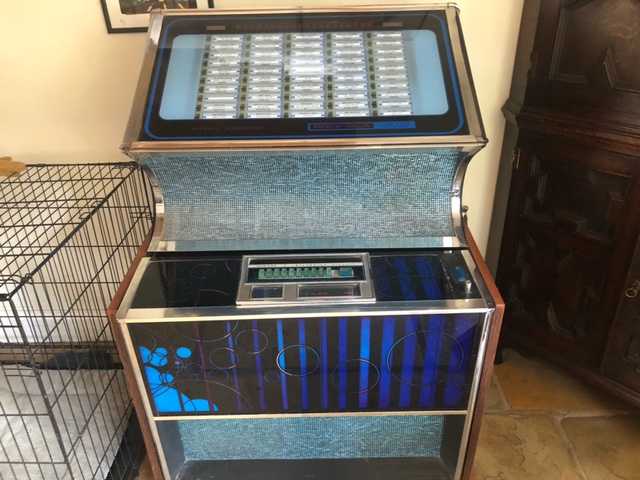
        Not often does your man from Just Backdated find himself spending a weekend in a private house equipped with a Rock-Ola juke box but that’s what happened last weekend when we stayed with our friends Adrian and Lynne at their home in a village a few minutes’ drive away from Bridport in Dorset.

        Adrian has owned the blue Rock-Ola 449 pictured above since the late seventies. Made in the US in 1972, it was shipped to Germany for use on an American army base before it found its way to the UK where Adrian paid about £250 for it from its previous owner. It’s set up to take 25 cent coins (American quarters) but like all juke boxes can be fixed to circumvent payment. 

        It contains 100 7-inch singles, two 12-inch speakers and is very loud. Indeed, the volume is difficult to control and even on the quietest setting booms out like sound systems at Notting Hill Carnival. Speaking of which, it comes as no surprise that almost all the singles on Adrian’s juke box are early reggae, not just Bob Marley, but less celebrated names too, as can be seen from the picture below.

        Perhaps more impressively, when it broke down about six months ago Adrian was told by the only juke-box repair man for miles around that it would be at least six months before a home visit to diagnose the problem could be arranged. So Adrian downloaded the manufacturer’s manual from the internet, took it apart and fixed it himself. Respect. Here are some pictures of the insides and scans of pages from the repair manual.


        While working on his machine, Adrian noted that missing from the manual was information about the device within that logs the number of plays for each record. This enabled its owner to report back to those who compiled record charts based on juke box popularity, which might be subject to fraud if tampered with. “They didn’t want anyone to know how it worked,” Adrian says. “You could fix the charts if you altered the readings.” 

The disc with the yellow ring records the number of plays. 

A bit of research on the internet tells me that the Rock-Ola Scale Company was founded in 1927 by David Cullen Rockola to manufacture all kinds of coin-operated entertainment machines. During the 1920s, Rockola was linked with Chicago organized crime – no doubt Mafia dudes offering ‘protection’ in return for the profits of coin-machines they supplied – but Mr Rockola escaped a jail sentence by turning State’s Evidence, which probably meant he watched his back for the rest of his life. 

           He added the hyphen because people often mispronounced his name – the long ‘o’ is important – and the name of his company was changed to Rock-Ola Manufacturing Corporation in 1932. From 1935, Rock-Ola sold more than 400,000 jukeboxes under the Rock-Ola brand name, some of which were shipped to the UK. One of them ended up at that coffee bar in Skipton, for which I gave thanks every day of my life. 


4.3.23

KAREN’S DILEMMA

To the Electric Theatre in Guildford to hear Lucy O’Brien talk about Karen Carpenter and listen to a trio – keyboard player and arranger Janette Mason, bassist Simon Little and singer Jo Harrop – perform their interpretations of Carpenters songs in a lounge bar style, a bit jazzy, a bit cocktails-at-six, a bit Hotel Ritz. 

        I reviewed Lead Sister, Lucy’s book about Karen Carpenter, on Just Backdated at the end of January* and in her talk she was keen to stress how, in her opinion, the female half of the Carpenters had more potential, and more imagination, than she was permitted to display. This came across more in her talk than it did in her book, and gave her address, which was punctuated by readings, more weight, and, for those who attended, something to think about on the way home. 

        Exhibit number one, of course, was the solo LP she recorded in 1979, produced by Phil Ramone, that A&M declined to release, ostensibly because it lacked a ‘hit song’. To add insult to injury, A&M charged the $400,000 recording costs to Karen’s royalty account.

        “Karen was deeply hurt at this complete rejection,” writes O’Brien. “She had made a female soul album, her first compelling statement as a solo artist. Listening to the record over forty years later, what comes through is Karen’s own fresh, funky aesthetic. She sings in a higher register than on the Carpenters albums, weaving throughout her own intricate vocal arrangements. Her approach is intimate, light and upbeat, a conscious departure from the low, lush overload of songs like ‘Solitaire’ or ‘This Masquerade’… This is an album of nimble, sophisticated soul; classy and smart like Teena Marie’s Lady T or Patrice Rushen’s Pizzazz.”

        The album, which was finally released in 1996, featured on its cover a photograph of Karen in black leather, a departure from the carefully constructed image of her as the girl next door. Reading between the lines, it seems that when Karen first delivered the LP she was a victim of the ‘don’t rock the boat’ syndrome that afflicted record companies in danger of losing an established cash cow. Paul Simon, of all people, suffered the same treatment after the demise of Simon & Garfunkel when Columbia was strangely lukewarm about his first solo LP. They’d have much preferred an S&G follow-up to the multi-million selling Bridge Over Troubled Water, of course. 

        Furthermore, O’Brien suggested that Karen was much happier as the drummer in the Carpenters’ band than being promoted to up-front singer. Cubby O’Brien, who became the Carpenters’ drummer when Karen was obliged to abandon them, recalls her missing the drums terribly. “She loved playing, she was one of the first female drummers who got recognition as a good player,” he says. There seems little doubt that Karen’s subsequent anorexia was in part brought on by the need to project a slimline image of herself in keeping with the general assumption that this was what audiences demanded of girl singers – but not necessarily girl drummers, not that there were many role models to follow in the 1970s. 

        Similarly, O’Brien pointed out that when Karen wasn’t being smothered by her brother, her family and those who sought to gain from the Carpenters’ success, she enjoyed behaving in a manner quite unlike the carefully cultivated, wholesome image foisted on the public. “She could talk like a truck driver,” O’Brien informed us, leaving our imagination to work out what she meant.

        As I mention in my review, in 1973 I interviewed the Carpenters at their home in Downey, south of Los Angeles, and Lucy O’Brien quotes me in her book. During a Q&A session that followed the music and talk last night I asked her what co-operation, if any, she had received from Richard Carpenter. Turns out he ignored her emails but didn’t seek to prevent others from speaking to her. “He’s very private,” she added before informing the assembled crowd of about 60 that the bloke in row H who asked the question had spent time with the Carpenter siblings. They all turned to look at me. After all, I was the only one present who’d met them, albeit 50 years ago this September. 

* https://justbackdated.blogspot.com/2023/01/lead-sister-story-of-karen-carpenter-by.html