Showing posts with label Led Zeppelin. Show all posts

10.9.26

SANDY DENNY - A People’s History by Georgia Rose Lucas


Georgia Rose Lucas, born in July 1977, this book’s author/ complier, is the daughter of Sandy Denny. Her father, Trevor Lucas, fearing that her mother’s lifestyle might in some way harm her, spirited Georgia away to Australia the following April and Sandy died following a fall later that same month, so Georgia barely knew her mother, only her music. It’s a profoundly sad story that has been told many times, and this book, the latest oral tribute to musicians and groups published by Spenwood, some reviewed elsewhere on my blog, tries its best not to retell it and, to a certain extent, succeeds. 

This People’s History, however, differs from the others in the series in that the contributors are largely fellow musicians and friends of the artist – Sandy in this case – with far fewer supplied by fans who witnessed performances as in others from Spenwood. As a result, it offers a much more in-depth portrait of its subject and, to my mind, would better have been titled An Oral History. Furthermore, the book is printed on art paper, heavy stock, that means the many illustrations – mainly photographs from the family archive but also scans from the music press, posters and flyers – are reproduced in fine definition. 

The contributors include Richard Thompson, who writes a foreword, his former wife Linda, and members of the Strawbs, Fairport Convention and Fotheringay, the writers Jerry Gilbert and Patrick Humphries, the photographers Ray Stevenson and Barrie Wentzell, and Georgia has researched the music press to extract quotes from musicians who have passed, among them Dave Swarbrick and Dave Cousins. 

All are insightful and many are poignant. That Sandy was much loved for all her insecurities and colourful ways is much evident. She was clumsy, forever tripping up, insecure and fond of a drink or three but stick her in front of a microphone, on stage or in the studio, capable of singing with amazing grace. “I’d say it was to fly above the music,” says Chris Blackwell, founder of Island Records. 

Though I met Sandy only twice, the first backstage at a disastrous rock festival near Halifax in 1970 when she was hanging out in Elton John’s caravan, I was even called upon to contribute to the book myself, an anecdote about the second occasion, the Melody Maker Poll Winners party at London’s Savoy Hotel later that same year. It doesn’t offer much in the way of analysing Sandy’s character but here it is anyway. 

They were a ‘hot little quartet’, according to Chris Welch who reported on the event in Melody Maker’s September 26 issue. He was referring to Sandy, Robert Plant, Jimmy Page and John Bonham, the former present to collect her award as Top female UK singer, the latter three as Top UK group, toppling The Beatles who had won that category for as long as anyone could remember.

“She is a small but heavily built young lady, with a noticeably large bosom and a face that defies any suggestion of showbiz glamour,” wrote Michael Watts in a profile of Sandy that appeared in the previous week’s MM, alongside the news that she had won the poll, beating last year’s winner, Christine Perfect, soon to be Christine McVie, into second place. “It’s a real honest-to-God English folksinger’s face; there is no trace of that saintly purity of feature that American girl singers, like Joan Baez and Judy Collins, always have. It belongs to the small, bare upstairs rooms of English pubs, where everyone is downing pints and the person in the seat at your elbow suddenly gets up and sings unaccompanied a 20-verse traditional. It’s a wholesome country barmaid’s face that makes you feel at home.

“She was pleased she had won the MM poll, but not in personal terms. She knows she is not the most conventional idea of a female singer, so she figures her success is a victory for music.”

Back in 1970 winning the MM poll was a bit like winning the Brits, so much so that national newspapers carried the results and the winning acts took the trouble to turn up to collect their awards, this year presented by Jimmy Savile. The three members of Led Zeppelin flew back from a US tour to attend – John Paul Jones was holidaying in Hawaii – and a host of others were on hand, whether they won anything or not, including Ian Anderson, Jack Bruce, Ginger Baker, Keith Emerson, Greg Lake, Carl Palmer, members of Free and Mungo Jerry and Top DJ John Peel. 

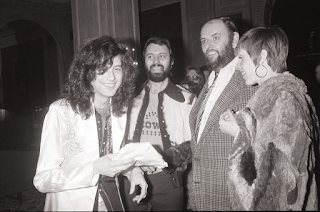
Sandy had her photograph taken with the members of Led Zeppelin by the Thames at the rear of the hotel and there’s a likelihood that it was here that she was invited to sing on ‘Battle Of Evermore’, the song on Led Zep’s untitled fourth LP that was released the following year. Although Sandy was on the cusp of leaving Fairport Convention to form Fotheringay with her partner Trevor Lucas, her old band’s bass player Dave Pegg was a lifelong friend of fellow-Midlanders Plant and Bonham, and the following month Page and Plant went to see Fotheringay supporting Elton John at the Albert Hall. Inclusion of the song on their next LP gave Sandy the singular distinction of being the only outside musician ever to be credited as having sang on a Led Zeppelin album. 

It also seems likely that in keeping with her reputation for enjoying herself at parties, she helped herself to a few glasses of complimentary wine. “Sandy Denny terrified Jiving K. Boots by attacking him in the lobby,” reported Chris Welch in reference to the fictitious rock star who made regular appearances in MM’s Raver gossip column. “She revealed she was upset because Boots had been graceless in his observance of proprieties,” he added mysteriously.


8.2.25

BECOMING LED ZEPPELIN

The promotional material for this film covering the first 14 months of Led Zeppelin’s stellar career suggests that their success was achieved “against all the odds” and that it is the “first officially sanctioned” film about the group. Neither statement is true. The second falsehood is easily rebutted by drawing attention to their 1976 movie The Song Remains The Same, their 2003 five-hour plus career retrospective 2-DVD package, and Celebration Day, the concert movie of their final appearance, when the reformed trio of Jimmy Page, Robert Plant and John Paul Jones performed with Jason Bonham, son of John, on drums, at London’s 02 in 2007. All three films were authorised by the group. The first falsehood is more nuanced but I would argue that the odds on achieving success were pretty short for a quartet that included two of the most experienced musicians on the 1960s London session circuit, one of whom had a keen eye for prevailing trends in rock music, and was managed by a Herculean, no-nonsense strongman who’d operated at the sharp end of the rock’n’roll trade for about seven years. 

        Quite why Page, Plant and Jones feel the need to tell these fibs is a bit of a mystery but mystery was always an essential commodity in Led Zeppelin’s bag of tricks. Let in too much light and you’re just another band, keep people guessing and you’re special, seems to have been mastermind Page’s mantra from day one; and, in his wisdom, which has never been in short supply, Page has prudently given the nod to a film that explains how they got where they did, but not what they did when they got there.  

        Becoming Led Zeppelin lets in a bit of that light in making clear that once the starting pistol sounded, Led Zeppelin set off at a furious pace, leaving little to chance. Realising at their first rehearsal in August 1968 that his group had something pretty special when they played together, and that this was their strongest card, Page established a rigorous work ethic from the outset and the others were happy to follow his lead. They made the road their home and recorded their first two LPs in the space of eight months, much of the second while on tour in America. Page and manager Peter Grant were quick to recognise that the kind of music they performed was more likely to find a receptive audience in America, which just happened to be where the biggest returns could be made, not that anyone mentions this.

        But before all this happens Becoming Led Zeppelin takes us back to the childhoods of the four boys. Baby boomers all, all bar Plant were raised in families that encouraged their musical ambitions and Jones’ family, the Baldwins, were professional musicians themselves. It was a black and white world but all the families were sufficiently affluent to own cameras and the kiddie pictures offer a sentimental touch not generally associated with Led Zeppelin; even the hardest of rockers were toddlers once. It would have been nice to include Grant, a virtual fifth member, in this anecdotal dip into the past but he’s ignored, as he is during almost all of what follows. 

        Next, we move on to influences, with each member allotted a few minutes to say how they were inspired by Lonnie Donegan (Page), Sonny Boy Williamson and Little Richard (Plant), bass players in general (Jones) and James Brown and Gene Krupa (Bonham). That old footage of 13-year-old Page skiffling away on a guitar twice his size on TV in 1957 is still presciently charming, and I enjoyed the footage of their heroes, so a nod here to whoever researched the old clips. 

        The preparatory years are also fun: Page and Jones as dapper young professionals on the studio circuit – they both played on Shirley Bassey’s 007 theme ‘Goldfinger’, arranged by Jones, amongst many other notable records – before the former is invited to join The Yardbirds and express himself at last; Plant in and out of various experimental outfits in the Midlands, one of which includes Bonham who is torn between drumming and the family building business. 

       When the four find one another they really were special. Much of the footage of early Led Zeppelin in the film has been seen before but there’s some new stuff and even familiar material has been enhanced. Here we have Page, his long black hair obscuring his features, conjuring up shards of jagged chords on the rather shabby looking, custom-painted Telecaster gifted to him by his pal Jeff Beck; a maestro on lightning fast solos, slides and the scraping of the violin. We see Jones running on the spot as he feverishly plucks the strings of the Fender Jazz Bass he used for years, its long neck swaying dangerously close to Plant on stages much smaller than those we grew accustomed to seeing Zep play on later in their career. The young Plant, at 20, is much thinner than he is today, a shaman in the making, trading vocal shrieks with Page’s bent notes, his curly hair bouncing, forever on the move. And at the back there’s Bonham, tumbling into his drums, grinning as he maintains a steady rhythm with Jones yet always looking to accentuate whatever Page is playing or Plant singing with a roll or a crash or an explosion everywhere. “I fell in love with his right foot,” says Jones at one point. 

        Led Zeppelin were truly fantastic, full of energy, in the early days but the suggestion that they toured America before the UK because they were ignored at home is open to question. The press in the UK didn’t ignore them – the earliest ever feature appeared in Melody Maker, written by Chris Welch after Page visited the office without prior warning, and I even wrote about them in the Bradford Telegraph & Argus before I joined MM. They chose to tour the US first simply because Page and Grant saw greater opportunities there and it was therefore advantageous to do so. Rolling Stone in the US may have been dismissive but that was really an exception. By and large, they were loved wherever they went, as the rapturous fans in their audiences – many of them female – seen in the film testify. 

        The present day interviews are candid and occasionally revealing with screen time shared impartially. His silver hair held back in a ponytail, Page looks dignified and, as ever, is the most enthused, contented and diplomatic, his pride in Led Zeppelin undimmed. Jones, traditionally the most reticent member of the group, looks the youngest, his hair trim, his features eager. He has plenty to say, which is refreshing, and he comes across as very likeable, modest too, almost as if 12 years in Led Zeppelin was just another session date in his work diary. “Led Zeppelin? A silly name,” he says. “But we were stuck with it.” Plant, craggy, his golden hair turned to bronze and tumbling everywhere, is the most droll, the slight grin and twinkle in his eye suggesting there may have been times when he’s looked upon Led Zeppelin as a youthful folly. “My family wanted me to be a chartered accountant,” he says, tongue firmly in cheek. Of his first plane flight to the US he expresses astonishment at being served a meal on a plate with real cutlery that in different circumstances he might consider stealing. Bonham is represented by a hitherto unheard interview he did around 1970 that acts as a voice over, and he too seems to be in a state of perpetual wonder at all that happened to Led Zeppelin in such a short space of time. His wife Pat warned him on more than one occasion not to get mixed up with “that Planty”. 

        The emphasis, though, is on the music, and Becoming Led Zeppelin features heaps of terrific footage from America and the UK, some hitherto unseen, at last by me, though at just over two hours, it is pretty long and could have been trimmed, especially during the final half hour. If its intention is to find new fans in the 21st Century, it’ll probably succeed, especially as it stops long before Led Zeppelin reached their apogee two or three years later and dutifully ignores the stairway to indulgence and subsequent mischief that led indirectly to their demise. 


1.10.22

LED ZEPPELIN FILM FROM BATH 1970

In terms of Holy Grail importance it ranks below footage from their first Scandinavian tour in 1968 or that final show in Berlin 12 years later, but film of Led Zeppelin’s renowned performance at the Bath Festival on the evening of Sunday, June 28, 1970, synced with sound for the first time, was briefly available last week for all to see on YouTube.  

        Not even walking Led Zeppelin encyclopaedia Dave Lewis can explain why it appeared on Thursday night of last week, only to be taken down 24 hours later. “Fans were awestruck across the globe,” says Dave, never one to play down a story about the group that has defined his life since he first heard them in 1969. “To see vivid moving colour images of this legendary Zep appearance was truly astonishing.”

        Dave let me know about this discovery late on Thursday night, drawing my attention to it with a link to the video that revealed John Paul Jones to be wearing white trousers with zoo animals printed on them. I didn’t notice this from the press pit where that day I observed Led Zep in action for the first time ever, headlining the first big rock festival I covered for Melody Maker

        The clip, which lasted about 10 minutes, featured snippets of ‘Immigrant Song’, ‘Dazed And Confused’, ‘Bring It On Home’ and ‘Thank You’, which had evidently been synchronised, probably by a fan, with a bootleg tape. To state that the group was on fire is no exaggeration, for this was the first huge gig they’d played in the UK and all four doubtless knew how crucial it was to make as good an impression at home as they had been doing in America over the past 18 months. 

        I remember it well, and have written about their set elsewhere on Just Backdated. Led Zeppelin simply exploded on that stage, blowing away all the other acts, and not just because they seemed one hell of a lot louder than everyone else. Hyper confident, they announced their arrival by playing ‘Immigrant Song’ – which I inadvertently called ‘Immigration Song’ in my review – which was yet to be released, its staccato riff reverberating over a crowd believed to be in the region of 150,000. Two and half hours later, pumped up to the eyeballs, they left the stage after a slew of encores that included seat-of-the-pants improvisations of many of their favourite rock’n’roll songs from the fifties.

        John Bonham, slimmer and probably fitter than he was in later years, is inexhaustible. Robert Plant dances around as if he’s barefoot on a hotplate, and even Jones, steady as ever on his Jazz Bass, moves about much more than he would later. Dressed in his yokel outfit, Jimmy Page is the least visible, somehow avoiding the cameras as he switches from hard chord grunge to delicate passages on his Les Paul guitar. 

        On a separate clip there are scenes of the group wandering around amidst the cars and caravans in the backstage area. Page is seen with girlfriend Charlotte Martin, and John Paul Jones escorts his friend Julie Felix. Donovan, LZ manager Peter Grant, tour manager Richard Cole and soundman Clive Coulson are also briefly seen. On that Sunday afternoon 52 years ago backstage at Bath was unquestionably the coolest place on earth, and I was there too, albeit not, alas, caught on camera. 

        The stage footage is over with pretty quick, and when I tried to access it again the following day was greeted with the message, “This video is no longer available due to a copyright claim by Kinolibrary”, which the internet tells me is an ‘independent agency representing remarkable and rare archive footage from around the world’.

        “This YouTube footage has been made available by the Kinolibrary film archive company,” says Dave Lewis. “By presenting silent footage they will have avoided any copyright issues with the music of Led Zeppelin which is owned by Warners. The synced footage matched to the clip independently might have a problem with this.”

        Dave confirms that the film was made by the late Peter Whitehead – famous for his films of The Rolling Stones and Pink Floyd and the January 9, 1970, Led Zeppelin concert at the Royal Albert Hall. Dave was present in May 2017 at a screening of the Albert Hall footage and observed bits of Led Zep memorabilia on display. Part of that was a vintage film label marked Led Zeppelin at Bath,” he recalls. “I was aware that Peter Whitehead had shot film of the band at the Bath Festival in 1970 and here was tangible evidence.”

Dave Lewis sent me this pic from Bath 
in which a cameraman can clearly be seen behind Robert Plant

        Present at this event was Steve Chibnall, Professor of British Cinema and Director of Cinema and Television History Research Centre at Leicester University, who revealed he had viewed the 20 to 30-minute silent colour footage. He hoped one day it could be restored and see the light of day. He told Dave: “The problem, according to Peter Whitehead, was he was stuck in traffic and had trouble getting to Bath so he arrived late. He was supposed to film the band arriving by helicopter and he missed that.

        “And then when Led Zeppelin played, they played in the dark and there was insufficient stage lighting for his cameras. He reckoned that the footage, the live footage, was not usable … [but]… it can be restored now. 

        “It looks beautiful to me and I think it was recorded. The band probably have a recording of it. Peter was supposed to do interviews with the band members as well, but I don’t think that ever happened. But certainly, there is 20 or 30 minutes of footage from Bath.”

        Although the synced footage has been withdrawn, three silent colour clips of Zep at Bath in 1970, shot in 16mm, and two backstage/audience clips, can be readily viewed now via the Kinolibary YouTube channel. “Watch them and be amazed,” adds Dave. 

(The picture at the top of this post is the cover of a bootleg CD 
of Led Zeps Bath set I found on the internet.)

26.1.22

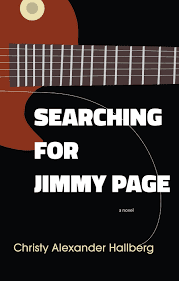
SEARCHING FOR JIMMY PAGE, a novel by Christy Alexander Hallberg


From the mid-sixties onwards, British groups touring America welcomed the attentions of free-spirited girls who hopped into their beds to ease the strain of being far from home in a foreign land. It was, I suppose, one of the perks of the job and it’s surely not unreasonable to suppose that during the early years of this touring era, when reliable birth control was not readily accessible to single women, such liaisons resulted in a few births to mothers who opted to keep the identity of the father to themselves. 

This is the premise on which Christy Hallberg has created her book, a coming-of-age tale about a go-getting girl from a redneck background in North Carolina called Luna. Just before she died, gratuitously violently by her own hand, Luna’s mother Claudia gave her daughter ambiguous reason to believe that her father might be Jimmy Page, a suggestion given credence by Claudia’s fondness for Led Zeppelin’s music and a photograph of Page, all in white with raven-black curls, she hung over her bed. This happened when Luna was quite young and now, having turned 18, she resolves to embark on a quest to discover the truth behind her mother’s claim, a voyage of discovery that takes her from the far-from-idyllic American home she shares with her grandparents to London, where she seeks out the former Zep guitarist – but I’ll stop there so as not to spoil the ending for anyone who might care to read the book for themselves. 

It’s very melodramatic, a rather spooky tale which, like the aura surrounding Led Zeppelin and their music, strays into areas of mysticism, tarot cards and scary things that happen at night beneath a full moon, with screeching owls and old men who stoop like the wood-gathering hermit on the cover of Led Zeppelin IV. The name Luna, of course, is a bit of a give-away. 

As you would expect, the story is liberally seasoned with references to Led Zep, carefully researched biographical details, song titles for its four parts, plus a Coda, but no lyrics, of course, lest copyrights are infringed, a bit of a sensitive issue these days what with that business over the origin of the descending arpeggios that introduce ‘Stairway To Heaven’. 

        Set in 1988, the book follows Luna from America to the UK where the story picks up pace and becomes more engrossing. She visits Page’s homes in London, hanging around outside Tower House in Holland Park, and also Windsor, where she glimpses Page’s then pregnant wife Patricia. She even takes trips to Rushock, where she nicks whiskey bottles from John Bonhams grave, and to Headley Grange, the former workhouse in Hampshire where much of Led Zeppelin IV was written and recorded. Now a private home, she is invited inside by its owner, ‘A distinguished-looking gentleman with sprigs of grey hair around his temples… a tall, reedy man, tidy and austere, his navy cardigan buttoned to the neck, his khaki trousers smartly pressed. “You’ve come to see the stairway, haven’t you?” he asked.’

         Impressed by the detail and accurate Zep research, I felt these were the book’s strongest scenes. 

        ‘Four Sticks’, the song about owls crying in the night, is a recurring theme, along with Luna’s aspirations to become a writer, all of which suggests an element of autobiography, it being assumed that the author is a die-hard Zep fan who in researching her book has visited the locations mentioned in her story. 

It’s an intriguing scenario with intriguing characters, stylishly written. Luna’s a bit of a misfit, bullied by more conservative peers, her only friend a coloured girl called Connie, and her need to exist outside of conventional society is reflected in the Mohican hairstyle she adopts for the trip. She’s also a bit careless, which leads her into financial difficulties, but she’s rescued by a bisexual London boy who works at the hotel in which she stays and becomes her friend and guide.

Searching For Jimmy Page is not fan fiction per se – Page himself appears only briefly and doesn’t speak – and the book pays no homage to anything previously published. Instead, it uses the mythology of Led Zeppelin as the landscape for a novel about one woman’s need to discover the truth about who she is and where she came from, a not uncommon scenario in literature old and new. Not overly long, it is slightly let down by substandard production, probably for reasons of economy, but Zep fans will love it. 


9.12.21

RICHARD COLE

Richard is seen here between Jimmy Page and Peter Grant, in a picture taken by Bob Gruen on February 3, 1975, at a post-concert party held by Atlantic Records at the Penn Plaza Club in 
New York’s Madison Square Garden. 
Your man from Just Backdated, wearing shades, can be seen in the background 
above Richard’s left shoulder.

Richard Cole, who has died aged 75, was the fearsome and once much feared tour manager for Led Zeppelin for almost all of their career. As second in command under the group’s equally formidable manager Peter Grant, Richard – known to his many friends as Ricardo – was not only responsible for the day-to-day business of ensuring their many tours ran smoothly but also for keeping the quartet amused during the long periods of boredom that occur while travelling. In this latter capacity he was celebrated as a weapons-grade hell raiser, the instigator of much of the hedonistic excess for which the group became notorious. 

        Such indulgences led to Richard becoming an alcoholic and heroin addict but, in a remarkable turnaround, he rehabilitated himself completely in the 1990s, and for the remainder of his life became a model of sobriety, the most affable of men, taking afternoon tea with old comrades, swimming regularly and attending AA meetings. Among his passions was buying flowers and his regular companion was a fluffy grey and white cat he named Puss Puss. 

        Richard was an old friend and in recent years we communicated regularly via Facebook. While in years gone by he was an occasional foe, we long ago buried any hatchets that may have been raised over his antipathy towards the music press. I first met him while covering Led Zeppelin concerts for Melody Maker in the early 1970s but he was a bit suspicious of journalists in those days, as were the group, all bar Robert Plant, after Rolling Stone in America was stubbornly critical of their music. I, in turn, was a bit wary of Richard. 

        Once, in 1976, he tried to put the make on my female dining companion at Ashley’s bar and restaurant in New York, and when I remonstrated he swung a punch at me that missed, and in the melee that followed he was forcibly ejected from the premises. Robert Plant, hovering nearby, apologised profusely on behalf of his employee, explaining that Ricardo had taken rather too much refreshment on a flight from London earlier that day. Evidently the Kojak actor Telly Savalas, a fellow passenger in the first-class cabin, had also endured a bit of ill-treatment from Richard over the Atlantic. All this was long forgotten in later years when Richard approached me to publish a memoir of his time working for The Who and others besides Zep but I declined because I felt it was insufficient to fill an entire book. He didn’t seem to mind. 

        Born in 1946 in Kensal Rise in north London, Richard left school at 15. His first job was welding handles to milk churns at a dairy, for which he was paid £3 12s a week. He later worked at a motor scooter repair shop, delivered crates around London for a food wholesaler and became a scaffolder on building sites which toughened him up no end. His entry into the music business came one night in 1965 when he offered to help the group Ronnie Jones & The Nightimers with moving their equipment, and this led to similar employment with Unit 4+2, The New Vaudeville Band, who were managed by Grant, and The Who, in the latter case as driver for Keith Moon and John Entwistle until his driving licence was revoked for speeding.

        When Jimmy Page assembled Led Zeppelin in 1968, Grant became their manager and recruited Richard for the arduous job of running their tours, marshalling the road crew and acting as a sort of concierge-cum-security-guard for the musicians. “When I went for the job interview I was not asked to sit so I stood in front of Peter to wait for his questions,” Richard wrote in that unpublished memoir. “He looked me up and down and came straight to the point. ‘How much do you want?’ ‘Thirty pounds, take it or leave it.’ Peter was taken aback by my answer. He later told me that anyone who spoke to him like that was not going to have a problem getting a band’s money from dodgy promoters.”

        The 11 years that Richard spent working for Led Zeppelin brought him considerable notoriety in the world of rock music. Peter Grant had learned his trade when the rock’n’roll business was run by spivs and strong-arm merchants who grabbed the cash and ran. Grant, however, saw a more profitable future in treating his management clients honestly while strong-arming everyone else. Taking his cue from his mentor, Richard was never shy about physically confronting anyone who sought to profit at Led Zeppelin’s expense or otherwise break their stride. A former Mod, he took pride in his appearance and was among the first in his line of work to adopt a trim hairstyle at a time when everyone else wore it past their shoulders. The suit and tie he occasionally wore, along with a ring in his ear, only added to his air of menace. 

        As Led Zeppelin rose to become the highest earning rock band in the world, Richard brought to the party a cornucopia of earthly delights, teenage groupies, class A drugs and an attitude of invincibility that, eventually, became their Achilles heel. The most infamous incident under his watch occurred at the Edgewater Inn in Seattle in July 1969, when an American groupie stripped and allowed herself to be pleasured with a fish, a now legendary episode in rock folklore. As the 1970s progressed and Led Zeppelin’s popularity mushroomed, everyone in the group’s inner circle apart from Richard became immensely wealthy, a factor that no doubt led him to become involved with, and benefit from, two salacious books published after the group broke up in 1980 following the death of drummer John Bonham. 

        Included among the stories would have been the time he rode a motorcycle along the corridors of the Continental Hyatt House hotel – the “Riot House” – in Hollywood. In 1969 he commissioned a lady of the night, armed with whips and a pair of handcuffs, to pay a surprise visit to the New York hotel room of an MM colleague, informing her that the more he resisted the more he would enjoy her services. It took a great deal of effort on his part to finally eject her. Some of his escapades, however, got out of hand. 

        On July 23, 1977, Richard, along with Grant, Bonham and renowned London tough guy John Bindon, unwisely recruited as extra security, were involved in a violent altercation backstage at the Oakland Coliseum in California. A member of promoter Bill Graham’s crew was seriously injured in an unprovoked attack and for a while it looked like all four might end up in jail. The upshot was that Led Zeppelin never toured America again. Richard was still working for the group when they performed before 200,000 or more at Knebworth two years later but by their final tour of Europe in 1980 he’d been relieved of his duties over his unreliability, this in part due to his various addictions. At the time he was languishing in an Italian prison on charges of terrorism, later dismissed. 

        After Led Zeppelin’s demise he worked for Lita Ford, Ozzy Osbourne, Black Uhuru, Fem 2 Fem, Three Dog Night, The Gypsy Kings, Fu Machu and The Quireboys, splitting his time between London and Los Angeles where he lived in Little Venice. He retired in 2003 and thereafter lived quietly in a small flat in London’s Notting Hill Gate, having weaned himself off drugs and alcohol through Alcoholics Anonymous. Now completely reformed, his hair turned white and his preferred dress was a blue blazer with brass buttons over a collar and tie. Occasionally he visited the French Riviera, tanning himself beside the Mediterranean and looking extremely toned for his age. He reminded me of a retired army colonel, the sort of genial old buffer who might be found propping up the bar at a provincial golf club sipping gin and tonic. He was a revered figure in Led Zeppelin fan circles, happy to reminisce when friends came calling.  

        In the meantime, however, Richard had co-operated with Stephen Davis on the controversial 1985 Led Zeppelin biography Hammer Of The Gods, the first book that made public the hedonistic lifestyle they enjoyed in their pomp. Relations between Richard and his former employers suffered as a result, and weren’t helped when he cowrote (with US journalist Richard Trubo) his own tell-all memoir, Stairway To Heaven: Led Zeppelin Uncensored, published in 1992. Jimmy Page later said he felt “completely ill” when he was shown extracts. Nevertheless, while no one from the Zeppelin camp has ever sued publishers over any scurrilous books about the group, the thought remains that had they been a bit more generous towards Richard over the years such books might never have been published in the first place. It’s not as if they’re short of a few bob. 

        Time healed the wounds, however, and both Page and Plant resumed cordial relations with Richard over the last two decades, welcoming him as a guest at the group’s 2007 Reunion Concert at the O2 in London. Both musicians are reported to have visited Richard at his home during the illness that eventually claimed him, and after his passing both paid tribute and expressed their condolences through social media. 

        Richard died from cancer and is survived by his daughter Claire.

        Richard Cole, tour manager; born 2 January 1946; died 2 December 2021.


23.11.21

RAISE THE ROOF – Robert Plant and Alison Krauss


On their long-awaited new album Raise The Roof, Robert Plant and Alison Krauss cover ‘Go Your Way’, written by Anne Briggs around 1962. In the unlikely event that Briggs, the mythical goddess of British folk music now residing on a remote Scottish island, gets to hear it I hope she’s delighted with the reverence that Plant, who takes the lead and is joined by Krauss only on the chorus, brings to her lovely song.

        Its presence on the new record serves to underline the sincerity of reformed scallywag Plant’s ongoing research into roots music, but this is not the first time that the paths of Briggs and Led Zeppelin have crossed. On the group’s first album the track ‘Black Mountain Side’, credited to Jimmy Page, is in reality a variation on ‘Blackwater Side’, a traditional song much loved by Bert Jansch that Briggs performed in folk clubs where Page evidently heard it for the first time. 

        Anne Briggs is one of those rather mysterious musicians from an earlier age whose influence casts a long shadow. She was idolised by Sandy Denny and Richard Thompson wrote ‘Beeswing’ about her. I own just one Briggs CD, a compilation simply called A Collection, which includes both ‘Go Your Way’ and ‘Black Waterside’, with excellent sleeve notes by Colin Harper, to the best of my knowledge the only music writer to have tracked down Briggs to her Scottish lair and written extensively about her. 

        Many of the 22 songs on this CD are sung unaccompanied, which is how Briggs preferred, though before she turned her back on a modern world she didn’t much like she was persuaded, perhaps against her instincts, to record with accompaniment, doubtless encouraged by those who might benefit from an upturn in her lowly commercial standing. Both ‘Go Your Way’ and ‘Black Waterside’ on my CD are accompanied by a finger-picked guitar, and on YouTube there’s a clip of her and Jansch performing ‘Go Your Way’ that was filmed for a TV show called Acoustic Roots, with both picking acoustic guitars while Briggs sings. Endearingly, she messes up her guitar part towards the conclusion of the first take. “Bollocks,” she says, grinning. “I lost it at the end. What happened?” And then they begin again. I like to think that, like me, Plant and Krauss have watched this clip a few times. In fact, the duo raided Jansch’s songbook for a second track on their new album, ‘It Don’t Bother Me’, Krauss leading a more rhythmic treatment than Jansch’s characteristic traditional reading, their arrangement gaining in intensity as it proceeds, its extended coda a delight. 

        The edition of Raise The Roof that I bought from the iTunes store last week has a generous 14 tracks, mostly intriguing, carefully chosen covers given a soft, sultry, bewitching energy, not all that removed in style from the music on Raising Sand, their 2007 Grammy winner. Plant’s voice had grown huskier over the years, his strident shriek of yore replaced by something far more mature and thoughtful. Krauss sings like an angel, of course. All of which seems to make the new record even more enjoyable than its predecessor, more soulful, more satisfying. 

        A better-known cover than ‘Go Your Way’ is ‘The Price Of Love’, written and recorded by Don and Phil Everly, their last big hit in 1965, also recorded by Bryan Ferry and, rather more boisterously, by Status Quo. Krauss takes the lead here, singing softly over a slightly eerie backdrop, a resonant electric guitar chord ringing in the distance, a deep bass drum holding down the slow tempo, with Plant echoing her vocals on the choruses, and in many ways this exemplifies the muted tone of the record as a whole. The first track ‘Quattro (World Steps In)’ opens with an insistently strummed mandolin, not unlike the kind of accompaniment that John Paul Jones provided for Zep when he put down his bass. They sing together on this song instead of alternating vocal chores, the exception rather than the rule. 

        There’s the now almost obligatory discordant sound of the desert in ‘You Led Me To The Wrong’, with a wailing violin adding a dollop of angst to a tale of sorrow, a song that Plant sings alone. It is followed by the bluesy ‘Last Kind Words Blues’, a deft bit of sequencing, which reminded me of something John Fahey might have resurrected. The production throughout is crisp and clear, the mood dark, the spectre of world music hanging over every track. ‘Searching For My Love’ is warm but broody, ‘High And Lonesome’ a touch western in the High Noon sense of cowboys galloping across the plains, and ‘Going Where The Lonely Go’ a truly delightful showcase for Krauss, melody and emotion in perfect sync.  

        There are two bonus tracks on the edition of the CD I bought, the first a lilting cover of Hank Williams’ ‘My Heart Would Know’, with steel guitar straight out of Nashville via Hawaii, and the second, Lucinda Williams’ ‘You Can’t Rule Me’, features a guitar part not unlike the instrumental ‘Moby Dick’, John Bonham’s drum showcase on Led Zeppelin II. Its octave leap always reminded of Bobby Parker’s ‘Watch Your Step’, first pilfered by John Lennon for ‘I Feel Fine’. 

        For all their swagger there was always a great deal more depth to Led Zeppelin than most of those who followed in their turbocharged wake and Plant’s varied solo career serves to emphasise this with every new record he puts out, whether on his own or with others. It even seems to me that, like Gram Parsons, about whom I wrote last week, with Alison Krauss Robert Plant has finally found his Emmylou.


4.11.21

LED ZEPPELIN: THE BIOGRAPHY by Bob Spitz


It’s a tug-of-war as mighty as Led Zeppelin itself. On one side we have Jimmy Page, Robert Plant and John Paul Jones all steadfastly maintaining a discreet reticence about Led Zeppelin’s extra-curricular activities and on the other we have authors continually writing books that do the precise opposite, sparing no one’s blushes in reiterating “infamous stories from the road, tales of excess, dominance and ego” in the words of uber-fan Ann Wilson, of Heart, on this latest Led Zep book’s back cover. “This is a story of poetry and power, rape and pillage, of rock’n’roll incarnate,” she adds, failing immeasurably in the discreet reticence department.

        The levee broke with the 1985 publication of Hammer Of The Gods by Stephen Davis, which to a great extent relied on the testimony of Richard Cole, the group’s buccaneering tour manager. Cole himself followed seven years later with the ghost-written Stairway To Heaven, which put him in the doghouse with the surviving members of the group, albeit temporarily. Betwixt and between came several more benign books, but the cat was set among the pigeons again in 2012 by Barney Hoskyns’ fascinating oral history Trampled Underfoot in which contributors, including this writer, didn’t hold back in the ‘infamy’ department. Since then we’ve had Chris Salewicz’s candid Jimmy Page biography and Mark Blake’s revealing but sincere Bring It On Home, a book about manager Peter Grant, neither of which held back on the juicy bits. Now, topping them all, we have this 674-page monster by the American writer Bob Spitz who lists over 50 interviewees, burrows down like a mole on small details and incidents, and leaves no stone unturned when it comes to those episodes in the Led Zeppelin story that Ann Wilson relishes so much. 

        Meanwhile, the surviving members of the group, especially Page and Jones, brush it all aside in much the same way as Randy Andy describes the activities of Jeffrey Epstein, implying without stating specifically that such talk is ‘unseemly’ when applied to gentlemen of their age and esteem. Plant, however, occasionally lets his guard down with a twinkle in his eye that suggests some unspecified misbehaviour may have occurred all those years ago. Nevertheless, the tug of war continues.

        But back to the book. Those 50-odd interviewees Bob Spitz acknowledges don’t include myself but I should make it clear at this point that he recorded my thoughts on LZ during a most enjoyable lunch we had in Soho three years ago, and with my permission included some of the observations and stories that can be found under Led Zep on this blog. Furthermore, Bob showed me his manuscript earlier this year and as well as pointing out certain factual errors I suggested some clarification pertaining to UK rock history. I was not privy to the two 16-page photo sections where, to my distress, I found a few more errors in the pre-publication edition that arrived on my doormat earlier this week, most of them pertaining to dates, which I hope will be corrected in future printings. Similarly, he hasn’t adopted all my recommendations to improve the book, nor would I expect him to. 

        But this is small beer compared to the vast scope of his enterprise. Grandly subtitled The Biography, it more than lives up to its name, and not just because it’s longer, more detailed and more revealing than any of the other Zeppelin books on my shelves. Bob Spitz is a fine researcher, a knowledgeable, experienced music critic and an astute storyteller, which makes the book appear shorter than it is because you keep wanting to turn the page to find out what happens next, even though the story he’s retelling is hardly new. The story in question, of course, is a classic rise and fall, a novelist’s dream that just happens to be true, and no rock band – not even The Beatles, who took far longer – rose to such heights so quickly as Zep nor fell from grace so tragically, suddenly or in such discomfiting circumstances, and the fact that they have since been redeemed, musically at any rate, does not alter this. 

        The tale is told well. It lasts 11 years and 11 months, from August 12, 1968, the date posited for their first rehearsal in London, to July 7, 1980, when they played their last show in Berlin; 4,347 days of music and mayhem, reckless ambition, seat-of-the-pants evolution and Icarus-like collapse, an epic saga of highs and lows scarcely credible in today’s anaesthetised rock climate. 

        As you would expect, five of the 22 chapters up to this point detail the lives of Page, Plant, Jones, John Bonham and Grant prior to Led Zep, with more on Page than the others combined, though it’s pleasing to note that throughout the book Jones, their secret weapon, is afforded a bigger slice of the pie than in any other Zep book I’ve read. The 20-page final chapter offers a fairly brief resume of Zeppelin-related matters, including Bonham’s death, that follow that final gig, all the way up to the 2007 O2 Arena show honouring Atlantic Records’ boss Ahmet Ertegun. No space is given over to their solo careers, the assumption being that Spitz regards them as nickel and dime compared to what went before. 

        Furthermore, unless I’m mistaken, this is the first Led Zeppelin biography to include copious notes, 62 pages in all, detailing the sources of all the quotes in the book, be they from the author's own interviews or lifted from magazines and other LZ titles. In this regard, unlike the vast majority of books in the rock canon, the book vies for scholastic recognition. 

        It goes without saying that Messrs Page, Plant and Jones have not contributed. Still, many of those around them, roadies, employees of Grant, Atlantic and Swan Song, music industry pundits, friends old and new (male and female), photographers, journalists and assorted observers including the odd rock star, have offered their stories and opinions. As a result, Bob Spitz has produced a doorstopper. Finally, I should add that it contains many anecdotes with which I was unfamiliar, at least until I saw the manuscript earlier this year, but, taking a leaf out of their book, like Page, Plant and Jones, I shall maintain a discreet reticence, so you’ll need to buy it to discover them for yourself.


20.8.21

EVENINGS WITH LED ZEPPELIN – A SLIGHT RETURN


Two Robert Plants sit on the coffee table in our front room right now. One of them stands next to Alison Krauss on the cover of this month’s Mojo magazine, inside of which the grizzled old rock veteran and his toothsome singing partner talk about their new album, Raise The Roof, out in November, a long-awaited follow up to their 2007 Grammy-winning collaboration Rising Sand. If the lead single, ‘Can’t Let Go’, is anything to go by, it’ll be another winner. 
The other Plant features on the cover of a new edition of Evenings With Led Zeppelin: The Complete Concert Chronicle by Dave Lewis and Mike Tremaglio. You can’t see his face as it’s obscured by his long, windswept hair, a thatch so plentiful it resembles the coat of a Cocker Spaniel, but in mid-flight with Led Zeppelin in 1969 Robert Plant was a wild, windswept creature on the cusp of a long and for the most part glorious musical career. 
        It’s nowadays quite possible that out there in this 21st Century there are Plant fans who are unaware of his illustrious past. In which case I would draw their attention to this book, the definitive account of Led Zeppelin’s life as a concert attraction, opening on September 7, 1968, and closing on July 7, 1980. As if 576 pages wasn’t enough, my friends Dave and Mike have now added a further 48. It now weighs in at 2.2kg, almost 5lbs, which is about half the weight of a Gibson Les Paul, so the combined weight of both editions gives you some idea of the mass that Jimmy Page, never the most robust specimen, was carrying on his shoulders during most of the 516 shows chronicled in the book. No wonder he’s complained of back problems. 
        Dave and Mike’s book now has over 300,000 words and 3,100 images, some 55 concert entries have been expanded with additional info culled from newly-discovered bootleg recordings, press reviews and adverts, and a 10-page bootleg discography that details almost 1,900 boots from 288 concerts that were clandestinely recorded, mostly by fans, with multiple titles from many shows. This statistic clearly indicates that LZ were among the most bootlegged acts ever, perhaps even the most, and there is a degree of irony here insofar as their manager, the cunning but ruthless Peter Grant, took every step he could to prevent Led Zeppelin from being pirated. That he so manifestly failed in this endeavour is a blessing in disguise for fans as years later the many bootlegs offer a valuable historical record that Page, for one, greatly appreciates. 
        I have an interest in this book. I edited the first edition and noted on this blog some of my own contributions, culled from the pages of Melody Maker. One I didn’t mention was the weekend I spent with Led Zep in Montreux, October 28 and 29, 1972, when I stayed with them and their entourage at the Palace Hotel and saw two shows at the Montreux Pavillon. A couple of weeks later I experienced their wrath by writing something that in their opinion was mildly uncomplimentary. Here’s what it says in the book:
        In the following week’s Melody Maker (November 11, 1972), Chris Charlesworth conducted an interview with Robert Plant in a feature called “Plant Life”. 
        In the interview, Charlesworth discussed the band performing outside of England: “Countries seem to put up no barriers to Zeppelin, who can consider themselves the unheralded ambassadors of British heavy rock. Unheralded because few reports of the group’s foreign activities seem to reach home, and ambassadors because few bands will clock up as many miles in a year as Led Zeppelin. To this end, England has been ignored this year by the group and their popularity has undoubtedly waned.”
        The band took great exception to this comment and used it as a sort of rallying cry. Perhaps feeling stung by the press criticism of the past, and having their wildly successful US tours overlooked back home, they reacted with a dig in the following week’s Melody Maker (November 18, 1972). The issue contained a huge tour ad listing the scheduled 24-date UK tour with the words “SOLD OUT” prominently displayed with the comment: “and their popularity has undoubtedly waned, Chris Charlesworth, Melody Maker, Last Week.” Even Robert Plant had a go at Charlesworth when introducing ‘Stairway To Heaven’ in Glasgow on December 4, 1972: “There was a guy who ah, worked for the Melody Maker, Chris Charlesworth, and he said our popularity has obviously waned... Thank you very much. Here’s a song that we wrote in a period of ah, everybody decided we were doing nothing, ‘Stairway To Heaven’.”
        It’s ironic that just two weeks earlier, Charlesworth had penned one of the most complimentary and enthusiastic concert reviews of the band’s entire career, and yet was being called to task for his comment. Perhaps the band’s press sensitivity had conveniently allowed them to overlook another comment from Charlesworth in the first Montreux report: “Led Zeppelin are alive and well and as good as ever. And if that crown they once wore has tarnished slightly, they will soon re-gain all their glory. They are, without a shadow of a doubt, Britain's greatest heavy rock act.”
I can report that any ill-feeling was soon forgotten, and I was welcomed to subsequent shows in America where I was stationed for the next three years as MM’s US Editor. Oddly, my coverage of the start of their 1975 US tour, in Chicago on January 20-22, isn’t included, and I take issue with the book’s handling of the sequence of concerts that followed, as can be seen from my retrospective recollections of that encounter, here: http://justbackdated.blogspot.com/2014/02/led-zeppelin-1975-part-1.html. Pedantic point that it is – and Dave Lewis and I have exchanged words about this before – it seems I am the only person in the world that believes Zep, minus bedridden Robert Plant, flew from Chicago to LA where they (and I) relaxed for 48 hours while Plant recuperated, then we all flew back across the country to Greensboro for a sub-par show on January 29. Either my memory is playing tricks with me, or the records books have been changed for reasons unexplained. 
Still, this is a minor quibble. As I wrote when I first reviewed this book on my blog in 2018, Evenings With Led Zeppelin: The Complete Concert Chronicle is not only far and away the most ambitious reference book on Led Zeppelin ever published but also one of the most entertaining; now new and improved, like detergents used to be in TV adverts, and like Robert Plant when he collaborates with Alison Krauss. 

22.7.19

LED ZEPPELIN – Tight But Loose, July, 2019


No rock group protected its rights more fiercely than Led Zeppelin. Manager Peter Grant famously declared war against anything and anyone that might seek to deprive them of income, make money off their backs or hamper their progress in any way, and if this meant something might get broken or someone get hurt then so be it. You made an enemy of the mighty Zep at your peril, at least until Grant retired from the front line. One old writer friend of mine suffers the occasional nightmare even now that involves a phone call guaranteed to sends shivers down his spine. “Hello, Peter Grant here,” he hears in that calmly intimidating voice Peter had perfected. “Me and the boys didn’t much like what you wrote in that magazine of yours. Don’t do it again.” The dial tone follows and he wakes up in a cold sweat.
         So it must have taken a bit of nerve on the part of Dave Lewis to launch his Led Zep fanzine Tight But Loose in 1978. Perhaps he wasn’t aware of the mighty Gee’s reputation, or perhaps he thought that Grant wouldn’t concern himself with a well-intentioned, supportive fanzine unlikely to sell more than a few hundred copies. Either way, he did send copies to Swan Song’s offices and, by issue four, word reached him that they liked it. That must have been a relief. By 1980 Dave had endeared himself to the group to the extent that he was made welcome at a few gigs on their final ‘Over Europe’ tour.
         All of this seems pertinent to the July issue, number 45, of TBL which comes complete with a replica of issue number three which was published in October 1979 and was largely devoted to in-depth coverage of the two shows that Led Zep performed in the open air at Knebworth on August 4 & 11 that year. So what we have is a 40-page facsimile within a 24-page ’zine, 64 pages in all, the biggest TBL ever produced.
         There were no home computers in 1978 and it shows. Issue three was banged out on a typewriter or written in longhand and though the Knebworth pictures, some of them in colour, are all reproduced clearly, there is a touch of the enthusiastic amateurishness that characterised the punk fanzines of the era, mostly notably Mark Perry’s Sniffin’ Glue which, in the light of the punks’ attitude towards the likes of Led Zep, seems deeply ironic 40 years down the line. Alongside the blow-by-blow account of the Knebworth shows, that issue also contains a four-page review of In Through The Out Door, a quiz, the results of a poll amongst fans and, at the back, some of the ‘fan community’ small ads that echo down the years to the present day. It cost 65p in those days, about 20 times cheaper than the current cover price of £12.99.

Three early TBL magazines. Issue three, included within issue 45, is on the right.
         
Nowadays TBL is recognised by Messrs Page, Plant and Jones as a sort of semi-official source of Led Zep information and an agency by which they can communicate with fans. To this end Dave Lewis has snagged an ‘exclusive’ interview with Jones about his current activities, which include an opera, and his thoughts on Knebworth 40 years later. “We were running through the soundcheck and I could see Bonzo out front and I thought, ‘Wait a minute, who’s playing drums?’” he recalls. “Then I turned around and it was [12-year-old] Jason – he had taken over the drum kit!”
         Elsewhere in the July issue are reports of Plant gigs, an interview with music writer David Hepworth and some retrospective thoughts on Knebworth. There’s also the usual consumers’ guides to ‘unofficial’ releases, extended in this issue to include tapes and CD bootlegs from Knebworth, of which there are many to choose from. Not quite sure what Mr Grant would have thought of that. “Hello Dave, Peter Grant here. About these bootleg records…”