27.7.23

SINÉAD O’CONNOR


Enchanted by her first album, The Lion And The Cobra, on 6 November, 1990, I bought last minutes tickets to see Sinéad O’Connor at the Royal Albert Hall, standing up in the gods as all the seats had been sold. From up there she looked tiny, her shorn head making her seem almost childlike, very vulnerable and dwarfed by the big stage and vast spherical surroundings. I thought she was fantastic, a huge presence, especially when she switched on a boom box for accompaniment and danced an Irish jig to one of her songs. Boy, she has a lot of bottle, that girl, I thought as her set progressed. She’ll be a huge star one day.

In those days I was the managing editor at Omnibus Press, which specialised in books about rock and pop performers, and seeing Sinéad at the RAH prompted me to commission a book about her. I sought out a Dublin-based journalist called Dermott Hayes, who was keen to write it, and even commissioned my future wife, Lisa, who’d been at the RAH with me, to design the cover. Published in 1991, the book, entitled So Different, was very successful, our second best seller that year, and it attracted several foreign language editions. Sinéad, however, was displeased. Not long after it was published Dermott encountered her at some event in Dublin and was the target of her sharp tongue, so he relayed to me. 

        In common with other non-fiction publishers, Omnibus Press regularly revised and updated titles on our back catalogue, and whenever we suggested this to authors they were always delighted to do so. Not only would it improve their books but they’d benefit financially, from a top-up advance for producing any necessary editorial work and the probability that their royalties would increase too.

        There was only ever one exception to this: So Different by Dermott Hayes. When I contacted Dermott and proposed he revise and update his book, he declined, which surprised me. Evidently, he had come to a concord with Sinéad not to do so, in the hope that the book would go out of print (which it eventually did, though it’s available on kindle). I later learned, an even bigger surprise, that he and Sinéad were in a relationship. 

        “The irony of that achievement [the book’s success] can only be surpassed by myself and Sinéad having a very public love affair nine years later,” wrote Dermott on a website. “There’s a song on Sinead’s fifth studio album, Faith And Courage, released in 2000, called ‘Dancing Lessons’… She says it’s about our relationship.”

I thought at the time that if I’d never commissioned this book Sinéad and Dermott might never have met. Maybe that’s the case, or maybe they’d have met anyway, but I hope they were happy together, at least for a while. 

Happiness was a commodity that seemed forever to elude Sinéad O‘Connor. She was a warrior and warriors are rarely content. They thrive on confrontations, of which there were many in her troubled life. Like everyone else, I followed her travails by reading about this or that strange or sad set of circumstances in which she was involved. She wasn’t one to grow old gracefully. Grace wasn’t her style. I still play her records and always will. 


14.7.23

BOWIE ODYSSEY ’73 by Simon Goddard


It is unusual to begin a series at the fourth episode but that is what I’ve inadvertently done with Bowie Odyssey ’73, the fourth in Simon Goddard’s ambitious sequence of books that, year by year, will chart David Bowie’s progress throughout the decade he made his own, one book per year, hopefully, up to 1980. 

        The project’s ambition is matched only by the sumptuousness of Goddard’s writing. These are not biographies in the accepted sense, researched through interviews with those on the side-lines collated alongside details of events like record releases and concerts, all glossed up with the author’s own take or critique on things. No, they are attempts to get inside Bowie’s head and observe things from his and everyone else’s perspective, in this case a heap of folk with whom Bowie associated; wife Angie, Spiders and other musicians, maverick manager Tony Defries and his flamboyant Mainman assistants, clothes designers, hairdressers, friends old and new, fans, and, last but by no means least, lovers, of whom there are several: take a bow Amanda, Marianne and Lulu to name but three. 

        This kind of writing is not new but is nevertheless quite rare, and it takes a good deal of skill to pull it off. The late great Nick Tosches succeeded to a certain extent with his wonderful Jerry Lee Lewis biography Hellfire, and to an even greater degree in Dino: Living High In The Dirty Business of Dreams, his astonishing excavation into the life of Dean Martin. The master, of course, was Hunter S. Thompson, who placed himself at the centre of the stories he wrote in a style that became known as gonzo journalism.

        Simon Goddard does not place himself within Bowie’s orbit, which, because he wasn’t there, would be foolish, but instead walks a mile in the shoes of those who were. Eschewing any hint of musical criticism or analysis, Goddard has produced 150-odd pages of fly-on-the-wall reportage, scrupulously researched through interviews with the flies but in place of the usual quotes from interested observers we have the actual conversations, real or imagined, all combined with vivid descriptions of time and place. He can’t know for sure what Bowie was thinking, or feeling, or saying, but his assumptions ring true time and time again. At times as I read Bowie Odyssey ’73 I felt like his shadow.

        David Bowie’s life in 1973 was nothing less than hectic, chaotic even. Ziggy was on his final tour, in the US, Japan and UK; his Earls Court show was a humiliating disaster; he travelled everywhere by land, across the USSR by rail; Aladdin Sane and Pin-Ups were recorded and released, four singles appeared too, one of them, to his deep annoyance, ‘The Laughing Gnome’; the Bowies were itinerant, rarely home but moving house more than once; Angie was hankering after equal billing; money was recklessly squandered, not least by manager Defries; cocaine arrived; fans with thunderbolts across their faces were everywhere he went. Snapping at his heels were Roxy Music and Slade, with Marc fading and pretenders galore waiting in the wings to render glam rock artless. In the real world there were strikes, the Lambton sex scandal and the marriage of HRH Anne, among much more. It’s a rich stew and Simon Goddard does the ingredients justice, blending all into a genuine page-turner. 

        There are hints, too, of things to come: financial woes, the arrival in Bowie’s midst of a nondescript girl who will, in time, prove indispensable, and a bold idea involving a theatrical presentation based on Orwell’s 1984. 

        That’ll have to wait until Bowie Odyssey ’74. Bring it on, and in the meantime I’m turning back to ’70, ’71 and ’72. 

        (Bowie Odyssey ’74 is published by Omnibus Press, and has an eight-page photo section; RRP £16.99, £12.76 on Amazon)

27.6.23

YUSUF & ELTON AT GLASTONBURY

“Some things change, some stay the same,” sings Chrissie Hynde in ‘Hymn To Her’, a song on The Pretenders album Get Close that seems to me to be an invocation of women as supreme beings, the mothers of mankind, as they surely are. It certainly wasn’t meant to refer to ageing pop stars but it struck me as pretty apt on Sunday as I watched Yusuf/Cat Stevens and Elton John at Glastonbury from the comfort of our sofa. Yusuf had changed but Elton hadn’t, and it wasn’t just their choice of names.

        Sunday at Glastonbury was always likely to send me back to a time when reviewing shows by Elton, Cat Stevens and Blondie was what I did for a living. Indeed, I saw both Steve – as Cat Stevens, now Yusuf, was known to his associates – and Elton for the first time at outdoor festivals in 1970, the former at Plumpton on August 8, and the latter at Krumlin, near Halifax, two weeks later, on August 15, and 50-odd years ago now I interviewed and wrote about both extensively for Melody Maker. Blondie, of course, came later, at CBGBs in New York, and their Sunday set – midway between Yusuf and Elton – was pretty much the same as when I saw them last year in Brighton, very professional, up-to-date, slick, even if Debbie’s voice doesn’t quite pack the punch it once did. 

        But it’s Yusuf and Elton that concern me here. 

Yusuf looks much older, with thinning white hair, and he seemed slightly unsure of himself facing an audience that was surely far greater than he’d ever faced before in any of his multiple careers. He seemed genuinely surprised by the warmth with which he was received, and humble too, openly grateful that his songs still struck a chord with the crowd. Wisely, he ran through several of the earliest in a medley that included ‘First Cut Is The Deepest’ and he concluded his set an hour later with ‘Father And Son’, both songs that have been covered by many. Bravely, perhaps, he included a handful of more recent songs, but none slackened the momentum of his set, and I liked the animated, slightly quirky, understated graphics beamed behind him. His band, too, were low key.

        Back in the early seventies he usually sat on a tall stool to perform and bobbed around a lot as he played, and he was invariably accompanied by the guitarist Alun Davies, but to my disappointment there was no sign of Alun on Sunday. Steve, his long black hair framing olive Mediterranean features, was a heartthrob in those days. Girls adored him. Now he’s a kindly old man. I could imagine him surrounded by children, telling fairy stories at bedtime. 

In 1983 I wrote a book about Yusuf and met with him to discuss it. He was adamant that he’d put his guitar away for good, and would no longer perform or write songs, all which were proscribed by the Islamic faith he’d adopted in 1978 when he changed his name from Cat Stevens to Yusuf Islam. A change of heart occurred in 2006 when he released his first new album for 28 years and since then he’s performed intermittently around the world. 

“Don't you feel a change a coming,” he sang in ‘Changes IV’ from Teaser And The Firecat in 1971, the first of two albums (the other was Tea For The Tillerman released earlier the same year) that defined his career. Yes, you have changed a lot I thought as he exited the stage, waving shyly at a vast crowd on an afternoon he’ll surely remember for the rest of his days. 

An hour or three later, dinner with red wine consumed, I sat down to watch Elton. He hasn’t changed at all, I thought. The songs he sang were largely the same as those he sang when I saw him perform regularly, all bar five I specify below. He didn’t look that much different either, no less podgy but a tad stiff, ungainly in his movements, as if he’d risen from a long rest and needed to stretch, and he seemed to have considerably more hair than he did 50 years ago. His gold lamé suit, perhaps modelled on the one worn by Elvis, was a bit bulky and didn’t seem to fit him too well, but he was the same ebullient showman he always was, a curious mix of humility and effervescence, his sincerity and professionalism intact, just as they always have been. His voice was a bit deeper but, as ever, he played his grand piano superbly. 


  Elton delivered 21 songs, 16 of which were recorded during the first flourish of his career, up to 1976, a staggering proportion of old, safe and reliable material to my mind. (This was the year when he announced [to me] his impending retirement from live shows for the first time.) Of the rest, two were from 1983, one from 1984, one from 1991 and one, ‘Until I Found You’ by Stephen Sanchez, with whom he duetted, from 2021. 

His audience, however, looked to me to be considerably less than half his age, which is 76, the same as me, with many even younger. The 16 early songs were first released around 50 years ago, yet the huge crowd of boys and girls born long after they were recorded seemed to know them all, singing along lustily as festival audiences are inclined to do. The obvious conclusion is that Elton’s hits compilations sell far more than his albums of new material, but it must be galling for him to have to base his show on so many old evergreens.  Furthermore, his band included the same guitarist, Davey Johnstone, and drummer, Nigel Olsson, who’ve played with him for decades, as has percussionist Ray Cooper, which is not a criticism, just an observation. 

So it was that I couldn’t help but think that little of Elton has changed since I last saw him perform in person, in America in August 1976. It was on this trip, on his private plane mid-air between Chicago and Cincinnati, that he told me he, “felt like stopping for a time. I’ve done it for six years and I’m fed up with it. I could change my mind. I’m not retiring. I just want to lay off for a bit.” I thought back to that conversation as I watched him. 

        The 1970 Krumlin Festival where I first saw Elton was a disaster, though this energetic newcomer on piano did his utmost to raise the spirits of a cold, damp audience. I was unacquainted with his songs but thought he was terrific, a fabulous showman, and afterwards went to the caravan backstage that was his dressing room, knocked on the door and was admitted by Sandy Denny who was inside, sharing a bottle of cognac with him. Elton was delighted that someone from Melody Maker was showing an interest in his work and happily supplied the titles with which I was unfamiliar. I went back to the office and wrote up a rave review, said he was the highlight of the festival, a star in the making, and this cemented a genial yet professional relationship that lasted for as long as I was a working music writer. In that time, no matter how big he became, I was welcomed into Elton’s entourage, granted interviews and on first-name terms. 

       The relationship was unlikely to withstand my departure from MM but it didn’t matter. I watched his life progress, read about his troubles and triumphs, his tantrums and tiaras. Throughout it all he remained the same, as he still is, quite remarkably in fact; little difference between the eager 23-year-old I saw at Krumlin in 1970 and the wise old 76-year-old I watched on Sunday. If he does retire, which I somehow doubt, I wish him the best. 

(Pic of Yusuf: Guy Bell/REX/Shutterstock; Elton: Samir Hussein/Wire Image)

26.6.23

NICK DRAKE – THE LIFE by Richard Morton Jack

It is the summer of 1966 and Nick Drake is with friends in St Tropez, playing his guitar for passers-by late into the night. “He played beautifully and people would clap at the end of each song,” says one of the friends. “But he never looked up in any way to solicit their applause or adoration.”

        “It was as if he was playing for himself, and the appreciation of others was incidental,” adds Richard Morton Jack, establishing a theme that runs throughout his exhaustively detailed yet simultaneously gripping biography of the singer, songwriter and – most significantly – immensely gifted guitarist who died at the age of 26 after swallowing an overdose of tablets prescribed to combat depression.

In truth, Nick never did seek acclaim for his work, not in St Tropez nor anywhere else in the years that followed. It was his absurdly romantic notion that acclaim would come anyway, without his taking steps to achieve it, and while a lack of material success in his lifetime is mooted as the cause of his depression, fame is nevertheless unlikely to have sat easily on his fragile psyche. “Fame is but a fruit tree, so very unsound,” he sings in ‘Fruit Tree’, a chillingly prescient song from his debut LP Five Leaves Left. “It can never flourish, ’Til its stock is in the ground.”

        This is one of the many conundrums that Morton Jack wrestles with as he shadows Nick from his birth in 1948 in Rangoon, where his father worked as an engineer, to his death in 1974 in Tanworth-in-Arden in Warwickshire, to where the upwardly mobile family, dad Rodney, mother Molly, sister Gabrielle and infant son, relocated in 1952. 

This is a desperately sad book, all the more so because it opens with his passing, but the popular notion of Nick Drake as a friendless loner is put to the sword by Morton Jack’s scrupulous research. Although he tended to compartmentalise them, Nick had plenty of friends and admirers in both the music business and elsewhere, from his home in Tanworth, from school and college in Cambridge, and from the creative world in which he immersed himself in London. Morton Jack has tracked down dozens of them, and their testimony leaves no doubt Nick was loved and admired by many. Trouble was, hardly anyone bought his records, not until long after he lay in the ground. 

The book benefits from the co-operation of Gabrielle, an accomplished actor, now retired, and from Drake’s estate which has been astutely managed by Martin ‘Cally’ Callomon, whom I met many years ago as the designer of Pete Frame’s book Rockin’ Around Britain. In a heartfelt Foreword, Gabrielle points out that this is not an ‘Authorised Biography’ which to her mind translates as a ‘straightjacketed affair, tailored … to fit the desired image of the protagonist’. It’s certainly no whitewash, for Nick Drake is presented warts and all, with high praise for his music tempered by excruciating aspects of his otherworldliness as he passes through life utterly incapable of dealing with its practicalities. “Nick’s story has too often been overshadowed by the tragedy of his final illness,” writes Gabrielle. “There was nothing romantic about it: like most mental illnesses, it was grim, repetitive and relentless, and it cruelly robbed him of his creative muse.”  

This makes the last 100 pages of the book fairly harrowing reading, with details of Nick’s descent into a private netherworld that involved extreme examples of behaviour we can euphemistically describe as eccentric. Rodney Drake noted all of this in a diary, to which Morton Jack had access, and it is fortunate for him too that the Drakes were not only dedicated letter-writers but also hoarders. Gabrielle evidently handed over a treasure trove of personal correspondence that, among other things, leaves no doubt as to the closeness of a loving family that supported Nick in every way to the very end, even if they were as baffled as to how to deal with their strange son as everyone else. “We could never get through to him either,” one friend told Rodney after the funeral.

The bare bones of Nick Drake’s life, his comfortable childhood, public school education, somewhat fortunate ascent to Cambridge, from where he dropped out to make records with producer Joe Boyd that were released via Boyd’s Witchseason production company on Island Records, is well told but not new. Patrick Humphries’ 1997 biography and Trevor Dann’s Darker Than The Deepest Sea in 2006 told much the same story, but both lack the immense detail that Morton Jack brings to his book, not to mention the personal touch afforded by the family archive. At times I felt I was sitting on Nick’s shoulders. 

        Similarly, Morton Jack lists just about every gig Nick performed – “a few more than thirty” – and speaks to many who saw him on stage. The common belief that almost all were disasters due to his lack of presentation skills is also dismissed, though some were, and he concedes that Island were at a loss as to how to promote him beyond sampler albums and the usual ads in the music press. Furthermore, with help from Nick’s musical collaborators, Morton Jack delves assiduously into the construction of his songs, the guitars that Nick used and the literary roots of his lyrics, scrutinising them with the proviso that his analysis is simply his interpretation and that no one can know for sure what Nick was singing about. That, of course, was his special genius and the reason why, almost 50 years after his death, Nick Drake is as revered as he is. 

Joe Boyd agrees. “He was a better [guitar] player than Bert Jansch, John Renbourn, John Martyn and Robin Williamson,” he says, a statement that took me aback somewhat. “I thought Nick was obviously a genius,” adds the producer who even now feels a twinge of guilt that he was unable to somehow help his protégé during the mental illness that devoured him. In this he is far from alone. 

Tenderly perhaps, Morton Jack does not dwell overlong on the aftermath, the posthumous recognition that in many ways softened the grief for Nick’s family and others. It is, after all, The Life, and it is a given that those who read the book will already know how Nick’s music reached out to and became enjoyed by millions in the decades that followed. This reticence on Morton Jack’s part somehow echoes the reticence of Nick himself, the introverted artist who in his own mind knew his capability but was somehow unable to communicate it to others. 

        Nick Drake The Life is a wonderful book, the last word on an enigma that, in equal measure, never ceases to fascinate and inspire. 


23.6.23

DEEP PURPLE: THE VISUAL HISTORY

This month sees the publication of a new edition of my book Deep Purple: The Illustrated Biography, first published in 1983. It has a new title, Deep Purple 1968-1976: The Visual History, to indicate that it covers only the first eight years of a career that is ongoing. 

There are many changes and it’s taken a long time – since 2018 – to get to this point. Most importantly, the new edition has 486 pages, as opposed to the original 96, and has been completely redesigned with over 500 new pictures, many published for the first time, among them a series from the 1972 concerts in Tokyo and Osaka where their big-selling Live In Japan LP was recorded. Furthermore, the text had been re-edited by myself, with some additions, some subtle changes, and new Introduction and Aftermath chapters. 

There was an early discussion as to whether I could actually update my book to the present day but this was deemed unfeasible, not least because any update would need to cover over 40 years of additional Purple activity, and to do so in the same detail as the original book would be unrealistic. In the event, I limited myself to the new intro and 3,500-word postscript that briefly brings the DP story up to date. 

The book is available two cased formats, Standard and Deluxe, the latter (pictured above) limited to 500 copies with all sorts of goodies and signed by David Coverdale, Ian Gillan, Roger Glover, Glenn Hughes, Ian Paice and Nick Simper. A promotional video for the book can be accessed here: https://www.youtube.com/watch?v=X_SfFs6LmdI&t=2s

    Here’s my new introduction: 


Introduction to 2023 Edition

In 1982 I was commissioned by Omnibus Press to write a biography of Deep Purple, a group with whom I’d become familiar during the early seventies as a staff writer on Melody Maker. I had seen them perform several times, both in the UK and France, and on tour in the US, and interviewed all the members of the ‘classic’ line-up. As a result, I got to know them and their management quite well, so I approached them for assistance, which was largely forthcoming. At that stage in Deep Purple’s story the group was defunct and there were no plans to reform, so my book covered only the years 1968-1976, which in the event turned out to be the first phase of a career that endures to this day. 

        The first edition of the book was illustrated throughout with photographs of the group’s four line-ups and reproductions of documents pertaining to their career. It was published in 1983 with a Japanese edition following two years later and, though I say it myself, Deep Purple – The Illustrated Biography became the standard narrative on the band’s formative years and ascent to fame. Much to my surprise, a year after the book’s publication the ‘classic’ line-up of the group did reform. This was the line-up that I referred to in my book as Deep Purple Mark II, the one that enjoyed the greatest success, comprising guitarist Ritchie Blackmore, keyboard player Jon Lord, drummer Ian Paice, bassist Roger Glover and singer Ian Gillan, but as in times past personality clashes created an instability that led to personnel changes and in the decades that followed other musicians came and went. 

        The sad death of co-founder Jon Lord in 2012 might have been expected to extinguish the Deep Purple flame but at the time of writing the group is still operating, with Paice, Glover and Gillan performing and recording with Don Airey on keyboards and, on guitar, Simon McBride who took over after Steve Morse left for personal reasons in 2022. Since 1997 Ritchie Blackmore has led Blackmore’s Night, a folk-rock group specialising in folk and Renaissance music that features his wife Candice Night on vocals. They dress in period costume and often appear at venues where Medieval Fayres are held, sometimes at ancient castles and stately homes. 

        Back in 1982, charged with the task of researching the book, my first port of call was the offices of HEC Enterprises at 25 Newman Street in London’s West End where John Coletta, the group’s original co-manager, looked after the affairs of Whitesnake, one of the many spin-off groups that Deep Purple would hatch. He agreed to help me and I also approached their second co-manager, Tony Edwards, who then ran Safari Records, and he too agreed to help. The two managers both gave me enlightening interviews while a third, who was purely an investor, left the partnership early in the game and was deemed by them to be irrelevant to the group’s story. John Coletta passed away in 2006 and Tony Edwards in 2010.

        Coletta’s new partner was Rob Cooksey, who had been Deep Purple’s tour manager, and both helped me contact Jon Lord, Ian Paice, Ian Gillan, Roger Glover and his successor on bass Glenn Hughes, all of whom agreed to be interviewed, the latter two answering written questions into a tape recorder and mailing me recorded cassettes. For reasons known only to himself Ritchie Blackmore declined to cooperate which disappointed me because during the period when I followed the group avidly he and I always seemed to get along quite well. A planned interview with David Coverdale never happened because his disagreeable tour manager wanted to set conditions that I found unacceptable. As well as Coletta and Edwards, I spoke to DP record producers Derek Lawrence and Martin Birch, and three members of the group’s road crew, Cooksey, Ian Hansford and Mick Angus. David ‘Screaming Lord’ Sutch, who died in 1999, gave me the low down on Blackmore’s early career, and I spoke with a few others who’d observed them closely. Original singer Rod Evans proved untraceable, latter day guitarist Tommy Bolin had passed away, and I was indebted to Simon Robinson of the Deep Purple Appreciation Society for allowing me to quote at will from a long and wide-ranging interview with original bassist Nick Simper.

        No one vetted my final manuscript and, thanks largely to Jon Lord’s sincerity and willingness to tell it like it was, the book was and remains remarkably candid, far more so than most ‘authorised’ biographies of the era, perhaps because at the time no one thought Deep Purple had an afterlife beyond the split in 1976 and there was therefore nothing to lose by holding back information that at one time might have been deemed confidential. (Among the book’s more startling revelations was a complete gig list which, because it was supplied to me by the group’s meticulous accountant, also included the fees paid to the group for almost every show they performed.) As it happened there was an afterlife to Deep Purple that has lasted until the present day. Many fans of the group as they are configured today might be unfamiliar with their illustrious beginnings and I hope this new edition of my book will enlighten them.

        For the record, this edition has been re-edited by myself, reworked here and there and benefits from new information culled from documents pertaining to the business affairs of HEC Enterprises. Such documents confirm that just because a musician no longer records or performs with a group doesn’t mean they’ve left in the ‘legal’ sense, so the comings and goings within the ranks of Deep Purple in 1973 and 1975 caused endless behind the scenes business problems for the directors of HEC, and that as a result some members of the band benefitted from their success far more than others. 

        For their help with this edition, which includes an extensively re-written aftermath at the end, I would like to thank Roger Glover, Mark Smith, Drew Thompson, Simon Robinson and Joel McIver. 

        Deep Purple 1968-1976: The Visual History is dedicated to the memory of my late friend Jon Lord, a fine musician and true gentleman whose graciousness towards me during my research for this book made it what it was and, I hope, still is. 

Chris Charlesworth, October, 2022


18.6.23

EVOLVER:63 – Mark Lewisohn & Guests

Another trip to The Bloomsbury Theatre on Gordon Street to listen to eminent Beatles-scholar Mark Lewisohn, this time in the company of BBC arts journalist (and Beatle fan since the age of five) Samira Ahmed, as he stages another afternoon of Fab Four curios. Samira was instrumental in unearthing a recording of The Beatles’ performance at Stowe School in Buckinghamshire on April 4, 1963, subsequently the subject of a Radio 4 Front Row programme she presented in April, in which Mark took part. Other guests on this series of Mark’s talks are Kevin Eldon, Harry Hill and Johnny Marr. 

        Of all the many concerts performed by The Beatles during 1963, the year of their UK breakthrough, this show at a public school was probably the most unusual. About 150 posh schoolboys paid five old shillings each to watch in relative silence as The Beatles went through their 60-minute set in the school’s Roxburgh Hall, and afterwards John, Paul, George and Ringo had their pictures taken enjoying a chicken and chips supper laid on by the master in charge of the school’s tuck shop. 

        The show came about after a Stowe pupil called Dave Moores wrote to Brian Epstein requesting the group play at his school. Moores was related to John Moores, the Liverpool retail and football pools magnate, and it’s likely Epstein’s awareness of this swayed his decision to book the date for £100 – “just under their going rate,” according to Lewisohn. 

Mark & Samira on stage in front a pic of The Beatles taken at Stowe school’s music room.

        Unbeknownst to The Beatles, the show was recorded by a 15-year-old pupil called John Bloomfield, who stuck a microphone onto a stand on the floor at the front of the stage, and extracts were played on the Radio 4 show, beginning with ‘I Saw Her Standing There’ which segues seamlessly into ‘Too Much Monkey Business’. Interviewed by Samira on the show, Bloomfield, who kept his tape for years but forgot he had it, admits that seeing the show “changed my life completely” and it’s clear from the cheers between numbers that all the boys loved what they saw. As Mark points out, they were hearing something they’d never heard before, a group of four musicians accompanying themselves on electric guitars and drums while they sang, with everything delivered at top volume too. Naturally, he regards the Stowe tape as being of similar historical importance to the lost treasures of Tutankhamun, the only complete recorded performance by The Beatles on the cusp of becoming the greatest pop group the world has ever seen. 

        Mark hopes that after a clean-up in the studio, the Stowe tape will be become publicly available, though he was not overly optimistic. Indeed, his belief that all manner of Beatles artefacts ought now to be made accessible to fans seems to have come up against the commercial objectives of those who control them. This was the only slightly sour note in an afternoon devoted to celebrating The Beatles not only as a musical phenomenon but as an important catalyst for positive change in the culture and mood of the British people. “They uplifted lives,” said Mark to unanimous agreement. 

        Naturally enough, discussion with Samira on the Stowe concert and recording opened yesterday afternoon’s talk before Mark delved into his Beatles archives to come up with many more gems. He is at pains to point out the many strange coincidences that occurred before and during the Beatles’ collective career, among them the case of 15-year-old Melanie Cole, who was adjudged by Paul to be the winner of a Brenda Lee miming contest on Ready Steady Go! on October 4, 1963. Two years later the same Melanie Cole ran away from home, inspiring a story in the press that was read by Paul who, as a result, sat down to write ‘She’s Leaving Home’. He had no idea it was the same girl. 

Among other Beatle topics discussed was the thorny question of how their songs became credited to Lennon-McCartney, as opposed to McCartney-Lennon, and how this still vexes Paul; the importance of their hairstyles at a time when almost all men or boys in the UK asked their barber to give them a short back and sides; and how conscientious JPG&R were at answering letters from fans, at least until the task became too onerous. Scanned letters from fans and the responses they received appeared on the big screen behind Mark and Samira, one of which – written by Paul – concluded with, ”Must rush, we’re due on stage”, which suggests they filled in the time between shows by responding to letters in their dressing rooms. 

Just before the afternoon concluded with knockout footage of the group in their With The Beatles black polo neck sweaters miming to ‘Twist And Shout’, Mark mentioned how Capitol Records, EMI’s US arm – which turned them down more than once – finally capitulated and began to promote The Beatles in the US. That, of course, would have to wait until 1964, which will no doubt be the theme of Mark’s next series of fascinating talks.  

Finally, I should add that the great honour of being accorded the title of ‘fifth Beatle’ is generally conferred on Brian Epstein, George Martin or Neil Aspinall. For admin purposes, I have now conferred it on Mark, as all posts on my blog that relate to him and his work can now be found under the heading ‘Beatles (Mark L)’, just as the individual Beatles have their own similar headings. 


13.6.23

MAGICAL HIGHS: ALVIN LEE & ME by Loraine Burgon

Around the middle of last year, through a friend of a friend, I was introduced by email to Loraine Burgon who asked me to help her with a book she had written about the decade she spent as the partner of Alvin Lee, guitar hero leader of Ten Years After. 

Loraine and Alvin met as teenagers in Nottingham, where they were both raised, and stayed together as TYA found fame and fortune, moving first to London and then to a country mansion near Henley. When it all became too much, the relationship fell apart. 

I edited Loraine’s book for her, reducing its length by about 30%, and helped her find a publisher. It is a very frank account of her time as the girlfriend of a guitar hero, 

        As it says on the cover, “MAGICAL HIGHS is a love story of sex, drugs and rock’n’roll… If you’ve ever wondered what it’s really like to be the partner of a rock superstar, MAGICAL HIGHS is the book for you.”

It was published last week and this extract details the night Loraine first met Graham Barnes, aka Alvin Lee.


On November 5, 1962, my friend Johnnie Clifton introduced me to a slightly drunk young man on the steps outside of the Rainbow Rooms in Nottingham, our midweek rock’n’roll jiving venue. He asked me for a kiss, which I gave him with a smile. I already knew who he was. I had glimpsed him briefly in The American Bar at the Black Boy hotel. He was a local musician with a mysterious, slightly dangerous reputation. Later he offered me a lift home and that evening my future was sealed with more kisses. I had no idea where my heart was leading me. 

His name was Graham Barnes but the world would come to know him as Alvin Lee.  

“It definitely wasn’t love at first sight, nor even lust,” I wrote in the late seventies. “Not that he wasn’t a handsome young man, he most certainly was. Six-foot tall, lean, blond hair cut short and swept back from a clear, wide forehead. His eyes were green-grey, misty with a positive twinkle, though on this occasion pinkish around the edges due to alcohol, which was also causing him to grin somewhat foolishly and sway unnervingly, like a snake attempting to hyponotize its prey. The nose was perfect. I believe the word is Greek, straight and finely chiseled, the nostrils slightly flared. Set between two fine high cheekbones and above a beautifully shaped mouth, the lips not too full but certainly not thin, the teeth, which flashed at me through a constant grin, white and straight. The jaw was square and strong, not overly so but in exact balance with the rest of his face. The total image was classic Greek.”

I daresay I was grinning back at him, disarmed and taken by surprise by his direct request. It was a short and tender kiss, a real connection, a brief meeting of lips despite or perhaps because of him being a little drunk. We grinned at each other, something was said, and I left those two on the wide steps of the Rainbow Rooms to continue up the remaining steps into the music and the dancing. 

A DJ was playing rock’n’roll records in a modern hall on the front of the stage, long curtains closing off the stage behind. Low lighting lit a polished wooden dance floor, with a carpeted standing area by a bar to one side. I joined my friends and in the twinkling lights from the glitter ball, we jived and smiled and laughed. From the corner of my eye I saw Johnnie and Alvin arrive. I was being watched. Alvin was not a dancer but later in the evening, he came over. “Do you have a lift home?” he whispered in my ear. Smiling, I accepted his offer and he left me to dance until I was ready to leave. I was excited, nervous. I saw him smiling at me again from the sidelines. My heart was beating faster, and not just from the dancing.  

I had heard rumours about Alvin, that “maybe he took drugs” because a friend had seen him “collapse in his dressing room after a show” and that he “had lived with a girlfriend”. This was pretty outrageous in 1963 in Nottingham, where most teenagers, including me, drank alcohol and smoked cigarettes, but were pretty moderate in our habits except at weekend parties. So, I was a little nervous but already drawn to his disarming directness and exotic look. He stood out among the Italian pin-striped suits. His casual, suede-fronted, knitted jacket, blue jeans and black Cuban heeled boots gave him an air of confidence and intrigue. 

I wish I could remember us leaving the dance hall, walking together, talking, not talking, finding The Jaybirds’ Commer van, painted cream and decorated with red birds and “The Jaybirds” painted in large red letters. I do remember him struggling to engage the gears, which caused me to wonder if that was because of his drinking. He assured me it was only a mechanical fault. By this time, I didn’t care. I was both confused and entranced.

We parked in the side street outside The Newcastle [the pub where Loraine lived with her family] and kissed and kissed. Our feelings were overwhelming, our connection obvious and complete. “It’s in his kiss,” sang Betty Everett in ‘The Shoop Shoop Song’, a huge hit in March 1964. 

When I met him, Alvin Lee was only his stage name. He was Graham Anthony Barnes, 18 years old, and living at home with his parents, Sam and Doris, a few miles from my own home. His friends and family all called him Graham, not Gray or any nickname. For me he only became Alvin when we started living together in London in September 1966. So, he was Graham off-stage and Alvin on stage with The Jaybirds. Although I’d heard of them I had never seen them play. 

It’s many decades ago now but I’m surprised I don’t recall the first time I saw The Jaybirds and saw Alvin play. It was definitely in the first week we met, as we were immediately inseparable. We just wanted to be together whenever possible. We just couldn’t stop kissing. I have a treasured black and white photo of us, standing, locked together kissing, taken by the official Locarno photographer, the second evening we were together. People are sitting watching us but we are lost to the world, lost in each other and never noticed the picture being taken. 


16.5.23

THE STONES AND BRIAN JONES – BBC 2 Documentary by Nick Broomfield

Stonesmania never grabbed headlines like Beatlemania but it was just as intense, perhaps even more so as the Stones attracted almost as many boys as girls and these fans were more uninhibited, more inclined to rush the stage and grab hold of Mick or Brian or Keith. They didn’t bother much with Bill, who was a bit forbidding, and couldn’t reach Charlie behind his drums, but then again Charlie was much too dignified to get involved in any of that malarkey anyway.

        Brian wasn’t dignified. He laughed his head off at the behaviour of fans, even encouraged it. One widely circulated comment from him that didn’t appear in last night’s documentary on BB2 occurred when the Stones were on the same bill as The Beatles at London’s Royal Albert Hall in April, 1963. Observing the fan frenzy as he helped Neil Aspinall move The Beatles’ gear, Brian turned to early manager Giorgio Gomelsky. “That’s what I went, Giorgio,” he said.

        He certainly got it, as several wonderfully chaotic scenes of Stonesmania worldwide in the documentary confirm, but if Jones really did say that, it gives lie to the belief that he was the purist in the group who railed against the pop star ambitions of Mick and Keith, aided and abetted by their next manager, Andrew Loog Oldham. This theory was promoted by this very watchable documentary, which featured plenty of hitherto unseen footage of Jones as a boy and interviews with many from the Stones circle, some new and others archival, prominent among them four of the five women who bore his children, all of whom harbour surprisingly benign feelings towards their father regardless of the callous manner in which he abandoned them.

        What is without question is that without Jones there would not have been a Rolling Stones. He was the band’s architect, furthering Jagger and Richards’ research into, and enthusiasm for, blues music, recruiting Bill and, probably, Charlie and taking on the hustler’s role until Oldham and his early partner Eric Easton became their managers. Bill Wyman, credited as Historical Consultant, confirms this and throughout the 90-minute programme extols Brian’s talents on guitar and other instruments he brought along to the studio to enhance recordings like ‘Little Red Rooster’, ‘Lady Jane’ and ‘Paint It Black’. Wyman, a genial old cove who turns 87 in October, sits in his book-filled study like a long-retired university don and gamely hums along to Stones numbers, explaining the parts that Jones contributed while waving his fingers around like a conductor. 

        The other side of the coin isn’t so entertaining. Raised in a family that expected him to aspire to their own bourgeoise ambitions, Jones was a mixed-up ball of confusion, at times playful, at times cruel, at times arrogant, at times deeply unsure of himself. When he wanted to be, he could be exceedingly courteous. After his parents kicked him out of the family home for not living up to their upwardly mobile expectations, he charmed his way into the homes of various girlfriends, impregnated them and moved on. 

        Once he gravitated to London, he founded the Stones and, at first, seemed crucial to their progress. He was a shaggy-haired dandy dressed in all the latest styles, a fixture of Swinging London, liked and admired by his peers, even Dylan. However, as his role as the group’s leader was usurped by Mick and Keith, encouraged in their songwriting by Oldham, his insecurity lead him into a downward spiral, exacerbated by drugs, dismissal from the group for being unable to cut it on stage and, soon afterwards, his death. 

        All that is pretty much well-known to anyone who has followed the Stones’ story over the years, and the documentary reinforces this version of events. It skims over Brian’s court appearances on drugs offences, doesn’t go into much detail about the bust-up with Anita Pallenberg – though all concur she was a terrible influence – and, unlike subsequent books that cleave to the murder conspiracy theory, avoids the headline-grabbing temptation to suggest that this was how Jones met his death at Cotchford Farm in East Sussex, the former home of Winnie The Pooh creator A. A. Milne, where his body was found in the swimming pool on July 3, 1969, aged just 27.

        What I did learn was that Jones hated ‘Satisfaction’, that four of his five sons were called Julian and that Jones’ father Lewis came to regret the way he treated his son. The documentary closes with one of his girlfriends, Linda Lawrence, reading a heart-rending note from Lewis Jones to Brian that she found amongst her mementoes many years later. “I have been a very poor and intolerant father,” he wrote. “I was quite out of my depth.”

        As narrator Paul Trynka, author of a book on Jones, makes clear, few of the millions of fans who nowadays flock to see the Stones in vast stadiums around the world have even heard of Brian Jones. Nick Broomfield’s documentary goes some way to restoring Jones’ role in their phenomenal career, if not his reputation as a human being. 


10.5.23

TOO LATE TO STOP: MORE ROCK’N’ROLL WAR STORIES by Allan Jones

Off we go again on another romp through the annals of Allan Jones, the music writer who never refused a drink yet somehow remained sober enough to set down his intemperate adventures on paper so that we might all enjoy them. This is Allan’s second volume of memoirs which, like the first, features a cast of rock stars who plied their trade from the mid-seventies to around the turn of the millennium, a period that encompassed Allan’s tenure on Melody Maker, where he rose to become editor, and Uncut, of which he was founding editor, remaining until he retired in 2014.

        Allan again offers up stories on many of his favourite musicians, both friends and foes, some of whom appeared in his previous book with some new faces this time around and the results are much the same: bad behaviour on the road and elsewhere, exhausting trips abroad that become feats of endurance and interviews wherein ideological disagreements over music and/or career status are exacerbated by alcohol and lead to meltdown. There are 45 chapters on characters as diverse as Elton John, Screaming Lord Sutch, Peter Cook, Joe Ely, Oliver Stone and Jon Anderson, lately ejected from Yes when Allan tracked him down to a mansion in the South of France. They vary in length from three or four pages to about a dozen. 

        As before, Allan’s sympathies lean more towards the post-punk generation than the heroes of the sixties and early seventies, and he’s unafraid to confront anyone whom he feels might be outstaying their welcome in the rock trade. In this regard he coaxes Anderson and Robert Plant to admit to being baffled at the negative jibes they encountered from punk rockers, while at the same time subtly implying that both have been so insulated by their lofty status that reality is simply beyond their comprehension. 

        While a common theme of Allan’s work tends towards hilarious escapades that involve consumption of booze on a heroic scale, these pieces confirm how wrong it is to assume that this is all you get. Longer pieces on Sting, who’s full of himself, Elvis Costello, a particular favourite, Chrissie Hynde, ditto, and Jerry Dammers, initially hesitant when it comes to disclosure, are both revealing and fact-packed; revealing insofar as Allan gets to grips with the nature and temperaments of those about whom he writes, while allowing the facts to pile up naturally as he goes along. In this regard he’s never, ever, boring. Sting, by the way, comes across as a someone you’d cross the street to avoid, while Bryan Ferry’s ranting about the way he is perceived by the media is almost certainly provoked by his reliance on a “tastefully patterned earthenware dish piled high with cocaine”. 

        Reading through, it is possible to discern how the differing drug and drink habits of those Allan encounters are reflected in the music they produce. By and large, the more they drink, the more he enjoys their music. Those with relatively abstemious habits come across as a bit dull, not just as interviewees but in the music they produce. Nevertheless, even those unlikely to stimulate Allan’s sympathy are whipped into life by his prose, like Ian Anderson, cod-piece favouring leader of Jethro Tull, who, believe it or not, opens their conversation by asking, ‘Are you in good cheer?’ “like a knighted thespian declaiming something shouty by Shakespeare”.

        I’m envious that Allan spent an afternoon with Peter Cook, our greatest ever comedian, at his house in Hampstead, discussing the bawdy language on the Derek And Clive albums he made with Dudley Moore, and also that he spent a day with R.E.M. in Athens just before Christmas 1999, cajoling them to wear Santa outfits for an MM cover. I particularly enjoyed his encounters with John Cale, clearly one of his heroes; also his interviews with Little Feat, delayed after they were frisked on arrival at Heathrow. Nothing was found. “We sent everything ahead of us,” says Richie Hayward. “It was all waiting for us when we arrived.” 

        In the book’s moving final chapter Allan catches up with guitarist Joe Carrasco, an old pal, who’s playing at The Cavern in Raynes Park, an evening that brings out in him hitherto uncharacteristic nostalgic reminiscences, not just about the Tex-Mex music he loves but fellow music writers who have left us, a roll call of names I recognise. As the final chords of ‘Little Queenie’ fade away Allan thinks back to… “other times, a hundred places like this. The years peel away, time in retreat. It comes back to you then, all of it. The music, the girl on your arm. Small rooms, lit up with guitars, feedback, love and laughter. All those bands, all that beautiful noise…. Where did they all go, and so many people with them. Talk about smoke through a keyhole.”

        Too Late To Stop Now is another very funny book by a very funny writer who, at the last moment, switches elegantly to poignant mode that made me think as well as laugh. Only someone who loves the music as much as he does, and whose life was so enriched by it, could do that. Thanks Allan. 


3.5.23

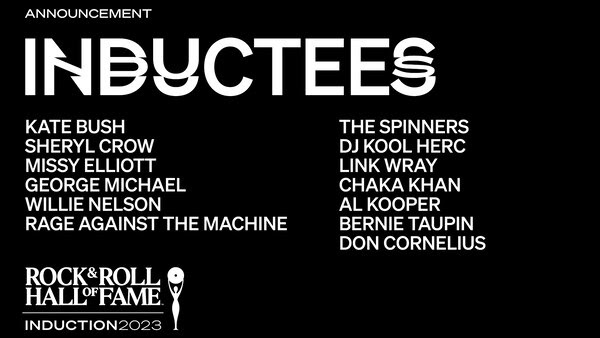
ROCK & ROLL HALL OF FAME 2023 INDUCTEES

My otherwise dismal record in picking winners for induction into the Rock’n’Roll Hall of Fame can be upgraded slightly, for two out of the five acts I nominated have been accepted. Last year I managed only one out of five. 

        Today brought news that Kate Bush, Sheryl Crow, Missy Elliott, George Michael, Willie Nelson, Rage Against The Machine and The Spinners are the 2023 inductees from among those for whom I and other electors were invited to vote. In addition to those, four previous nominees – DJ Cool Herc, Link Wray, Chaka Khan and Al Kooper – appear to have been given a sort of wild card entry. All four have been nominated in previous years but weren't on the voting form this year. As far as I am aware, this is a break from the normal procedure and suggests someone upstairs in the R&RHoF boardroom has it in their power to shoo in whoever they want regardless of how many, or how few, votes they received. Bernie Taupin, Elton John’s lyricist, and Don Cornelius, host of the long US TV music show Soul Train, are inducted into the ‘non-performing’ category. 

        I voted for Sheryl Crow and Willie Nelson, so I’ve doubled my success rate – if it can be called that – but am still way below 50% in overall terms, not that it matters much these days. As I have repeatedly observed in recent years, induction into the R&RHoF has become increasingly irrelevant of late, not that this in any way demeans the work of Willie Nelson, whose music and attitude I enjoy, or Sheryl Crow, who has what it takes to play alongside any inductee you care to name. 

I’m curious as to how Kate Bush will respond to her induction. Famously reticent in terms of public profile and generally unwilling to perform in public without extensive preparation, I somehow can’t see her belting out ‘Wuthering Heights’ or ‘Running Up That Hill’ with an unrehearsed scratch band. As far as George Michael is concerned, in an ideal world Elton will step up to the plate, sing ‘Careless Whisper’ and accept the award on his behalf, the only hitch being that if he sticks to his plans he might have officially retired by the time the ceremony takes place. 

Among the losers are Joy Division/New Order, which is a shame as I wanted to see if avowed adversaries Bernard Sumner and Peter Hook would share a stage, and long-suffering Iron Maiden, snubbed for the second time. I can’t help feeling the long-suspect anti-British bias played a part in these rejections. 

I voted for New Order/Joy Division but not Iron Maiden as any sympathy for heavy metal I once had has long since gone down the plughole. I also voted for White Stripes, who’ll no doubt be nominated again and get in eventually, ditto Warren Zevon whose elimination surprises me insofar as he was both American and a critics’ favourite, two criteria that almost always ensure induction.