28.9.23

THE WHO IN ROME, PALASPORT, September 14, 1972.

Around 51 years ago this month The Who were playing concerts in Europe on a tour that saw them attract 400,000 to a concert in Paris, their biggest ever audience. Aside from that show, it was a low-key tour, with several days off between cities and all bar Keith flew home to the UK between shows. Keith and Dougal drove around Europe from show to show, looking for trouble I suppose. 

I caught up with them in Rome, on the last date of the tour, and there are two things I remember from this trip. After the show Keith, Dougal and myself took a taxi around Rome looking for female company in a club or a bar, but found nothing, and wound up back at the hotel a bit disappointed. The following day there was a mix-up with the plane tickets. They’d flown me out first class, very nice of them, but the first-class section was overbooked for the return, and I was relegated to coach. Pete thought this was very funny. “Melody Maker writers are second-class citizens,” I recall him saying, much to the amusement of John and Roger. 

        Below is my report as it appeared in MM, verbatim. I actually sat on the stage, up on a platform behind John's speakers, and wasn't to know that the sound in the hall was pretty bad, and that this was why Pete smashed his guitar. The picture above is the cover of a bootleg of the show I found on the internet, but I haven't heard it. Nor do I know if the photo on the front is from that night in Rome. The picture below is a cropped scan of the page from MM. Much of what I write about The Who these days is written with hindsight, but this isn't. 


Pete Townshend shed his white kaftan and slumped in an angular fashion across the dressing room table. Red braces upheld his baggy white trousers which were both soiled and stretched at the knees. A small white Meher Baba badge stood out against his tanned skin.

He gulped some brandy and pointed an accusing finger at sound engineer Bob Pridden. “I’m gonna cut your thumbs off,” he threatened.

Alan Smith, Townshend’s own roadie, came towards us with an unopened bottle of expensive Napoleon brandy. He dropped the bottle which smashed into a thousand pieces at Townshend’s feet. Townshend laughed and shook hands with an American kid who had somehow crashed through into the dressing room.

“It was great show. I know those kids out there didn’t like it but I thought it was fantastic,” said the young American. Townshend smiled and acknowledged the compliment. The young American babbled a bit about being a guitarist himself. He asked for some tips, then asked for a job as a roadie with The Who.

“We have a road team of ten and they are the best in the world,” replied Townshend.

Bob Pridden knew his thumbs were secure after all.

“I always cut Bob’s thumbs off at the end of a tour but they usually grow in time for the next one,” Townshend told me.

All this took place in Rome last Thursday when The Who wound up a three-week European tour, their first in three years. They played a massive sports hall in this ancient city and attracted an audience of around 10,000 Italian rock fans who sat impassively throughout the kind of set that most groups would swap their PAs for. It didn’t satisfy Pete Townshend but nothing but the best ever does. 

Roger Daltrey didn’t like the sound in the hall and John Entwistle was fed up with travelling around anyway. Only Keith Moon seemed happy enough about the outcome of the tour. 

It was the group’s first visit to Rome in a long time so reputation alone must have attracted those fans. Who’s Next sold only 7,000 copies in Italy. Tommy fared better and consequently drew a better reception from those peaceful Romans but it was all rather low key for a group of The Who’s stature. 

“They are always like that in Rome,” the young Italian promoter told me later that night. “All they want to do is listen. That is because they have never seen The Who before and won’t see them again in a long time. They wanted to make the best of it. If The Who plays again next week there will be a riot because these kids know they are good. They don’t want to show it too much in case the police stopped the concert or future concerts. “

He was speaking loudly because Entwistle and Moon were within earshot. But you can bet your shirt that whether they heard or not, The Who won’t be playing Rome again next week.

It seems an almost unbelievable situation: fans are unable to demonstrate their appreciation of an act for fear of arrest and future banning of rock show. Imagine, just for example, if some upholder of the law banned rock concerts at London’s Rainbow because a band succeeded in drawing fans from their seats to stamp, clap and cheer. 

In the north of Italy demonstrations like this during and after concerts have had these consequences. These Romans have obviously learned their lesson.

But back to The Who, who haven’t played in Britain now since the opening of the Rainbow last November. They won’t be playing in England for a while either, until they’ve finished their next album so that a new stage act can be presented. It seems unlikely this will be before the end of the year. And there are tentative plans for an American West Coast tour next February with a possible trip to Japan thrown in.

It was virtually the same act from The Who in Rome as it was 12 months ago in England. Point the accusing finger of “same old stuff” if you like, but remember many Europeans haven’t seen The Who in ages, so for many it would be a first-time experience anyway. 

It’s as good as it always is – a combination of violent excitement, near perfect sound and those power-packed Who songs. 

Townshend is the most fluid mover I’ve seen since those Olympic gymnasts. He twists and turns and spirals around, leaping from one side of the stage to another, spinning his arm like a propeller from start to finish. He falls over, somersaults and crashes to his knees like a man on a trampoline. 

Someday he’ll go head first into his stacks of speakers, break both legs and an arm but that’s his style and he couldn’t change it if he tried. He has to be the ultimate in visual rock guitarists.

At Rome only one new song was included in the set – ‘Relay’ , a Townshend rocker in the accepted Who style. The rest were as familiar as the Coronation Street theme tune: ‘Can’t Explain’ (which has to be the best ever opener), ‘Summertime Blues’, a selection from Who’s Next, ‘Magic Bus’ (which died a rather tragic death), ‘Pinball’ and ‘See Me Feel Me’ from Tommy, and the inevitable ‘My Generation’ for closing.

Townshend smashed his guitar into fragments – the first break of the tour – at the end and the Italian fans didn’t know what had hit them. He swung it wildly at Moon’s kit, and took three heavy blows against the stage floor before the instrument succumbed. The body left the neck and the whole mangled mess arrived in the front row. The police moved in and the ovation was stifled as a result. No one wants a truncheon across the skull no matter how good a band performs.

The Who were disappointed in the gig and it showed. It was nobody’s fault but if the blame has be credited to something, then doubtless the group themselves are more than just a teeny bit tired of playing the same numbers for so long despite the demand for them.

On a different scale, it’s not unlike the man at the car factory who spends all day every day screwing door knobs on car doors. A monotony has crept in and a selection of new material would help the group overcome the lethargy that arises from playing the same songs over and over again.

The Who are so good they could probably put their shows over with their eyes shut. The inevitable problem arises: what next for The Who?

Well, Townshend has just completed work on the orchestral version of Tommy which, among others, features Maggie Bell and Steve Winwood. He’s writing more material for The Who which they will soon be recording for their next album.

John Entwistle has completed his second solo album and in a week’s time he’s off to the States for three weeks to promote the album in America. His first solo album was vastly more successful in the States than over here and his single ‘My Size’, which failed to make any impression here, was a big seller in the States, especially in Los Angeles where fans thought it was a Who single.

Roger Daltrey is also working on a solo album which, knowing Roger’s personal tastes, is likely to me marked step away from the Who’s style. I predict an almost acoustic sound for his record.

Keith Moon, following in the footsteps of Ringo Starr, is getting himself involved in films and we can soon expect to see his grinning face on the big screen in some obscure comic role. A serious acting role really isn’t on for Keith Moon.


26.9.23

EDDIE COCHRAN In Person by Lee Bullman

“Eddie came by my apartment and we were having a rehearsal,” Jerry Capehart, Eddie Cochran’s manager and co-writer is quoted as saying in this book. “Recording was scheduled the next day, so I said, ‘Well, why don’t we write something? Summer’s coming, OK, there’s never been a blues song written about summer, call it ‘Summertime Blues’. So, Eddie says, ‘Hey, you know, I’ve got this really great riff on the guitar…”

Shouldering his orange Gretsch 6120 Chet Atkins guitar, Eddie would have hit hard on his strings, an open E chord, followed by an open A, then an open B7 and back to the E, pretty easy, even for a beginner, but it’s thinking of the sequence, and its rhythm, in the first place that counts. “Maybe… you’ll think that what he did wasn’t so special, that any other kid with a guitar could have done the same, even down to you or me,” Lenny Kaye would write in the sleeve notes to a posthumous Cochran collection. “But that’s only because he was you or me, and any other kid with a guitar could have had the chance if he’d wanted, simple as that. In the years that Eddie worked and created, the secret of rock’n’roll lay in this clandestine knowledge, grasped by everyone within reach of a top-40 station, uncared about by virtually anyone else.” 

        “Everything Eddie Cochran ever did in his life had to have humour in it,” adds Capehart. “For example, his favourite performer at the time was the Kingfish from Amos’n’Andy days and the little voice you can hear on Eddie’s version of ‘Summertime Blues’ [presumably ‘I’d like to help you son, but you’re too young to vote’ – CC] was really his salute to the Kingfish. I think that ‘Summertime Blues’ was really indicative of Eddie’s imagine to his fans. That song gave him his individuality.”

        Capehart is right about the playful nature of Eddie’s songs. In so many of them there’s a light-hearted quality, like the guy who’s too tired to rock after climbing 20 stories to see his girl because the elevator has broken down, or Shorty who cuts across the field in the race to win Miss Lucy’s hand, or the guy in ‘Somethin’ Else’ who dreams of the girl and the car, and can’t quite believe he ends up with both. ‘Summertime Blues’ has a similar feel, teenage frustration mixed with eternal hope, and was first released on June 11, 1958, reaching number eight on the US charts that September, Eddie’s first hit. In the UK in November, it reached number six. It’s been a rock’n’roll staple ever since, covered by just about everyone who’s ever hung an electric guitar around their shoulders, perhaps most famously by The Who, as heard on Live At Leeds and at countless concerts during their heyday. 

Of course, The Who were by no means alone in trumpeting their fondness for Eddie Cochran. The first song 15-year-old Paul McCartney played to 17-year-old John Lennon, on 6 July, 1957, at Woolton Church Fete in Liverpool, was ‘Twenty Flight Rock’ and thereafter The Beatles included it and three other Cochran songs (‘Three Steps To Heaven’, ‘I Remember’ and ‘C’mon Everybody’) in their stage set, while their version of a fifth (‘Hallelujah, I Love Her So’), written by Ray Charles, owes everything to Eddie’s arrangement. Among countless other premier league acts who’ve recorded his songs are The Rolling Stones (‘Twenty Flight Rock’, on a live record from their 1982 tour), Led Zeppelin (‘Somethin’ Else’, from their 1970 Royal Hall show) and Rod Stewart (‘Cut Across Shorty’ on Gasoline Alley, 1970). Bruce Springsteen has a crack at ‘Summertime Blues’ on the 3-CD set recorded in 1978 at Cleveland’s Agora Ballroom, while US rockabilly band The Stray Cats, and their singer/guitarist Brian Setzer in particular, are virtually indistinguishable from an Eddie Cochran tribute act.

        Though a handful of Eddie Cochran’s most famous songs have been permanently wedged in my consciousness since pre-Beatles times, I knew next to nothing about Eddie until a double LP of his in UA’s Legendary Masters series, with those sleeve notes by Lenny Kaye, arrived in my desk at Melody Maker in 1971. Lenny’s notes were terrific, full of enthusiasm, written with a real love of Eddie’s music, but it wasn’t until I read Eddie Cochran In Person that I truly grasped all there was to know about the life of the handsome young rocker who tragically died on 16 April, 1960, in a car crash at Chippenham while on his way to Heathrow after a concert in Bristol. 

        Eddie Cochran books are thin on the grounds these days and this is a lovely, large format, illustrated one with 186-pages printed on art paper. It’s subtitled In Person because it benefits from photographs of the contents of a locker that contained all of Eddie’s possessions, collected by his mother and sister, that remained unopened until 2021 when it was offered for sale and bought by an English fan called Sonny West. Alongside an authoritative biography by thriller writer Lee Bullman, we get almost 100 photographs, both professional and personal, many seen here for the first time, press cuttings he collected, touching letters from fans (and one, extraordinarily heartfelt, from girlfriend Sharon Sheeley), cheques, royalty statements, posters advertising his concerts, records from his own collection and expressions of sympathy following the events in Chippenham. 

        In July 1963, Heinz reached number five in the UK with ‘Just Like Eddie’, a tribute song produced by Joe Meek that featured Richie Blackmore playing a catchy little phrase on guitar. Oddly, it’s the only tribute unmentioned in a final chapter that summarises Eddie’s gift to the world. Eddie Cochran In Person will make a fine gift to his fans. 


23.9.23

THE WHO – Civic Arena, San Francisco, December 13, 1971

Back in 1993, charged with compiling tracks for what became 30 Years Of Maximum R&B, The Who’s 4-CD box set, I was offered (and eagerly accepted) a live version of ‘Bargain’, recorded at this show. In an essay for Crawdaddy magazine shortly after the set was released in 1995, I wrote that ‘Bargain’ was the best reflection of The Who at their finest on the whole box set. “This is a truly stupendous performance, fluent, confident, full of highs, a perfect example of The Who at the peak of their ability, reckless yet somehow still in control, flowing with their music, relishing their skills.”

This version of ‘Bargain’ had already been made available on MCA’s Who’s Missing, released in 1985, while two other songs performed at this concert, John’s ‘My Wife’ and Don Nix’s ‘Goin’ Down’, a spontaneous closing jam, appeared on Two’s Missing a couple of years later. I ought to have pressed for more from the show for 30 Years, just as I pressed for a whole live Tommy as a fifth CD, but I had a hunch there was a covert strategy to hold back material so that it might be used on future re-issues at some unspecified date. Then again, it might be that the estate of Bill Graham, whose BG Productions promoted the Civic Arena shows, had tried to claim ownership of the recordings, as they had with other concerts, and this issue needed to be settled before the entire concert could be released. 

Whatever the ins and outs of the matter, it has now been made available on two CDs among the ten included in the Who’s Next 50th Anniversary super-deluxe box set, just released by Polydor and costing a whopping £224.99 on The Who’s own website, with slight price variations elsewhere.

The Who’s 25-day American tour at the end of 1971 holds special memories for me as I was present at the opening date, at Charlotte, North Carolina, on November 20, on what was my first ever visit to the USA, and I have written about this elsewhere on this blog. The two concerts in San Francisco on December 12 and 13 followed 15 others across the South and West Coast of America, with the tour concluding on December 15 in Seattle. I am reliably informed that contrary to what it might state elsewhere, the show on the two discs in the bells and whistles Who’s Next is from the 13th and not the 12th; also that the live ‘Bargain’ on 30 Years was from the 13th, and not from the 12th, as stated in the track listing. 

But all this is academic. What really matters is that The Who were on the form of their lives that December, the greatest rock band in the world performing the greatest music they ever made, a combination of brilliant songs from Who’s Next and Tommy sprinkled with bits of their past and a hint of the future. They were also cresting a wave of Stateside popularity, so a massive anticipatory ovation greets Bill Graham as he introduces the group in typically sonorous tones, like a Master of Ceremonies announcing distinguished guests at a VIP banquet, pausing for effect between each name: “Four of the greats and four very nice people,” he says. “On bass, Mister John Entwistle, … on vocals, Mister Roger Daltrey, … on drums, Mister Keith Moon (which, inevitably, prompts a flourish around the kit), … on guitar, the king, Mister Peter Townshend. The Who.”

Within seconds the staccato chords of ‘I Can’t Explain’ ring out loud and clear, like a hammer on an anvil, and they’re off, electrifying their fans as only The Who could in those days. Roger sounds angry on an angry song; John’s lines complement Pete’s chords; Keith sounds like an automatic rifle on the chorus. ‘Substitute’ follows, tight and snappy, and somehow even better, the combined vocal attack in perfect sync. All four are on top form tonight and know it. Roger introduces ‘Summertime Blues’, a belter, as ever, similar to Leeds except Pete solos mainly above the 12th fret, high frequency, and ‘My Wife’, “by our bass player, affectionately known as The Ox”, which explodes after the second verse, Roger repeatedly yelling “Keep on moving” and “Oh, she’s coming” as Pete solos and Keith goes manic. After another verse this whole eruption is repeated, only this time they step back to idle for a moment, clearly improvising, enjoying the moment, then tumble back in for another bout of sheer pandemonium. It is a portent of things to come. At just over six minutes ‘My Wife’ is the longest work out so far. Prolonged cheers ensue.

“Here’s a song [for] which we use a tape to put a synthesiser sound on stage,” announces Roger. “It was a lot easier than getting someone to play it. We couldn’t handle that, getting someone else. Anyway, Pete plays the synthesiser on the tape so it’s just like playing with two Petes if you like. [In the background, you can just hear Keith yelling, ‘One’s enough!’] It’s a great song. I really like this one. The lead track off Who’s Next, ‘Baba O’Riley’.”

By my reckoning this is the first live version of this Who staple, as performed by them, ever officially released and there’s a freshness to it here not found elsewhere, especially in Roger’s vocals and the moment when Pete urges us not to cry as it’s “only teenage wasteland”. The crunch chords sound like bells and the accelerating harp coda last just over a minute before arriving at a sudden, unexpected, well-drilled stop. Perfect. 

It’s Pete turn to talk. “No sooner have we taken you up than we’re gonna take you down again, very slowly,” he says. “This is a cameo, if you like, of a Who performance. It starts off nice and easy and ends up sort of bouncing all over the stage. We start off without Keith Moon and end up with him.”

This is the cue for some horseplay from the drummer, the light-hearted repartee that so often took the edge off Pete’s intensity, furnishing The Who with a skittish sense of humour rarely found in rock groups of their stature. “All right then I’ll piss off,” we can hear Keith muttering. 

        “I wasn’t trying to get rid of you or anything,” retorts Pete. 

        “It’s been nice working with you,” adds Keith, acting pissed off. “I’ll see you later.”

“It’s called ‘Behind Blue Eyes’,” says Pete before telling the audience that the set for tonight has been changed, presumably from the previous night. Knowing full well that Who fans would be attending both nights, he seems to delight in second-guessing them. Perhaps inspired by Moon’s quips, he adds: “It’s special but it’s all rehearsed, you know. We work out these dance steps, me and Roger, for hours.”

There follows one of the loveliest versions of one of The Who’s loveliest songs I’ve ever heard. As in ‘Baba’, Roger is pitch perfect, moving effortlessly from the purity of the verses to the tough middle section and back again. Pete’s hammering on and off during the arpeggios is clean as a whistle and when Keith re-joins the group their focus is pin sharp. 

And so, we come to ‘Bargain’, “a song about what you get from being here,” says Pete. “If you’re alive, whether you’re rich or you’re poor, if you’re up or you’re down. If you’re alive, you’re getting a bargain.” 

I wrote about this performance of ‘Bargain’ at length in my essay for Crawdaddy, and I can’t improve on it, so here we go again. During the opening chords Pete gleefully shouts something off mike which is difficult to make out, but it sounds like a call to arms that simply enhances the anticipation. Roger leaps in over Pete’s rumbling guitar before the song’s real highlight, the emotional contrast between Roger and Pete’s separate vocal lines. I especially love the way Pete’s keening vocal refrain is counterbalanced by John’s lovely bass melody and how Pete yells ‘pick me up’ at the top of his voice after his final line. Keith and John take up the challenge in a thrilling bass and drum rumble that launches Pete into a magnificent solo. The song itself, like many that Pete was writing at the time (including – most notably – the climax to Tommy), is a prayer of yearning in which the singer prostrates himself before the blessed one – ”I’d pay any price just to get you,” sings Roger – while in his refrain Pete admits his inadequacy: “I know I am nothing without you”. In some ways it’s possible to mistake ‘Bargain’ for a love song, but when you get your head around the idea that it really is a hymn (to Meher Baba, Pete’s spiritual guru), then it becomes all the more impressive. Then there’s that extended coda, one of The Who’s on-stage trademarks, in which the song appears to be over until Pete launches into a series of fragile chords before finding his way into another riff, taking the others if not by surprise then at least by the lead as he pounds on, carried along by the momentum, confident that the band are on such good form at this moment that it would be a crime to stop just because the song is at an end. Quite wonderful. Then there’s another roar from the crowd.

Up and down. Dark and light. Earnest and comic. “If you were here last night you will have noticed my knees trick,” says Pete as the cheers die down. “If you’re wondering why I’ve got such funny shaped knees it’s because I’m wearing knee pads, so I don’t agitate the fractured knee cap.”

“Have it off,” yells Keith. “Amputate.”

Next up is ‘Won’t Get Fooled Again’, mid-set in 1971, again as fresh as you can imagine, sharp and precise, another triumph for Roger, the ensemble playing along with the synthesiser track faultless, Keith an almighty presence both before and after the synth interlude. Roger’s roar at the climax is leonine. In a review of the deluxe Who’s Next in Mojo, Mark Blake wrote of this reading of ‘WGFA’ that it “sounds like The Who achieving the transcendental lift-off that Townshend claimed they managed on a good night, and also suggests drummer Keith Moon might spontaneously combust.” He’s not wrong.

More humour. Pete tells us his Doc Marten shoes have bouncy soles. “High jumpers should wear these,” he adds. “What are we doing now? This one is an old tune we used to do when we very first started, and it would be very nice to think there was at least one person here who saw us in London at the Marquee Club and maybe heard us play this number. We played a lot of Tamla Motown stuff in those days. It was very hip, trendy to play Tamla Motown. We used to play ‘Heatwave’, ‘Dancing In The Street’ and this one. Roger will tell you what it is while I change my guitar. I have to use a special Tamla Motown type guitar.”

“For a change,” says Roger, “we actually feature Mister Keith Moon.” This is the cue for a bit more silliness until Keith charges into ‘Baby Don’t You Do It’, a fierce work-out on the Tamla song recorded by Marvin Gaye, highlighted by Keith’s energetic drumming throughout, Roger’s strident vocals and The Who’s unique ability to turn soul into furious rock at the drop of a hat. Playing off one another as no other band can, there’s some lovely bass work from John, and Pete’s buzz-saw guitar solo towards the end is terrific. During a furious ‘head for home’ climax Pete, John and Keith play their hearts out with Roger hollering to be heard above the din. Then, just to stress the point, there’s a false ending and the band rev up yet again, only for Roger to have the last word. An edit of this recording would become the B-side of ‘Join Together’ the following year.

“Let’s have an English song now,” yells Pete as Roger blows his harmonica. “We’re gonna sell you something. We’re gonna sell you a bus… a magic bus. You’re gonna have to pay us… but it’s worth it.” Keith taps the blocks, John thumps away on one note, playing his bass like a drum, and Pete gives us what Charles Shaar Murray once described as a masterclass in rhythm guitar. At 17 minutes ‘Magic Bus’ is far and away the longest individual song of the night, retaining its tense Bo Diddley tempo and the preposterous horse-trading banter between Roger and Pete until the ten-minute mark when Keith switches to his kit and all hell breaks loose. Then, just when you think it’s all over, it’s not. A false ending is followed by another coda: Roger back on the harp, accompanied only by Keith’s rolls with Pete improvising more lyrics, all building to another breath-taking extended finish. 

After all that most bands would be taking a bow and heading for the dressing room, perhaps returning after two minutes for an encore. Not The Who. It’s time for Tommy. Professor Keith Moon is introduced as the conductor. “Daltrey, stop drinking on stage,” he yells. “John, stand still you ruffian.”

“He’s breathing,” says Pete.

Keith: “I’ve told him not to move on stage.” 

Pete: “Actually I’ve seen him moving in hotel rooms.”

Keith: “He gets up to turn the television on and off.”

Pete: “He picks the phone up. Room service…”

Keith: “Hot tuna sandwich.”

After a count in from Keith – “three million, four million” – The Who launch into the ‘Overture’ from Tommy, played with its usual panache, followed by Pete’s unaccompanied solo guitar piece, much of it improvised, leading into the intro to ‘Amazing Journey’. This is followed by the instrumental ‘Sparks’ on which, for the first and only time, the guitar mix seems too low, at least for the first two or three passes until the octave drops sweep in. A minute later it’s all back on balance, and the three instrumentalists are up and away, sailing head-on into the ‘Underture’ storm with Keith leading the charge for a full four minutes. The audience erupt at the end. 

        After a breather ‘Pinball’ arrives, Pete’s furious strumming punctuated by John’s stabbing bass, another hell-for-leather ride leading to ‘See Me Feel Me’, the spiralling Tommy hymn which, as ever, raises the roof as The Who pay tribute to their audience, climbing mountains and seeing the glory, a truly majestic performance.

        But it’s not over yet. “It feels good to see you standing up,” says Pete. “This one is where we drive you back into your seats again. ‘My Generation’ – are you in it?”

        And off they go yet again, into their biggest, most sacred hit, a faster version that on record, Roger screaming the lyrics, John rattling off the bass solo, Pete finding a riff in his solo, then another, then another while everyone follows him into unchartered territory until John and Keith cotton on to where he’s going and gamely follow while Roger sings whatever comes into his head. After eight minutes it settles and Pete works his way into the nagging riff of ‘Naked Eye’ which Roger sings beautifully, the other three straining at the leash until, as in so many other songs tonight, the structure breaks open to allow more free-form soloing which this time morphs into the bluesy ‘Going Down’, after which the concert finally ends. The combined length of ‘My Generation’, ‘Naked Eye’ and ‘Going Down’, all segued together, is almost 24 minutes, this on top of the 90 minutes plus beforehand. It goes without saying that the final climax is explosive, electrifying. I have no idea how long the cheering continued as only a minute can be heard on this recording. There would have been no encore. 

* * *

Sometimes, just occasionally, even though there’s pictures of them as young men on the walls of my home, I forget how great The Who once were; when they were young and pioneering, forever moving forward, lighting a path that no other group of their era could tread. For my money, The Who in 1971 left every other group on the planet in their wake. For a few glorious years they were simply untouchable, playing out of their skulls night after night, the greatest rock concerts ever. I’m not that enamoured of the recent activities of Pete and Roger, though I don’t blame them for carrying the torch, playing their music in whatever form they choose to present it these days for those that still want to hear it played on stage. They are musicians and that’s what musicians do. I’m just not that interested any more. 

What I am still interested in, however, and still delirious about, are Who recordings like this 1971 San Francisco Civic Auditorium concert, just as I was over the Moon about that 1968 New York Fillmore show. My review of that, by the way, has had almost 50,000 hits, far and away the most of any posts on Just Backdated. So, I’m not alone in feeling this way.  

It’s been fun writing again about The Who I loved so much. 


(The photo at the top of this post was taken by Jim Marshall at the San Francisco concert on December 12, 1971.)

14.9.23

Charlie’s Good Tonight: The Authorised Biography of Charlie Watts by Paul Sexton

Inspired to dig deeper into the world of Charlie Watts after learning about his fabulous book collection – see last post about Christie’s sale of Charlie’s library – I bought a book called Charlie’s Good Tonight: The Authorised Biography of Charlie Watts by Paul Sexton. It was a mistake. It is bland, riddled with repetition and insufferably dull, unlike its subject, and I strongly suspect that its subject would agree with me, not that Charlie Watts would have wanted an authorised biography to have been written about him in the first place. 

        No one in their right mind would deny that Charlie Watts was a fine fellow, a great drummer, a delightful companion and man of exceptionally modest virtue. Such qualities, however, do not make for a page-turner. Paul Sexton, I fear, was faced with an insoluble problem when he took on this commission, presumably at the behest of Charlie’s wife Shirley, who died in December, 2022, 16 months after her husband (the book was published in September 2022), insofar as Charlie didn’t say very much, at least to interviewers. When he did talk, he was vague, often evasive and occasionally taciturn. So, the most obvious research tool (and page filler), music press interviews, was scant to say the least. The next port of call would have been fellow Stones past and present, among the most useful archivist Bill Wyman, all of whom loved him dearly, as did his daughter Seraphina and granddaughter Charlotte. Old friends and fellow musicians too weigh in with their memories but all anyone can say is what a great, laid back, lovely bloke Charlie was, which is no doubt correct.

        Mick and Keith write forewords and it must have been something of a relief for them to read a book about a Rolling Stone that draws a polite veil over the stuff that makes most people buy them in the first place. It’s no secret that the Stones’ story is littered with decadence on an industrial scale, as detailed in countless other books, but apart from a brief lapse in the mid-1980s when he overindulged in drugs and booze Charlie seems to have been looking the other way when all that was going on. It comes as no surprise that the brief lapse is dealt with briefly.

        The distance that Charlie placed between himself and the rest of the group, certainly Mick, Keith and Brian, though perhaps not Bill, was established early on. “It’s just a job that pays well,” was his default position, and it remained that way until the end. It seems he threatened to leave a few times but was dragged back, perhaps because he enjoyed playing the drums, perhaps because Rolling Stones tours were so lucrative, most especially from the 1990s onwards. He was never happier than when the tour was over and he could return to his small family, whom he loved as deeply as they loved him. Charlotte thinks he was born a granddad, which is rather sweet, but doesn’t set the pulse racing. 

        There isn’t even much about the Stones’ music, which is discussed only in the most insipid of terms, and never with a critical eye. Nevertheless, if you want to know about Charlie’s love of jazz, the jazz albums he made and jazz bands he led, his drumming technique, what others felt about his drumming and lifestyle, the camaraderie within the Rolling Stones, the cool and often extremely expensive clothes he liked to wear, his love of cricket and antique firearms, and Shirley’s love of horses, this is the book for you. Considering it’s about a man who lived to the grand age of 80, it won’t take you long to read either. File under ‘Affectionate Memoir’. 


6.9.23

CHARLIE WATTS – Some Sort Of Epic Grandeur


The true character of a man is often revealed only after their passing, frequently to their detriment, but the opposite is the case with Charlie Watts. There were hints of his noble demeanour during his lifetime, of course; that quiet reserve, that well-groomed approach to everything he ever did, that refusal to bow to anyone, least of all his fellow Rolling Stones.  

Some Sort Of Epic Grandeur is the title of Matthew Bruccoli’s definitive biography of the American writer F. Scott Fitzgerald, and I chose it for this post not just because Charlie’s first edition of The Great Gatsby, signed by Fitzgerald, has the highest guide price (£200,000-£300,000) of any of around 100 books in Christie’s forthcoming sale of almost 200 items from Charlie’s collection but because Epic Grandeur seems to me to be the perfect synonym for the life of Charles Robert Watts.

I was alerted to this sale by my former Melody Maker colleague Richard Williams whose post on his Blue Moment blog on the same subject he perceptively titled A Man Of Wealth And Taste. When we last met he and I agreed that Charlie’s episode of the 2002 My Life As A Rolling Stone TV series of profiles of individual members of the group was quite wonderful, leaving viewers in no doubt that Mr Watts was a Gentleman in the strict, old-fashioned sense of the word. His Savile Row tailor said precisely that, and he should know.

Now we have further enlightenment in the form of the catalogue for the Christie’s sale, a document of some grandeur in itself. Charlie Watts: Gentleman, Collector, Rolling Stone, it says on the cover, placing Charlie’s credentials in order of importance as they see it. Almost 200 pages of items on sale are prefaced by essays by Paul Sexton, author of Charlie’s Good Tonight, The Authorised Biography of Charlie Watts. “Once Charlie Watts had some funds at his disposal, he became almost obsessively acquisitive, but only about things that complemented his impeccable taste,” he writes. “Cars, first edition books, silverware, flatware [cutlery], records, photographs, memorabilia on the American Civil War and Horatio Nelson, and vintage drum kits.”

So, where we do we start on this superb collection of first editions? How about Agatha Christie? We have 25 hard backs, including the first appearance of Miss Marple in The Thirteen Problems, with ultra-rare dust jacket and wraparound band, price 7/6d when published in 1932, now estimated at £40,000-£60,000. “We have been unable to trace any first edition in a dust-jacket sold at auction,” Christie’s inform buyers. Or how about Parker Pyne Investigates “from the library of Agatha Christie’s sister, first edition in the extremely scarce dust-jacket, signed by the author and her sister Madge”, (£6,000-£10,000).

        Moving on, we have Arthur Conan Doyle, A Study In Scarlet, 1890, “the first Sherlock Holmes Story: presentation editions of the first American edition, inscribed by the author” (£25,000-£35,000), along with four other Holmes books, including The Hound Of The Baskervilles, first published in 1902, (£70,000-£100,000), “a remarkably fine presentation copy of the first edition in book form, inscribed by the author on the title page: ‘I perambulated Dartmoor before I wrote this book. A Conan Doyle.’”

The Great Gatsby is by no means the only Fitzgerald book in the sale. There are eight more, including a second (unsigned) first edition with the iconic blue cover depicting the eyes of optometrist T. J. Eckleburg over the lights of Manhattan (£100,000-£150,000). 

    Elsewhere we can find Graham Greene (13 books), Dashiell Hammett (five), James Joyce (two), George Orwell (five), P. G. Wodehouse (seven), Evelyn Waugh (11), Dylan Thomas, Ernest Hemingway, D. H. Lawrence, H. G. Wells, Oscar Wilde, Tennessee Williams, Virginia Woolf, Langston Hughes and others. In almost every case Charlie collected signed first editions, some accompanied by letters from the authors to friends. 

Then there’s music, mostly jazz (photographs, paintings, records and artefacts like Duke Ellington’s baton) but also Count Basie Orchestra manuscript arrangements for 31 compositions, 88 pages in total (£30,000-£50,000) and material that relates to the Great American Songbook: scores. for George Gershwin’s An American In Paris, Rhapsody In Blue and Porgy And Bess, all signed. Mostly, though, it seems Charlie liked his namesake, Charlie Parker, and collected 78rpm recordings, autographed photos, contracts and even reel-to-reel tapes from Parker’s recording sessions. It’s all in the catalogue, with precise descriptions, price a modest £40 to delve into Charlie’s obsessions. 

In the essay at the beginning of the catalogue Charlie’s daughter Seraphina tells Paul Sexton: “I opened this cupboard the other night, a piece of furniture with drawers, and I found all these things, Edwardian glasses and carved pipes. I was like, ‘He’s forgotten about this stuff, hasn’t he, totally forgotten about it! I really wanted to speak to him [and say] ‘What is this? This could be Roman and incredibly valuable, or it could be a piece of junk.’ He had phases where I can see he’s gone completely OCD-collecting mad, throughout his life.”

The Charlie Watts Collection can be viewed at Christie’s St James Street premises between 20 and 27 September, and the sale takes place there at the 28th.


1.9.23

PHIL OCHS IN CENTRAL PARK

Recently granted access to a cache of Melody Makers from the 1970s, I was pleased to find this in the issue dated May 24, 1975 – my review of an unusual concert in New York’s Central Park on May 11. Phil Ochs, of course, was my absentee landlord when I lived in his apartment in Los Angeles during the latter part of 1973, an arrangement enabled through his brother Michael, and for this reason I have always felt an affinity with this singer, songwriter and hero of the American protest movement. 

It was the croaky, off-tune voice of Phil Ochs singing ‘The War Is Over’ that brought a huge crowd of Sunday afternooners to their feet in Central Park at the weekend, reliving memories of an earlier occasion when this song was sung on the streets of New York. 

        Ochs was the central figure in a free concert planned to celebrate the end of the war in Vietnam and although he recruited a host of artists to appear on the bill alongside him (Paul Simon, Richie Havens, Joan Baez, Peter Yarrow, Pete Seeger, Tom Paxton and others), it was Phil’s rendering of three essential period pieces that set the mood for an afternoon graced not only by fine weather but with a sense of achievement for an event well organised.

        Phil, who admits his voice is shot and whose recent creativity has slumped to an all-time low, is something of a legendary figure in New York/Village/political/folkie circles. He put the bill together for this show, designed a poster (above) and duetted with Joan Baez on a moving rendition of ‘There But For Fortune’, perhaps his best-known song.

        Unrehearsed and off-key, Phil stood up to sing ‘I Ain’t Marching Any More’ with the determination of a political candidate. “My voice ain’t too good these days,” he admitted. “And I probably can’t hit the high notes any more. But we’ll try it anyway.”

        The crowd joined in on the choruses and the years fell away to the period when it was hip to protest against the hostilities in the Far East. With Baez, he was hesitant (it was the first time the two – songwriter and hitmaker – had ever duetted on ‘There But For Fortune’) but they traded lines across Phil’s Martin; it wasn’t the moment for musical subtlety anyway.

I found this picture of Phil & Joan at the event online. It is credited to Jean Pierre Laffont. 

        Ochs closed with ‘The War Is Over’, relating how the song was originally written during a demonstration in New York’s Washington Square some seven years ago. On that occasion Ochs and various colleagues decided to declare the Vietnam offensive over themselves. Slipping into a lower octave for the verses, Och’s strained at the throat to hit the higher notes without much success. Again, it didn’t matter. The feel was what counted.

        Paul Simon was the biggest star of the day, John Lennon having excused himself on the grounds of “not being in a singing condition at the present time”. Lennon probably declined to attend because of his decision to lie low while the courts decide his future in the US. Publicity surrounding his appearance at this kind of event would do more harm than good. There was a rumour that George Harrison would show, but he never did.

        Paul Simon, never the spontaneous artist, looked his usual nervous self. He opened with a flawless rendering of ‘Bridge Over Troubled Water’ while photographers literally fought to snap his profile. He received a tremendous ovation but looked hesitantly around him for encouragement from the other artists waiting to appear.

        Attempting a tune-up, he slid into ‘American Tune’, a particularly appropriate song but it never got off the ground. While tuning his guitar and singing at the same time, he hastily decided to abandon the song – which was beginning to drag – and liven up the proceedings with the jerky intro to ‘Me And Julio Down By The Schoolyard’.

        He completed about half this song before giving up on the guitar, bowing and picking up his young son Harper, and encouraging him to say ‘peace’ into the microphone. He did just that and was rewarded with a cheer that rivalled his famous daddy.

        “I wasn’t quite prepared for that,” a flustered Simon told me backstage while being trodden underfoot by yet more cameramen. He made a hasty getaway.

        Joan Baez sang a version of ‘Joe Hill’ which reminded me of the live Woodstock album, and was joined by Peter Yarrow for a fine version of ‘Blown’ In The Wind’. The audience responded as if Dylan himself was up on stage, singing the choruses and even cheering the end of each stanza.

        Other artists had their chance to sing a couple of numbers. Richie Havens sang a lengthy ‘Freedom’, Sister Odetta, Pete Seeger and Tom Paxton all came up with a couple of songs and Patti Smith, folk poet and totally original rock performer, put over two pieces before her biggest-yet audience. She also brought greetings from Stevie Wonder in the form of a cassette recording which, unfortunately, couldn’t be played.

        Between acts there were political speakers who, for the most part, tended to drag proceedings to a deathly crawl. Every tub thumper with a cause was allowed to air their views and, consequently, topics that ranged from the American Indian Movement to the struggle within trade unions were all debated from the platform. The majority of speeches, however, dealt with the celebration to mark the liberation of Vietnam and all speakers showered plenty of praise on the Viet Cong.

        Advertisements for the event had promised a minimum of speeches but this was forgotten as a host of personalities, from deserters to mothers who had lost their sons in the conflict followed each other to the microphone. There was even a telephone conversation with some Vietnamese arrivals who didn’t speak English. Quite fatuous. 

        The speeches actually took up the bulk of the afternoon and it was a long afternoon, stretching from midday until sunset when Central Park is traditionally taken over by ne’er do wells and winos seeking a berth for the night.

        “It was a success, I think,” Phil Ochs told me a couple of days later. “We raised enough money to pay for the event with a little left over to send to Vietnam, and I was pleased everyone showed up. I called Paul Simon personally and knew he would show because he had to pass through the city that day on his way from Long Island to New Jersey.” 


29.8.23

JUKE BOX WEEKEND


From the age of ten I have loved juke boxes. Much of my earliest musical education – Elvis, Chuck, Buddy and the like – came from a red and yellow one in a coffee bar near Mill Bridge in Skipton where I was raised. Some years ago, whenever I was tasked with compiling a weekly shopping list that Mrs Charlesworth might need for a trip into town, I would slip ‘juke box’ somewhere in between the food and drink items, only stopping when the joke wore thin. 

Over and above the music, there was something tantalisingly attractive about gaudy American Rock-Ola juke boxes, the lights that twinkled, the plastic that shone, the chrome that glinted, the curves that somehow reminded me of American cars to be found in ads in National Geographic magazine, low and flat with sweeping tailfins and sleek, flowing bodywork. 

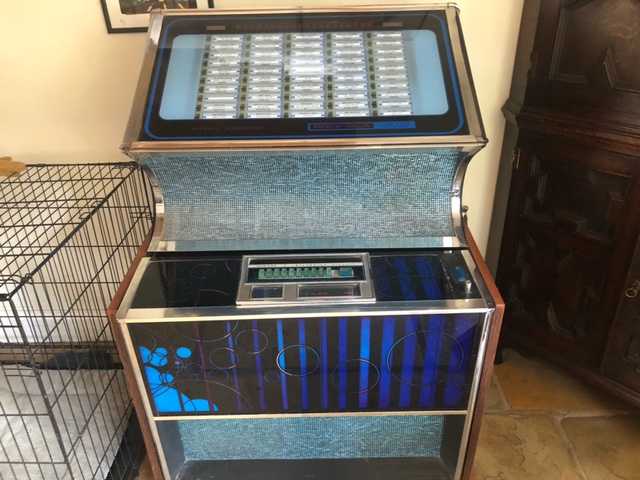
        Not often does your man from Just Backdated find himself spending a weekend in a private house equipped with a Rock-Ola juke box but that’s what happened last weekend when we stayed with our friends Adrian and Lynne at their home in a village a few minutes’ drive away from Bridport in Dorset.

        Adrian has owned the blue Rock-Ola 449 pictured above since the late seventies. Made in the US in 1972, it was shipped to Germany for use on an American army base before it found its way to the UK where Adrian paid about £250 for it from its previous owner. It’s set up to take 25 cent coins (American quarters) but like all juke boxes can be fixed to circumvent payment. 

        It contains 100 7-inch singles, two 12-inch speakers and is very loud. Indeed, the volume is difficult to control and even on the quietest setting booms out like sound systems at Notting Hill Carnival. Speaking of which, it comes as no surprise that almost all the singles on Adrian’s juke box are early reggae, not just Bob Marley, but less celebrated names too, as can be seen from the picture below.

        Perhaps more impressively, when it broke down about six months ago Adrian was told by the only juke-box repair man for miles around that it would be at least six months before a home visit to diagnose the problem could be arranged. So Adrian downloaded the manufacturer’s manual from the internet, took it apart and fixed it himself. Respect. Here are some pictures of the insides and scans of pages from the repair manual.


        While working on his machine, Adrian noted that missing from the manual was information about the device within that logs the number of plays for each record. This enabled its owner to report back to those who compiled record charts based on juke box popularity, which might be subject to fraud if tampered with. “They didn’t want anyone to know how it worked,” Adrian says. “You could fix the charts if you altered the readings.” 

The disc with the yellow ring records the number of plays. 

A bit of research on the internet tells me that the Rock-Ola Scale Company was founded in 1927 by David Cullen Rockola to manufacture all kinds of coin-operated entertainment machines. During the 1920s, Rockola was linked with Chicago organized crime – no doubt Mafia dudes offering ‘protection’ in return for the profits of coin-machines they supplied – but Mr Rockola escaped a jail sentence by turning State’s Evidence, which probably meant he watched his back for the rest of his life. 

           He added the hyphen because people often mispronounced his name – the long ‘o’ is important – and the name of his company was changed to Rock-Ola Manufacturing Corporation in 1932. From 1935, Rock-Ola sold more than 400,000 jukeboxes under the Rock-Ola brand name, some of which were shipped to the UK. One of them ended up at that coffee bar in Skipton, for which I gave thanks every day of my life. 


7.8.23

THE ENDLESS COLOURED WAYS: The Songs Of Nick Drake

Considering the esteem in which Nick Drake is now held, there is a paucity of albums by various artists covering his songs. Perhaps it’s because they are a bit tricky to play and sing, or maybe too personal. Some years ago, I bought one called Way To Blue which features recordings from concerts in Melbourne and London, assembled by Joe Boyd, Drake’s original producer, which is superb. Now, along comes another, The Endless Coloured Ways, which is equally lovely.

        Available in a variety of formats, which suggests Chrysalis is rather milking the concept, The Endless Coloured Ways is quite different from Way To Blue insofar as almost all these cover versions are designed to enhance, as opposed to replicate, the originals. It offers 25 Drake songs in total, across two CDs, in four ‘episodes’, A, B C and D, designed to create a seamless flow, all performed with instructions from producer and Drake estate manager Cally Callomon to the artists to ignore the original versions and perform them in their own styles. “We asked the contributors to adopt each song as if it were their own,” writes Calloman in the accompanying booklet. “Not only do the songs stand up as great songs in themselves, regardless of the original recordings by Nick, we believe the results are typical of each performer.” 

        Which is precisely what the artists do, in some cases turnings songs inside out, in others adding layers of inventive instrumentation, in others taking turns where Nick stayed straight. The most notable feature to these ears, though, is how the lyrics seem clearer in almost every song. While veneration of Nick Drake appears endless, if there was a flaw in the 60-odd recordings he made during his lifetime it was his uncertain enunciation. This tendency to mumble meant the words were lost amidst the maestro-like guitar picking and orchestration, so on many songs, oblique as they are, we can’t grasp what he’s singing about. Without exception on this tribute set, all the singers involved, many of them women, enunciate with far greater clarity. Most of them aren’t from the UK either which makes it all the more intriguing. 

        As a prelude, we hear an a cappella verse from ‘Voice From A Mountain’ before Fontaines DC rattle off ‘Cello Song’/’Strange Face’, drums establishing a brisk pace behind a distorted guitar, with Nick or Robert Kirby’s cello part now a choral backdrop as part of a 90-second prologue before the vocals enter. Accustomed over time to hearing Nick’s rather plummy accent, it comes as a bit of a surprise to hear Grian Chatten’s Irish brogue. An extended outro replicates the intro. French singer Camille follows with a delightfully fragile ‘Hazy Jane II, backed by guitar and what sounds like a plucked cello. 

        Elbow’s Guy Garvey interprets ‘Saturday Sun’ in the blunt drawl he applies to his day job, the tempo so slow it almost grinds to a halt with a minute to go, followed by a coda of Lennon-like dissonant noise. ‘Road’, by Bombay Bicycle Club & The Staves, is another brisk outing, enhanced by a lovely acoustic guitar figure, while ‘From The Morning’ by Let’s East Grandma is set to a drum machine and synths, Jenny Hollingworth’s vocal soaring over the top.

        David Gray sings ‘Place To Be’ over a stark accompaniment, as does Stick In The Wheel’s Nicola Kearey on a spooky stab at ‘Parasite’. Aside from when he sings in a higher register towards the end, Ben Harper’s turn on ‘Time Has Told Me’ is one of few tracks that differ only slightly from Nick’s recording, while Emile Sandé skates nicely through ‘One Of These Things First’, complete with metronomic programmed drums. This is followed by a truly lovely reading of ‘Northern Sky’ by Scotland’s Karine Polwart and Kris Drever, perfect harmonies enhanced by a melancholy trumpet. 

        Of all the songs that Nick Drake wrote and recorded, none are bleaker than ‘Black Eyed Dog’, a meditation on depression that dances around a simple guitar figure, at least by Drake’s standards, with spare lyrics and sparser instrumentation that foresee imminent mortality. Nick sang this song in a high, plaintive voice that left little doubt he was singing about his own isolation, the incessant harmonic of his ringing strings and occasional frayed note adding to the tension. Over now to Craig Armstrong featuring Self Esteem who add plenty of echo to the haunting guitar lines, taking the song from its skeletal blueprint into something altogether richer, with double-tracked, whispered vocals, a false ending to herald a slide back to the start, and that nagging guitar figure which on this reading somehow reminded me of U2’s ‘Bad’ from The Unforgettable Fire. 

        CD2 opens with another a cappella chant, this time ‘Road’, reprised by Bombay Bicycle Club & The Staves, followed by a gorgeous ‘Poor Boy’ by Nadia Reid and the ringing acoustic guitar of Christian Lee Hutson accompanying himself and Elanor Moss on a reverent ‘Which Will’. Skullcrusher & Gia Margaret offer up a delicate ‘Harvest Breed’, as does Katherine Priddy on ‘I Think They’re Leaving Me Behind’ and Norway’s Aurora (aka NjÃ¥l Paulsberg) on a brief ‘Pink Moon’. 

        There is no better example of the clear enunciation I referred to earlier than Joe Henry and Meshell Ndegeocello’s lovely ‘Time Of No Reply’, enhanced by an alto saxophone. Famous Blue Cable, with Leslie Feist on vocals, tackle ‘River Man’ delicately, played largely on fretless baritone guitar with brushed drums. Liz Phair swings nicely through ‘Free Ride’, Radiohead drummer Philip Selway takes the vocals on ‘Fly’, fragile, almost spoken, and Icelandic John Grant takes us on a mysterious ride for ‘Day Is Done’ before the CD concludes with a reprise of ‘Voices’ from The Wandering Hearts.

        I’ve been playing this CD at home and in our car for the last two weeks, enjoying it more and more each time. If you like Drake you'll like this too. 


27.7.23

SINÉAD O’CONNOR


Enchanted by her first album, The Lion And The Cobra, on 6 November, 1990, I bought last minutes tickets to see Sinéad O’Connor at the Royal Albert Hall, standing up in the gods as all the seats had been sold. From up there she looked tiny, her shorn head making her seem almost childlike, very vulnerable and dwarfed by the big stage and vast spherical surroundings. I thought she was fantastic, a huge presence, especially when she switched on a boom box for accompaniment and danced an Irish jig to one of her songs. Boy, she has a lot of bottle, that girl, I thought as her set progressed. She’ll be a huge star one day.

In those days I was the managing editor at Omnibus Press, which specialised in books about rock and pop performers, and seeing Sinéad at the RAH prompted me to commission a book about her. I sought out a Dublin-based journalist called Dermott Hayes, who was keen to write it, and even commissioned my future wife, Lisa, who’d been at the RAH with me, to design the cover. Published in 1991, the book, entitled So Different, was very successful, our second best seller that year, and it attracted several foreign language editions. Sinéad, however, was displeased. Not long after it was published Dermott encountered her at some event in Dublin and was the target of her sharp tongue, so he relayed to me. 

        In common with other non-fiction publishers, Omnibus Press regularly revised and updated titles on our back catalogue, and whenever we suggested this to authors they were always delighted to do so. Not only would it improve their books but they’d benefit financially, from a top-up advance for producing any necessary editorial work and the probability that their royalties would increase too.

        There was only ever one exception to this: So Different by Dermott Hayes. When I contacted Dermott and proposed he revise and update his book, he declined, which surprised me. Evidently, he had come to a concord with Sinéad not to do so, in the hope that the book would go out of print (which it eventually did, though it’s available on kindle). I later learned, an even bigger surprise, that he and Sinéad were in a relationship. 

        “The irony of that achievement [the book’s success] can only be surpassed by myself and Sinéad having a very public love affair nine years later,” wrote Dermott on a website. “There’s a song on Sinead’s fifth studio album, Faith And Courage, released in 2000, called ‘Dancing Lessons’… She says it’s about our relationship.”

I thought at the time that if I’d never commissioned this book Sinéad and Dermott might never have met. Maybe that’s the case, or maybe they’d have met anyway, but I hope they were happy together, at least for a while. 

Happiness was a commodity that seemed forever to elude Sinéad O‘Connor. She was a warrior and warriors are rarely content. They thrive on confrontations, of which there were many in her troubled life. Like everyone else, I followed her travails by reading about this or that strange or sad set of circumstances in which she was involved. She wasn’t one to grow old gracefully. Grace wasn’t her style. I still play her records and always will. 


14.7.23

BOWIE ODYSSEY ’73 by Simon Goddard


It is unusual to begin a series at the fourth episode but that is what I’ve inadvertently done with Bowie Odyssey ’73, the fourth in Simon Goddard’s ambitious sequence of books that, year by year, will chart David Bowie’s progress throughout the decade he made his own, one book per year, hopefully, up to 1980. 

        The project’s ambition is matched only by the sumptuousness of Goddard’s writing. These are not biographies in the accepted sense, researched through interviews with those on the side-lines collated alongside details of events like record releases and concerts, all glossed up with the author’s own take or critique on things. No, they are attempts to get inside Bowie’s head and observe things from his and everyone else’s perspective, in this case a heap of folk with whom Bowie associated; wife Angie, Spiders and other musicians, maverick manager Tony Defries and his flamboyant Mainman assistants, clothes designers, hairdressers, friends old and new, fans, and, last but by no means least, lovers, of whom there are several: take a bow Amanda, Marianne and Lulu to name but three. 

        This kind of writing is not new but is nevertheless quite rare, and it takes a good deal of skill to pull it off. The late great Nick Tosches succeeded to a certain extent with his wonderful Jerry Lee Lewis biography Hellfire, and to an even greater degree in Dino: Living High In The Dirty Business of Dreams, his astonishing excavation into the life of Dean Martin. The master, of course, was Hunter S. Thompson, who placed himself at the centre of the stories he wrote in a style that became known as gonzo journalism.

        Simon Goddard does not place himself within Bowie’s orbit, which, because he wasn’t there, would be foolish, but instead walks a mile in the shoes of those who were. Eschewing any hint of musical criticism or analysis, Goddard has produced 150-odd pages of fly-on-the-wall reportage, scrupulously researched through interviews with the flies but in place of the usual quotes from interested observers we have the actual conversations, real or imagined, all combined with vivid descriptions of time and place. He can’t know for sure what Bowie was thinking, or feeling, or saying, but his assumptions ring true time and time again. At times as I read Bowie Odyssey ’73 I felt like his shadow.

        David Bowie’s life in 1973 was nothing less than hectic, chaotic even. Ziggy was on his final tour, in the US, Japan and UK; his Earls Court show was a humiliating disaster; he travelled everywhere by land, across the USSR by rail; Aladdin Sane and Pin-Ups were recorded and released, four singles appeared too, one of them, to his deep annoyance, ‘The Laughing Gnome’; the Bowies were itinerant, rarely home but moving house more than once; Angie was hankering after equal billing; money was recklessly squandered, not least by manager Defries; cocaine arrived; fans with thunderbolts across their faces were everywhere he went. Snapping at his heels were Roxy Music and Slade, with Marc fading and pretenders galore waiting in the wings to render glam rock artless. In the real world there were strikes, the Lambton sex scandal and the marriage of HRH Anne, among much more. It’s a rich stew and Simon Goddard does the ingredients justice, blending all into a genuine page-turner. 

        There are hints, too, of things to come: financial woes, the arrival in Bowie’s midst of a nondescript girl who will, in time, prove indispensable, and a bold idea involving a theatrical presentation based on Orwell’s 1984. 

        That’ll have to wait until Bowie Odyssey ’74. Bring it on, and in the meantime I’m turning back to ’70, ’71 and ’72. 

        (Bowie Odyssey ’74 is published by Omnibus Press, and has an eight-page photo section; RRP £16.99, £12.76 on Amazon)