23.9.24

CROWDED HOUSE – GRAVITY STAIRS

Not content with sounding a bit like The Beatles, the cover of the new Crowded House album, Gravity Stairs, looks a bit like the cover of Revolver and, what’s more, it opens with a bit of studio weirdness, a bit like ‘Taxman’, before settling down into familiar Crowded House territory that is sustained throughout the entire record; a change, then, from many of the tracks on the last two CH albums that sounded to me as if Neil Finn was groping around looking for something beyond the perfect pop style he’d perfected for the group he’s led since 1986. I’m glad he’s back where he belongs and looking forward to seeing him and the latest edition of CH in Brighton next month, a review of which will appear on Just Backdated in due course.

In the meantime, we have Gravity Stairs, recorded by Finn with long serving bass player Nick Seymour, also responsible for graphics, ergo the Revolver look, Finn’s sons Liam, on guitar and vocals, and Elroy, on drums, along with Mitchell Froom, producer of four CH albums, who now plays keyboards with the group. Tim Finn, Neil’s brother, adds occasional backing vocals, and the blend of the brother’s voices here and there is probably responsible for the new record sounding as pleasing to these ears as 2007’s Time On Earth, the last CH album I really liked, and that bit more enjoyable than the two that followed it, Intriguer (2010) and Dreamers Are Waiting (2021).

Crowded House still sound a bit like The Beatles, which is no bad thing of course. This stems not just from the vocal harmonies which can, at times, appear inspired by the second side of Abbey Road, but how Nick Seymour’s lyrical bass lines underpin many of the songs on Gravity Stairs in ways that echo Paul McCartney’s sense of melodicism and occasional flights of unexpected fancy. The overall emphasis on song writing is a CH trait that goes back to their first hit ‘Don’t Dream It’s Over’, still their best known-song, which may or may not be infuriating for Neil Finn.

After the studio trickery, the new record opens with ‘Magic Piano’, a wistful song brimming with optimism, its inscrutable lyrics giving the album its title and setting the scene for songs that for the most part seem to float on the breeze, tranquil, unhurried, considered, this latest alignment of CH comfortable in its own skin but not afraid to add a touch of weirdness here and there to spice the pie. 

        ‘Life’s Imitation’, which follows, is a tad quicker, driven by a rhythmic acoustic guitar, its lyrics similarly enigmatic, its title appearing on my computer as ‘Teenage Summer’, a repeated phrase among words that seem like an apology for absence. ‘The Howl’, the first single from the album, written by Liam Finn, takes its cue from past CH endeavours, underlined by one of those sparkling guitar figures that inhabit so many CH songs, before it slips further into familiar territory on a soaraway chorus featuring high harmonies. ‘All That I Can Ever Own’ sees Neil musing on his past on an anthemic ballad in the same vein as ‘How Will You Go’ from Woodface, while ‘Oh Hi’, not a million miles away from Bowie’s ‘Everyone Says Hi’ on Heathen, boasts another catchy chorus. The midpoint is reached by trilling mandolins that lead into ‘Some Greater Plan (For Claire)’, a gorgeous, luscious ballad, a love song, the slowest song on the album, quite lovely, and to these ears the album’s key track. It’s certainly superior to the three that follow, neither of which reach the standard set thus far. Indeed, ‘Blurry Grass’ by Elroy and his dad, sounds like an outtake. Happily, Gravity Stairs is redeemed by the two closing songs, ‘Thirsty’ and ‘Night Song’. The former features female voices quite prominently – there are hints of them elsewhere on the record, some belonging to Finn’s wife Sharon – which I believe is first for Crowded House. After a bit of weirdness ‘Night Song’ opens dreamily but gathers pace to bring the album to an eccentric conclusion. 

        Anyone seeking more CH gems like ‘Weather With You’, ‘Distant Sun’ or ‘It’s Only Natural’ might not find it amongst these songs but I’m not bothered. Gravity Stairs is beautifully produced pop record by a group led by a craftsman. 


13.9.24

A CONTINUAL FAREWELL: MY LIFE IN LETTERS WITH TONY WILSON by Lindsay Reade

Lindsay Reade was once Lindsay Wilson, long suffering wife of Tony Wilson, Manchester man about town, Granada TV presenter and founder of Factory Records and its offshoot, the Hacienda club. Ambitious yet raised in a traditional household where wives shopped, cooked and cleaned, she certainly found life with Tony “challenging”, nowadays the preferred euphemism for difficult.       

        The challenge was Tony’s relentless energy which left her neglected and alone, and it forms the basis of this, her second, and quite lovely, book about the marriage, a follow-up to Mr Manchester and The Factory Girl: The Story of Tony and Lindsay Wilson in 2010. It differs from the first in that it tells the story of their see-saw relationship through letters, mostly from him to her, and it’s certainly brave of Lindsay to expose her innermost feelings to this kind of scrutiny. Tony believed in honesty, however, and if nothing else, Lindsay’s book is scrupulously honest, so much so that in part it has the feel of a novel, fact as fiction. 

        It’s also well-written, not just by her but also by Tony, who died from cancer in 2007, by which time he and Lindsay had long since reconciled. Well read, he was a regular, loquacious and literate correspondent, sprinkling his lengthy letters, most of them typed and reproduced as facsimiles in this book, with lines from Shakespeare, Proust, Yeats and modern lyricists, Latin quotations and even philosophy gleaned from books about Ancient Greek warriors. It’s left to Lindsay to analyse them, which she does in hindsight with remarkable clarity and candour, explaining how the various references allude to aspects of their life, both together and apart, and interactions with friends, lovers and Factory colleagues. It’s like looking through the keyhole at a disintegrating marriage, the sort of thing kitchen-sink playwrights like John Osborne, Alan Sillitoe or Shelagh Delaney might have used for research material.

        Running parallel to the marriage are the fortunes of Factory Records and the acts on the label, most notably Joy Division, whose singer Ian Curtis was the subject of Torn Apart, the book Lindsay co-wrote with Mick Middles, commissioned and edited by myself and published by Omnibus Press in 2006. I went up to Manchester to meet with her and Middles, their original intention to write a book about Factory Records, but over dinner I persuaded them to drop this idea and concentrate instead on Curtis, Factory’s most charismatic performer, which I’m happy to say worked out to everyone’s satisfaction. 

        But I digress. Married in 1977, wedded bliss somehow eludes Lindsay and Tony, and within a couple of years both are unfaithful, on her part (initially with Howard Devoto) as a form of revenge, not only for Tony’s own tomcat impulses but also as a response to the boys’ club culture at Factory where women are excluded from decision making, which righteously vexes her. So does Tony’s laissez-faire attitude towards punctuality and bookkeeping, with the result that the portrait Lindsay paints of him is that of a loveable rogue, attractive and erudite but irresponsibly consumed by restlessness and his sense of self-importance. “He was an easy man to love but a hard man to stay in love with,” she writes. 

        All of which makes for a compelling read, especially as the relationship lingers on after they separate. Tony doesn’t seem to want to let Lindsay go, so he keeps on writing letters to her, even from China where he holidays in 1981, leaving her to muse despondently on his intentions. Though they live apart, this prolongation occupies the central part of the book, leading to a sort of will-they-won’t-they tension, this despite copious references to Tony’s next wife, Hilary Sherlock, with whom he had two children, and, following her, the former Miss UK Yvette Livesey, with whom he spent the final years 17 years of his life. 

        We also learn that Lindsay naively signed away any rights she may have had in Factory which, as she points out, was launched with funds that were held jointly. Neither are acquisitive, however, and money is frittered away by everyone involved to everyone’s ultimate detriment. Only after the Hacienda takes off do Tony’s fortunes soar and by this time Lindsay has gone, not just from Tony’s life but also from Factory, where she was briefly employed looking after foreign rights before her abrupt dismissal for what she rightly regards as confected crimes. 

        But this isn’t a book about money or even Factory, it’s about love, a love that endured despite everything that was thrown at it, from Tony’s occasionally appalling behaviour to what Lindsay now regards as her immature reaction to this. It’s somehow comforting that in the closing chapters Lindsay reveals their secret trysts on trips to America and, at the close, the nights she spent by Tony’s deathbed. “I stayed with him every weekend in the three months of his illness but she [Yvette] never knew this,” she writes. And later: “I bear much guilt for the failure of our marriage. After all, I was the volatile one who finally walked away from it, the one who broke it up. Tony really meant it to be for life, as evidenced by his letters… He might have been a self-confessed twat, he might have treated me appallingly many times, punishing me severely for my offences, but there it is. He really was the nice boy his mum wanted him to be, he just went astray, as we all do in one way or another.”

        A Continual Farewell is beautifully produced and illustrated throughout, not just with their typed and handwritten letters but with photographs, many of them from Lindsay’s archive. It has 350 pages and costs £25.00, 18.39 on Amazon. 


6.9.24

REVIEWING MUSIC BOOKS

My review of David Hepworth’s Hope I Get Old Before I Die on Just Backdated earlier this week was the 114th music book review I’ve posted since I launched the blog 10 years ago, and it occurs to me that Just Backdated just might have become the largest dedicated rock’n’roll book reviews website on the internet. I say ‘might’ because for all I know there could be a site along these lines of which I am unaware but when I type ‘rock and roll book reviews’ into Google, all that comes up are individual reviews of individual books, not a site that is dedicated to reviews of lots of music books. If there is such a site, then please tell me about it. 

        When I launched Just Backdated back in 2014 it was never my intention to create a site that featured primarily music books reviews. It just happened that way but I suppose it was inevitable. After all, I spent 33 years as the editor at Omnibus Press, the world’s largest dedicated music book publisher, and in the course of that employment commissioned and edited upwards of 800 rock books, probably more than anyone else in the world, and read many more than that, some to check out as potential Omnibus titles, others purely out of interest. So, I guess I’ve read a few more music books than most people. 

        Nowadays authors and publishers send me loads of music books to review. In many cases the authors are known to me, but some publishers have become aware that they might sell a few more copies if a decent review appears on Just Backdated. Some of the books I’ve reviewed I’ve bought, of course, but I’d say that 75% are sent to me as review copies. BTW, before I buy a book I always always scan the acknowledgments page: if there’s a long list of relevant names then the chances are the book will be OK but if it’s on the short side and the names don’t mean much to me I’ll pass. 

        In my opinion, music book reviews in magazines are invariably too short. In some cases, it’s pretty obvious to me that the reviewer has merely scanned a book, especially when whoever is writing the review uses the opportunity to write more about the act – the subject of the book – than the book itself. In others it seems to me as if all they’ve read is the first chapter and maybe the blurb on the back but I can’t really blame reviewers for this. After all, unlike the hour it might take to listen to an album for review purposes, or the two to three hours or so at a concert, it could take up to a week to read some books in their entirety, and knowing how little magazines pay freelance book reviewers that’s hardly optimum use of time on a sliding pay scale. I don’t get paid for writing book reviews, of course, which goes some way to explaining why most of those I write exceed 1,000 words, far more than you’ll find in any music magazine or even the book reviews pages in most newspapers. Truth is, I do it for fun and generally I’m pretty benign. Only when I decide a book is a load of old rubbish do I say so and, of course, I tend to avoid such books anyway. 

        Inevitably, our house is chock full of books though in 1997, during a house move, I was obliged to sell about 500 music books for space reasons. In those days there was a shop on London’s Denmark Street called Helter Skelter that specialised in music books and its manager, Sean Body, now sadly deceased, and I became quite friendly, so he sold them for me. We split the proceeds 50/50. Now I wish I’d kept a fair few of them as I realise some were quite rare and are going on Amazon for well over their original price.

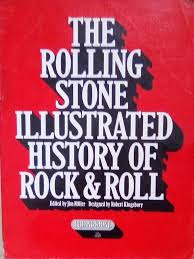
        I chose to illustrate this piece with one that I will never sell, The Rolling Stone Illustrated History Of Rock’n’Roll, published in early 1976. I was living in New York at the time, working as Melody Maker’s US editor, and was sent my copy by someone at the magazine. I recall being impressed by the book’s scope, the quality of the writing and pictures, and the attention to detail in the discographies that followed each act or genre it covered. I loved Nik Cohn’s piece on Phil Spector, and Paul Nelson’s investigation into Bob Dylan, written in the hard-edged style of a Raymond Chandler short story. I found only one mistake, a picture of Uriah Heep vocalist David Byron identified as Ian Hunter but when I pointed this out to the magazine someone there told me to fuck off (as if they didn’t believe me!). This book can still be picked up on Amazon for a reasonable price, and is highly recommended for connoisseurs of this kind of thing but be sure to pick up the original edition above and not later, smaller sized, editions in which the photographs are reduced in size.

        The first rock book I ever read was Hunter Davies’ Beatles biography, in 1969, closely followed by The Sound Of The City by Charlie Gillett, Rock From The Beginning (aka Awopbopaloobop Alopbamboom) by Nik Cohn and Elvis: A Biography by Jerry Hopkins. In those days rock books were few and far between, unlike today when rock books vie with books about film, sport or the royal family in the non-fiction departments in bookshops. 

        Inevitably I have far more books about The Who than any other act. My first Who book was simply called The Who, by Gary Herman, in 1972, and I have reason to believe that the copy on my shelf is a reprinted pirate edition as the cover is in b&w and not colour: see below, with my copy above the genuine one.


        This was the first ever Who book to have been published (in 1972) but now there are over 70, and 68 of them sit on a shelf in my study; biographies of the group and its individual members, day-by-day chronologies, discographies, collections of press cuttings, fiction by Pete, photo books, sheet music books to which I contributed editorial matter, books that focus on one phase of their career and even one on John Entwistle’s guitar collection. Three of them were written by me, and a fourth co-written. There’s about half a dozen Who books I haven’t bothered with because I sense they won’t be much good but by and large the group has been unusually well served by biographers and chroniclers, which is a testament to their cultural importance, though Pete Townshend’s own literary ambitions may have something to do with it. 

        And like my reviews of books on Just Backdated, I didn’t set out to amass a Who library. It just happened that way. 


3.9.24

HOPE I GET OLD BEFORE I DIE – by David Hepworth

David Hepworth writes about the rock trade with great authority, often spiced with dry humour. He mixes facts and figures with judicious comment that can come only from someone who’s seen it all and done it all, and emerged with an understanding that enables him to reveal not only what goes on behind the scenes but also humbug and hypocrisy, occasionally on a large scale. The subject of his latest book, its title a neat transposition of the best line in Pete Townshend’s most famous song, is how and why rock stars and the music they make go on and on and on, gathering younger audiences as the decades pass, a seemingly incomprehensible denial of rock and roll’s first principle, which was to rebel against anything and everything embraced by our parents. 

This subject matter offers Hepworth the opportunity to paint a broad canvas, both chronologically and musically, and include plenty of tales that portray rock stars in a less than favourable light. It unfolds over 36 shortish chapters, all highly readable, that explain just how much the music industry has changed since the days when he and his teenage friends bought vinyl LPs and 7-inch singles, queued at box offices for inexpensive concert tickets and obtained all the info they needed about their rock heroes from the UK’s once thriving weekly music press. This latter aspect of Hepworth’s book has a special significance for me, of course, and I was wryly amused by his observation that, “In the twentieth century, when the job ‘rock journalist’ could at least have been said to exist, there were no academic courses teaching it. In the twenty-first, when the job no longer exists, there are hundreds.” 

        Hepworth astutely cites Live Aid in 1985 as the turning point in the fortunes of the rock industry and those who toil within it. Designed initially as a charity event to benefit the starving in Ethiopia, it became a showcase for several rock stars and groups whose best years were perhaps behind them. It was, writes Hepworth, “the dawning of the Age of Spectacle” and, largely because it attracted a massive global TV audience, it supercharged moribund careers by reminding the world at large, not just fans, of rock’s existence. Experienced performers with savvy, most notably Queen, used the opportunity to present an assured suite of greatest hits, a 20-minute free advertisement for their wares, and since Live Aid coincided roughly with the dawn of the CD age, with it came the realisation on the part of record labels that they could resell all those vinyl records all over again in this shiny new user-friendly format. Ka-ching. 

        His concept established, Hepworth goes on to illustrate it through various manifestations: the Rock and Roll Hall of Fame; groups reforming, not always harmoniously, to cash-in in middle-age; the rise of merchandising, or branding, with the Rolling Stones’ lips and tongue logo “arguably a greater asset than their music”; Elton at Diana’s funeral, signifying that what was once anti-establishment was now the establishment itself; the arrival of computers and iPods and the wholesale realignment of the record industry brought about by the internet and file-sharing; how performance became more significant than selling records; the requirement for once famous headliners to sustain a certain income level in order to maintain obscenely large mansions; how Bob Dylan’s 1985 retrospective box-set Biograph ushered in the trend for expensive multi-disc sets that feature alternative, previously rejected, material; exhibitions of rock ephemera at the V&A; tribute bands; rock at Las Vegas; Dylan’s Nobel Prize; the rise of Clear Channel and Live Nation; how sampling can enrich those who least expect to be enriched; negligible sales of new records by old acts; acts selling their back catalogues to hedge funds; how Abba’s Voyage might signpost the future; and, last in this far from comprehensive list, how death can be good for business. “Death and social media were made for each other,” writes Hepworth, “making it possible to mourn without putting yourself to even the smallest inconvenience.” 

        The book is not without a few minor shortcomings. The chapter on Liz Phair seems surplus to requirements. I fail to understand why in the chapter on Christine McVie and Fleetwood Mac Hepworth fails to mention the extraordinary success of their 1977 LP Rumours and how this impacted on group dynamics. Chapter 18 – The Not Entirely Lonesome Death of John Entwistle – relies overmuch on material gleaned from Paul Rees’s depressing book The Ox. And was Bing Crosby really “the most successful musical entertainer of the twentieth century”, as claimed in chapter 34, when that same century produced Sinatra, Elvis and The Beatles? But these fairly trivial quibbles are mitigated by my delight at the pinpoint turns of phrase with which Hepworth litters his book: Kiss described as “reliably preposterous”, Elton “cannot abide to be idle”, Dylan is “never appropriately dressed”, Mike Love is “traditionally the least modest of the Beach Boys” and Roger Waters “prides himself on not fitting in”. They reminded me of how he described Marc Bolan as “not one for digging out a valuable away point” in his earlier book 1971 – Never A Dull Moment. I still chuckle at that one. 

Hepworth closes his book with a lovely chapter on the legacy and longevity of The Beatles – who else? – and Paul McCartney in particular, entitled – what else? – And In The End.... He equates the life Paul has lived with that of Queen Elizabeth II, “with whom he had something in common… he knew that a large part of his job was simply to raise national morale by being seen, to smile and to wave and give people something to go home and tell at least a hundred other people about… being Paul McCartney might just be wholly unlike being anyone else on earth.” Quite. 

Published today, Hope I Get Old Before I Die has 414 pages, black and white photos introduce each chapter and there’s an eight-page colour section, an idiosyncratic playlist and a useful index. RRP is £25, £20.99 on Amazon.


28.8.24

RICHARD MACPHAIL – The Glue That Held Genesis Together

News reached me yesterday of the passing of my friend Richard Macphail, whose memoir My Book Of Genesis I ghost-wrote for him in 2016. He visited our house many times over that summer to tell me all about his life, focusing mainly on his role as tour manager for Genesis and Peter Gabriel, to whom he remained close. Peter wrote a foreword and four of them – Phil Collins was detained elsewhere - turned out for its launch at a bookshop in Holland Park. 

        As is explained on the back cover of his book, Richard was the singer in Anon, the Charterhouse school group that included Mike Rutherford and Anthony Phillips, which would merge with Peter Gabriel and Tony Banks’ group The Garden Wall to become Genesis. Thereafter he became their one-man road crew, shepherding them from gig to gig, providing a cottage where they could live and rehearse and offering much-needed support when it was most needed. When Peter left, Richard went with him, acting as his tour manager for two years, then took on a similar role with several others, among them Van Morrison and Leonard Cohen, before quitting the rock trade and making a career for himself in alternative energy. 

        His was a great story and I was pleased to be able to help him set it down on paper. On one of his visits to our house we headed off in his car to Christmas Cottage, the small dwelling his parents had owned on Sheephouse Lane at Wotton, about three miles away. The current owner let us look inside, even upstairs where the lads kipped. “Living there were Peter, Tony, Mike, Ant [Anthony Philips], John Mayhew [first drummer] and myself, all of us together in this three-bedroom cottage,” wrote Richard in his book. “What had been my parent’s room had three mattresses on the floor for me, Ant & John. Mike had the little bedroom next to that and what had been my bedroom when I lived there with my parents, which had twin beds, was where Peter and Tony slept.” 

        An enterprising man, Richard published the book himself, selling well over 7,000 copies on the internet or at Genesis fan conventions where tribute bands performed. One or two of them even asked him to mix their stage sound, just as he had done for Genesis in years gone by. The fans looked on Richard as a hero, the sixth member of the group. 

Here we are at the book launch, left to right: Peter Gabriel, Richard, CC, Mike Rutherford, 
Tony Banks and Steve Hackett. 

        It’s my contention that before rock’n’roll tours were conceived, even before those package tours back in the fifties and sixties when anything up to eight acts played on the same bill, the travelling circuses and funfairs of the day relied on men like Richard. Roustabouts, they used to call them. They would tend to the animals, put up the big tops, dodgem rides and waltzers, grab as much cash from the punters as they could, ravish the town’s daughters, then take it all down again and head for the next city. It was a rough, tough, old sort of life, forever on the move, but there was a sliver of romance about it that was hinted at in movies like That’ll Be The Day, with David Essex and Ringo as leery fairground lads on the make, nowhere to hang their hats but plenty of scope for quickies in a filthy caravan. The rock’n’roll road crews of Richard’s era followed the same byways as these circus and fairground roustabouts, inheritors of a proud tradition, bringing pleasure to the masses and fleeing before anyone could catch up with them. 

        That was then. Nowadays the high end rock’n’roll tour industry runs as smoothly as an Olympic figure skater. Concerts are announced anything up to a year in advance, tickets sell out months before the gig, the money banked long before the band has played a note. The acts fly from gig to gig in private jets and employ an army of roadies who travel by luxury coach while drivers – who do nothing else but drive – transport their equipment in huge lorries, all of it packed snugly into flight cases with foam linings. 

        You don’t have to be a fan of Genesis, or even like them very much, to appreciate how men like Richard laid the foundations for today’s multi-billion pound rock tour industry. In 1967, when Genesis started out, they had just one roadie, and that was Richard. Night after night he was first in and last out; he drove, he carried, he cooked, he fetched, he set up the gear and he took it down again, he strung the guitars, he mixed the sound, he fixed the amps, he counted the cash, he jostled, he criticised, he cheered, he watched as the spark became a flame, all the while blowing on it until it became a bonfire.

RIP Richard. 


23.8.24

THE FIRST EVER BEATLES FAN CONVENTION

This week sees the annual Beatles fan convention in Liverpool which closes after the August Bank Holiday weekend. It’s been running, on and off, since 1977 but the first one ever was held 50 years ago in July in America, in Boston, the second two months later at the Commodore Hotel in New York. I was there, reporting on the event for Melody Maker, and what I remember most about it was bumping into May Pang, John Lennon’s partner at the time, whom I knew because she was present when I’d interviewed John in LA the previous year. John has sent May along to buy stuff for him but she didn’t know what John would want and when she saw me she asked my advice. I steered her in the direction of a few bootlegs because John had told me liked them, and since money was no object May bought several. 

I also suggested May buy some prints of photographs taken of The Beatles in Hamburg when they were playing there before they became famous, among them one of John in a doorway in a leather jacket with his hair quiffed up like a rocker. This had been taken in 1960 by their friend Jurgen Volmer who was at the event. We chatted with Jurgen and May bought a print of this same picture. The next time I saw it was on the cover of John’s 1975 LP Rock ‘N’ Roll. 

This was probably the first time fans had witnessed a Beatles tribute act, or any tribute act for that matter, which gives the feature I wrote for Melody Maker a rather archaic tone in the light of today’s tribute band world. Here’s what I wrote for the September 14, 1974, edition of MM: 

Ten years on and you can’t keep a good band down.

Last weekend New York plunged back into the days of Beatlemania. A two-day convention for Beatle fans brought on all the nostalgia for the four mop tops in an overdose of enthusiastic sentimentality that occasionally bordered on the ridiculous.

The loyalty of American Beatle fans is quite frightening. But more frightening still is that in ten years of progressive rock music no other artist or group has had anything like the impact on popular taste that The Beatles had when they exploded into our lives in 1963. (For US readers change that to 1964 – the convention was planned as a ten year anniversary celebration.)

Ironically Beatlefest ’74 – the second such event in the US this year, following the first at Boston a couple of months ago – occurred in a year when all the box-office records that The Beatles set up were well and truly shattered by the likes of Crosby, Stills, Nash & Young or Eric Clapton. Even more anonymous American acts like Grand Funk, Chicago and Three Dog Night have probably eclipsed Beatles sales figures too. 

Beatlefest ’74, the brainchild of one Mark Lapidos, a 26-year-old assistant in a record shop and devoted Beatles fan, was the ultimate nostalgic celebration, offering convincing proof that no matter what people say or think, The Beatles, despite the fact that they’ve split up, remain the biggest rock act in the world. 

“I first had the idea of the festival last November, but it wasn’t until I ran into John in Central Park earlier this year that I decided to do something about I,” Mark told me. “He really liked the idea and put me in touch with people who’d be able to help. From that point on, it was on the road.”

Clearly, Lapidos had put much work into organising the event. It was a labour of love and profits went to Phoenix House, the drug rehabilitation centre in New York, a charity approved by The Beatles themselves. 

A raffle raised most of the money, prizes being guitars donated by John and Paul, a tabla from George and drum sticks from Ringo. In addition, John had autographed books which were auctioned, and 10% of all the new items sold in the market room went directly to charity. They raised $3,000.

The two days of Beatles fun included a host of attractions. There were showings of A Hard Day’s Night, Help!, Yellow Submarine, Magical Mystery Tour and Let It Be, along with more obscure promotional films loaned by Apple and private collectors. 

There were Beatles cartoons (pretty dreadful, actually), and talks given by people who were associated with the group, including Sid Bernstein, the promoter who brought them to Shea Stadium, disc-jockey Murray The K and Pete Bennett, the notorious Apple promotion man in New York.

Bernstein’s talk preceded the showing of the excellent Shea Stadium movie. Tinged with emotion, he told the assembled gathering how he negotiated with Brian Epstein (a huge cheer went up every time Epstein’s name was mentioned and when his face appeared on the screen) to promote The Beatles at Carnegie Hall on their first US appearance, February 13, 1964.

And when the film was shown these Beatle freaks reacted like a live audience, screaming, clapping and yelling as each motop went through their paces. It happened during the Dick Lester films too: whenever Paul shook his dark head or John grinned his absurd ear-to-ear smile, the cheers could be heard a mile along the street. In other rooms there were lectures and panel discussions on The Beatles, an art exhibition, continuous unedited Beatle interviews and swopping and dealing in Beatles merchandise.

The market room, in fact, was the eye-opener of the festival. Collectors were swopping and dealing in Beatles bric-a-brac long since off the production line. There were Beatles badges, Beatle mugs, Beatles dolls, Beatle trays, Beatle jog-saws, Beatle board games, Beatle wigs, and Beatle everything else. Of course, there were records and posters, some old, some new.

The most prized item, it seemed, was a good condition copy of The Beatles’ Yesterday And Today album. This, of course, was never released in Britain though the songs that made up the album were available on other LPs. What made it special, though, was the original sleeve design depicting The Beatles with chopped up baby dolls, which this was hastily deleted. It was re-issued with a different sleeve soon after. 

A mint condition album with the original sleeve was selling at one stall for $225 (about £90). Another stall sold a copy for £175. Singles in picture sleeves were selling at up to ten dollars (£4) and some of the older Beatles badges were selling for a similar amount.

It was a question of shopping around the various stalls to get the best deal. My only purchase was a badge an inch and a half in diameter with a black and white photo on the front with a brass surround. On one stall the badge was selling for $15 and on another for $10. Five minutes bartering and I got it for $7.

I still have the Beatle badge I bought that day. 

The most unusual attraction was a group called Liverpool, a Toronto outfit whose repertoire consists entirely of Beatle songs, mostly latter-day stuff which , of course, was never performed live by the real thing. Dressed to the nine in Sgt Pepper military costumes, the group stunned everyone with almost perfect imitations of Beatles music. 

It was their first New York appearance and they couldn’t have had a more sympathetic audience. Each song was greeted like an old friend and their hour-long set on each of the two nights developed into an emotional sing-along. To hear a thousand people singing ‘Sgt Pepper’s Lonely Hearts Club Band’ brought a tear to many eyes, but their rendering of the medley of pieces from the second side of Abbey Road was the most impressive feature of their set.

They didn’t resemble The Beatles in the slightest, and one observer remarked that they looked more like the Grateful Dead out to fool everyone. A pity their bass player wasn’t left-handed – and he really ought to have had a Hofner Violin bass instead of a Fender. The drummer, however, had a perfect nasal voice, just like Ringo’s.

None of The Beatles turned up which was wise decision. Lennon, in town that weekend, had expressed a wish to go but, realising that he’d probably be torn limb from limb, decided against it and sent an emissary, his new girlfriend. Tony King, boss of Apple, was wandering round enjoying himself.

There was a Beatles quiz that was so difficult no one got all the questions right, though two enterprising fans managed 39 correct answers out of 40. There was a look-alike contest and a sound alike contest, the latter won by a youth who went up an sang ‘Yesterday’ accompanying himself on acoustic guitar and sounded every bit like Paul.

Price of admission was $10 which entitled you to 24 hours solid Beatling. Everyone got their money’s worth. 

“A splendid time is guaranteed for all,” said the programme. Quite right too.


19.8.24

HOLLYWOOD DREAM – The Thunderclap Newman Story by Mark Ian Wilkerson

With a foreword by Pete Townshend and a bold claim on the cover that Thunderclap Newman symbolise the Birth of British Indie Music, Hollywood Dream is a labour of love by an author who has spent years clearing up the details to an unfathomable project tangentially connected to The Who. Nevertheless, there’s good reason to heed the call: of all the one hit wonders that reached number one in the UK during the 1960s none were more enchanting than ‘Something In The Air’, recorded by an ad-hoc group assembled by Townshend to record a song composed by their singer, John ‘Speedy’ Keen, who also happened to be his chauffeur. 

        With a wistful lyric that celebrated revolution at the same time as John & Yoko were knee-deep in their own activism, ‘SITA’ wedded youthful optimism to a persuasive, lilting melody and tumbling guitar figure, its even production and feel-good vibe interrupted by an incongruous barrelhouse piano solo that set the scene for a soaring, climactic final verse. It’s always been a favourite of mine, filed away amongst my Who records as I consider it a sort of ‘honorary’ Who single; produced by Townshend, who also played bass on it, and released on Track, the label run by their co-managers Kit Lambert and Chris Stamp.

This is my own copy of 'Something In The Air'.
Note that Keen is wrongly spelt with an 'e' on the end. 

Mark Wilkerson, a UK-born former US Army helicopter mechanic, brings to Hollywood Dream the same thoroughness he brought to his biography of Townshend, initially self-published but in 2008 issued by Omnibus Press during my editorship. Leaving no stone unturned, it’s a deep dive, mixing just about every contemporary report printed with much original research, and very rewarding it is too, if, like me, you’re fascinated by small details of Townshend’s almost obsessive creativity during this period of his life. Pre-occupied by the thoughts and philosophy of Meher Baba, he’d just created Tommy and was spending most nights performing it on stage with The Who while writing material for Lifehouse/Who’s Next and coming to terms with being a father for the first time. That he also found time to launch Thunderclap Newman, who took their name from pianist Andy Newman, a post-office engineer and avant-garde piano player, beggars belief. 

But while Townshend plays a prominent role in this book (and has assisted the author in his research), the central story is that of the three men around whom the group was formed: Newman, Keen and pint-sized guitar maestro Jimmy McCulloch. Hollywood Dream charts their lives closely, before, during and after the group, and to some extent it’s a tragedy since all three men are no longer around, Newman the last to leave us in 2016 following Keen in 2002 and McCulloch in 1979 at the tender age of 26. 

        They were an unlikely trio. Newman’s odd, bumpy, piano style made a deep impression on Townshend when he gave a lunchtime recital at Ealing Art College in 1963 and thereafter they stayed in touch, Townshend evidently resolved to record him sooner or later. Newman was an implausible pop star; a man of stout girth, bespectacled, untroubled by any hint of sartorial sophistication and, by all accounts, a perfect gentleman who was straight as a die. Keen, on the other hand, had a mixed-up childhood in the mould best labelled as “we were poor but we were happy” – the pages dealing with it are amongst the most touching in the book – and may have spent time behind bars. In his bearing and outlook, he was the direct opposite of Newman’s orthodoxy. Add Scottish McCulloch, who turned 16 the month ‘SITA’ hit the charts and was already fond of anything intoxicating, to the mix and we have perhaps the oddest group ever to see the inside of a recording studio.

        Most of their recording, in fact, was done at Townshend’s own studio at his home by the Thames in Twickenham where Mrs Townshend was caring for babe-in-arms Emma. All this – the formation of the group, recording ‘SITA’ and their LP Hollywood Dream, and the troublesome touring that followed – is covered in great detail, as is the group’s eventual disbandment, which can be attributed to incompatibility and a lack of focus. Townshend wasn’t around to oversee matters, Track Records was a sinking ship and, put simply, no one knew what to make of them. Though it doesn’t lack humour, Wilkerson’s version of Thunderclap Newman’s tale of woe is as precise an account as you’ll find anywhere of what happens in the pop world when things don’t work out right. 

        The final third of the book is devoted to what happened next for our three heroes. McCulloch went on to join Stone The Crows, a group called Blue and Paul McCartney’s Wings, then died with a whole lot of trouble running through his veins, to borrow Springsteen’s take on Elvis. Keen recorded a well-received solo LP, Previous Convictions, that I recall liking a lot, especially a song called ‘Old Fashioned Girl’. (I also recall that its credits appeared in braille on the reverse, as was the case with The Who’s outtakes compilation Odds & Sods, released a year later. I don’t believe any record label other than Track did this.) Neither troubled the charts, nor did a second solo LP on Island, Y’know Wot I Mean? Thereafter Keen did a bit of record production, lived on a boat and enjoyed an idiosyncratic domestic life, all recounted in glorious detail. When he died following a heart attack aged 56, his only son Robert was not yet a year old while his daughter Trish was in her mid-thirties. 

        And what of Newman himself? There was a solo LP, on Track, entitled Rainbow, but the label’s demise left him penniless and, after a few isolated appearances in the 1970s, he went back to working as an electrician. Not until the early 2000s was Newman encouraged by admirers of Hollywood Dream to resurrect the group, now called The Thunderclap Newman Band, including, amongst others, Mark Brzezicki, formerly the drummer with Big Country. Their final show was at the Isle of Wight Festival in 2012. Chronically overweight, Andy Newman died aged 73 at his flat in Vauxhall, and was buried in the suit he wore on stage. “Andy was a true genius, lost in time between the pop music of the 20s and 30s and that of the 20th century,” wrote Townshend in a letter that was read out his funeral.

        Published on October 1, Hollywood Dream is a fine epitaph for this unlikeliest of chart topping groups. It has 420 pages, a few photographs amidst the text but lacks an index. On Amazon it costs £17.67. 


9.8.24

BRUCE SPRINGSTEEN & ANNE MURRAY IN NEW YORK'S CENTRAL PARK, August, 1974

Just over 50 years ago this week I witnessed an unlikely triple bill in New York’s Central Park that backfired somewhat: Canadian MOR/country singer Anne Murray headlining over Bruce Springsteen & The E Street Band with Brewer & Shipley as the opening act. This was precisely 12 months before Born To Run would be released, the third time I’d seen Bruce and I was already a fan. Here’s what I wrote for Melody Maker’s Caught In The Act page, dated August 17, 1974.


Three acts with little in common, Anne Murray, Bruce Springsteen and Brewer & Shipley, were together in Central Park last weekend for another concert in the Schaeffer Music Festival series – an unlikely combination, but one that appeared to satisfy the audience that each artist attracted. If Anne Murray was calm but professional, Springsteen was artistic and inspired, and Brewer & Shipley were dull but competent.

It was Springsteen’s night. Although he was second billed to Ms Murray, he received the biggest ovation and at least half the crowd didn’t stay when he’d finished. The concert was running well overtime but that, I feel, was a secondary factor. He’s all New York, full of songs about the city, while Anne Murray is fresh air and country: the Big Apple is her least likely market.

Springsteen has been deemed the future of rock’n’roll by US critics for over a year now, a burden that’s hard for any man to bear. His Central Park performance was probably his most important show to date and he rose to the occasion, bopping and rocking one moment and romanticising about his youth the next. 

In his vest and black jeans, shades and wispy beard, he’s every inch the New York street kid, straight from West Side Story. He could probably get away with singing ‘Maria’ if he wanted, but his material stands up on its own. The utter helplessness he exudes shines like a light in the darkness and if the tough New York Westsiders could ever cry Bruce would be the man to make it happen. 

If Bruce is unclean but emotional, Anne Murray is clean but unemotional. Bruce could harm but Anne is harmless, a true professional who does a good night’s work for an audience that’s less demanding from an emotional standpoint. 

She’s managed by Shep Gordon, who also manages Alice Cooper, another unlikely combination, and I would question his wisdom in teaming up his client with Bruce. Another noteworthy factor about Anne is the high number of gay women she seems to attract. As the audience filtered down after Springsteen’s set, I couldn’t help but notice the female “couples” who took over the seats at the front. To them, at least, she means as much as Springsteen does to those who were filing out into the night.

Though Anne is aware of this phenomenon, she plays it down. She also ignored isolated, uncalled-for yells of “Bruce” during her set that, when stretched out, sounded like boos. Her songs are fresh and crystal clear, her band (including a string section) polished and professional and her songs are delivered in a heavy, rather deep voice that is more noticeable on stage than on her records.

The girls clapped and cheered and Anne did a couple on encores. When it was all over lots of them were waiting at the back with cameras. Although poles apart, Bruce Springsteen and Anne Murray mean a great deal to a great many.


6.8.24

A FEW WORDS ABOUT JOHN

This morning I learned from his wife Jane that another of my oldest friends, John Holmfield, died yesterday in my old home town of Skipton. Here we are aged about 18 playing our guitars together in my bedroom in my parents’ house there. So I wrote this for him.  


Teenage boys learning to play guitars somehow find one another. It’s a secret society with its own curious customs, a bit like Masons except much more fun. You’ll find a plectrum among the loose change in their pockets, they listen to records more carefully than most people and never, ever, pass by a shop with a guitar in its window without stopping and staring. 

        John and I found one another through our guitars. It was 1963, the year The Beatles released their first LP, perfect timing because one of the first songs we learned to play together was ‘I Saw Her Standing There’, the first track on side one. When we formed our group, ‘I Saw Her Standing There’ was always the opening song at our shows. “One, two, three, f…,” and we were away.

        There were four of us, John, Bob, Terry and myself, four Skipton friends, and we called ourselves The Pandas. John and Bob knew one another because they sang in Skipton Parish Church choir. Bob, Terry and myself all lived up the Raikes, and Bob and I went to the same primary school. John lived across town on Regent Crescent and played bass but didn’t have a real bass, not that it mattered. Bob played drums and he, John and Terry all sang. I was tone deaf, but John especially sang well, though he was a bit withdrawn, never one to push himself forward. I realise now that he was the most musical of all of us, and certainly had the best voice. All we had at first were acoustic guitars and even when we turned electric our equipment wasn’t much good but it was all we had and we made the best of it. When John eventually bought a 30 watt amp, twice as powerful as mine, I was very envious. 

        We used to meet and make plans for our group on Friday nights in the bar at the Midland, the hotel opposite Skipton railway station, now called Herriots, where no one seemed to care that we were under age. John and I soon became drinking buddies around Skipton and grew particularly close after Bob and Terry went to Leeds, Bob to the university there, Terry commuting to work in insurance. John worked in Keighley, in a lab at a school, and I worked in Skipton, on the Craven Herald, the local paper. John and I would bring our guitars to each other’s houses and play together, teaching ourselves songs by The Beatles, The Rolling Stones and The Searchers. Then the four of us would get to together so we could all learn them. 

        The lifetime of The Pandas was about three years and in all that time I doubt we played more than 25 shows. Bob kept a tally in an exercise book with an orange cover, long since sadly lost. We played regularly at the RAF Club by the old swimming pool up Shortbank Road and at Skipton Rugby Club at Sandylands where, one night, we carried on until two in the morning. Angry parents arrived in pyjamas to ferry us home. One night at Gargrave Village Hall we supported a far more competent group from Barrow-in-Furness who played Gibson and Fender guitars. John and I begged them to let us have a go on them, which we did, briefly. We played a few private parties, making a terrible racket in the living rooms of houses where our teenage friends danced while we played. Our biggest show was at Aireville School, with about 100 pupils watching us. Our only ambition was to have fun – and in that we succeeded. 

        In 1967 John and I holidayed together in Scarborough, travelling by coach from Skipton bus station and staying at the St Nicholas hotel. We brought our guitars and I remember us playing them on a grassy hillside that overlooked the beach and sea. No one mistook us for buskers. 

        By this time John and I had moved on from the Midland and discovered the New Ship, a small, cosy pub on Mill Bridge, seen above. I can still remember the first night we went inside. It was full of ramblers, very noisy and very smoky. The bar was tiny, like a kiosk, and there was a back room behind it where regulars gathered for afters. The Ship grew in popularity during the second half of the 1960s, becoming one of the busiest pubs in town, at least among the under 25s. From around 1965 we drank nowhere else in Skipton, though when I got a car John and I would drive up the Dales, to the Devonshire Arms in Cracoe and the Old Hall in Threshfield. We talked about girls and guitars and records, and spent a good deal of time assessing the quality of the beer. John was always partial to Youngers IPA. 

        I introduced John to Alison, his first wife. She worked as a secretary in the advertising department at the Craven Herald, and, in fact, I’d made a feeble attempt at courting her myself, soon abandoned when I realised we had little in common. I came up from London for their wedding at Threshfield and visited John and Alison at the house where they lived in Embsay. It saddened me that the marriage didn’t last but I was somehow relieved when John told me they’d parted on good terms and remained so. Later he married Jane and I visited them too. By this time John had a white Strat and I had a sunburst one, Fenders at last but no audience to listen to us. 

        John was the only Panda to remain in Skipton. Bob settled near Hull where he became a solicitor and Terry’s subsequent whereabouts would always be a bit of a mystery. I went to live in London, then America, then London again, and by this time our lives had taken very diverse paths. Nevertheless, whenever I came up to Skipton to see my dad I generally looked in on John. Then, after my dad died in 1997, these visits more or less ceased. 

        Nevertheless, when you become a member of a pop group, even a group as insignificant as The Pandas, there’s a bond that remains always. It’s got something to do with being up there on a stage together without a safety net, knowing that you’re relying on each other to reach the end of the song without making a mistake, all for one and one for all. It’s a bit like playing together on a sports team, or working together on a successful project, a memory that stays with you, warm, nostalgic and comforting. Unforgettable, unbreakable.  

        In 2014, when John and I were told by his wife Yvonne that cancer was overtaking Bob and he wouldn’t last more than a few months, we spent an evening at their house near Hull, playing together again one last time. The first song we played was ‘I Saw Her Standing There’. “One, two, three, f…” and it was 1963 again. RIP John and Bob.  

CC, Bob - now playing bass - and John, at Bob's house in 2014. 


30.7.24

DREAMS – THE MANY LIVES OF FLEETWOOD MAC by Mark Blake

Had William Shakespeare lived in the 20th Century he’d have written plays about the UK’s great rock groups instead of kings, queens and ill-fated lovers who communicate from balconies. All the elements are there: feuds, deceit, romance, jealously, madness, death, and nothing personifies these plot lines more than the epic saga of Fleetwood Mac, whose 18 participants are helpfully itemised by Mark Blake whose cast of characters resembles dramatis personae in a theatre programme.  

Only two of those 18, Mick Fleetwood and John McVie, are on stage throughout the performance, which lasts for 55 years, assuming the death of Christine McVie in 2022 brings down the final curtain. These characters are listed alphabetically, with the first, Bekka Bramlett, ‘fired by fax’, and the last, Bob Weston, ‘fired for adultery’. In between we find unlikely actors like Dave Mason and Neil Finn, respectively better known for their roles in Traffic and Crowded House, but topping the bill alongside Mick, John and Christine are Peter Green, their original guitarist, and Lindsey Buckingham and Stevie Nicks whose arrival in 1975 brought about the renaissance that propelled Fleetwood Mac to the stratosphere, guaranteeing them lines around the block (and on mirrors), bulging bank accounts and fantasy lifestyles in line with midsummer night’s dreams.

It’s a complicated plot, a daunting task for any playwright, and Mark Blake presents it in seven acts, each containing many scenes, 108 in total, some quite brief, others far longer, individually dealing with an aspect of FM, a musician, a song, an LP or an event, in roughly chronological sequence, albeit skewed slightly by Blake’s decision, probably wise, to bring almost everyone’s story up to date at the earliest opportunity. By this means he steers a steady passage through the choppy waters of FM’s story, a turbulent stream that has been navigated before, albeit not quite so methodically. Lest methodical suggests dry, fear not however: some scenes, mostly the shorter ones, are as quirky as you’ll find anywhere, which is entirely in keeping with the comedy and drama that has visited Fleetwood Mac over the years, much of it – but by no means all – of their own making. 

        Act I opens with Peter Green, legendary blues guitar hero whose greatest skill, unlike many of his peers, was always knowing what not to play, but who was once cautioned by police for hitting a neighbour with a loaf of bread. “It made me very sad,” says John McVie, which sums up the general attitude towards the founding FM father’s mental decline. The final Act closes with the death of Christine, FM’s secret weapon, a discreet team player, forever unobtrusive yet crucial to their pop success, which I’m sure made everyone who’s ever owned an FM record very sad too.

        Green is followed by Bob Brunning, their earliest bass player, who lasted just two months and left FM to become a schoolteacher. He’s one of several whose roles are somewhere between supporting actors and extras in the story; his stay was the shortest. Next, we leap to Mick, the joint longest in terms of years and by far the longest in terms of feet and inches, and here we’re into the meat of the book where the depth of research is selective but admirable, by which I mean Blake omits the dull stuff but focuses on the eccentricity, not least his pre-occupation with genitalia and wildly fluctuating bank account. 

        There’s lots more weird stuff as we progress through this complex tale. Next up is Jeremy Spencer who, like Green, was deranged by religion, rather more so in fact, quitting without telling anyone in the band to join The Children of God, and, in later years, returning to music with the sect’s approval. Next up is John, Mick’s loyal but boozy partner, who is as dull as dishwater compared to just about everyone else. 

        There’s diversions, among them a meditation on ‘Albatross’ and the identity of the black magic woman, before we arrive at the fate of FM’s third troubled guitarist, Danny Kirwan, writer of ‘Dragonfly’, who, in 1980, was sleeping on a park bench. “I couldn’t handle the lifestyle and the women and the travelling,” he says. Danny died from pneumonia, aged 68, in a care home in south London. Then, in what is becoming an almost predictable tradition, another guitarist, American Bob Welch, comes and goes, his great contribution persuading the others to move to California where, it turns out, a pot of gold awaits at the end of Sunset Boulevard. 

        Before this happens, however, Christine has married John, they’ve all moved into a country house in Hampshire, a singer called Dave Walker and another guitarist, Bob Weston, have been and gone, the latter axed for embarking on an affair with Mick Fleetwood’s wife Jenny, sister of Pattie Boyd-Harrison-Clapton. This leaves the group in disarray, not for the first time, stranded in California with nothing on the horizon, which prompts manager Clifford Davis to recruit five random musicians, call them Fleetwood Mac and send them on an American tour, an episode curiously mirrored in attempts by phoneys to impersonate Jeremy Spencer and Peter Green. Around the same time Christine starts an affair with studio engineer Martin Birch. Could the unrelenting drama get any worse? 

        It does, but not before things get better and better. By now we’ve reached Act III in Blake’s book, the arrival of Lindsey Buckingham and Stevie Nicks who turn the group’s fortunes around and within two years they’re one of the best-selling bands of all time. Having abandoned their blues roots they embrace AOR and, rightly, the ‘white’ album and Rumours get fulsome coverage, not that everyone’s amorous exploits take a back seat. In fact, it is almost de rigour for everyone in the group’s inner circle to leap in and out of bed with colleagues, employees or friends; Mick with Stevie, Christine with a lighting guy, Stevie with an Eagle, Lindsey with a costume designer called Carol, to whom Rod Stewart took a fancy and who, as a result, is swiftly escorted from her midst. 

        Act IV deals with Rumours and takes us to Tusk, the era when FM’s spending knew no bounds, mostly on drugs. I was relieved to learn that stories about Stevie having cocaine blown up her backside have no basis in fact. Act V features Mirage and Tango In The Night, and includes a detour about Christine’s ill-considered romance with doomed Beach Boy Dennis Wilson who spent lavishly on her, albeit with her own money, and others about Billy Burnette and Rick Vito, dual understudies for Buckingham when he went awol, as he was prone to do. Much the same applies to Dave Mason and Bekka Bramlett who understudied for Christine, though the Rumours quintet regrouped – not entirely amicably – for Bill Clinton’s presidential inauguration ball in 1993. 

        With two acts to go, I was beginning to admire Mark Blake’s stamina. Act VI opens by dissecting The Dance, FM’s live album, and closes with a scene about penguins that reveals how John McVie, who has one tattooed on his right forearm, can tell the difference between an Adélie, a Gentoo, a rockhopper and a Humboldt. Act VII covers the recruitment of two further Buckingham understudies, Neil Finn and Tom Petty guitarist Mike Campbell, whose solos went on too long for Stevie. “She would get exhausted playing tambourine,” says Mike. “And say, ‘Fucking hell, Lindsey only did twelve bars.’”

Fittingly, Blake devotes the closing scene of Act VII to Christine, her life and legacy. After all the craziness that’s gone before, it’s somehow reassuring to learn how she escaped from the madness, sensibly retiring to a country house in Kent, became bored, then overcame her fear of flying to rejoin FM for the final tour with Finn and Campbell. “She’s a lovely, lovely lady, even though she told me to fuck off,” adds her bass playing ex-husband, not a line you’ll find in Shakespeare’s oeuvre. 

        Published by Nine Eight Books, an imprint on Bonnier, in September, Dreams has 408 pages but, according to the author, lacks a photo section and index, which is sub-standard for a book of this scope and ambition. It is priced at £15.45 on Amazon.