17.3.16

THE WHO – Focusing On Nowhere, Investigating Miles


This photograph of yours truly with Ian McLagan and Kenney Jones, taken is Los Angeles in 1973, appeared on my Facebook page last weekend and came from a bulging green envelope folder that was named ‘Who Bio Etc’ that I found at the bottom of a pile of old Q magazines underneath our staircase. It also contained piles of Who documents that date from 1981 when I was researching my book The Who: The Illustrated Biography, published by Omnibus Press in 1982, and my book on Pete Townshend that came out a couple of years later. In view of the high standard of many subsequent Who-related books, both seem rather slight nowadays but at the time I was quite proud of them.
So I scanned some of the documents in the folder to post on Just Backdated with a few notes about each item.
When I wrote those books I asked Pete for his help. It was, of course, during the period when he ran his own book publishing company, Eel Pie Books, so the request was a bit of a long shot as I was writing for a rival company. Nevertheless Pete took the trouble to reply, gracefully, as the letter below indicates, and even cc’d the letter to his mum and dad in case I went snooping around their house in Ealing. Heaven forbid! Nevertheless, I’m pretty sure nine out of ten rock stars would have thrown my letter in the bin.


Denied access to the source I did what all researchers do and went to the Public Records office, in those days at Somerset House at Aldwych where records of British births, marriages and death are kept. Over the course of several days I painstakingly looked up such documents as I could find that related to the Townshend family. I found Pete’s birth certificate, his mum and dad’s wedding certificate and the wedding certificates of both of his grandfathers, Horace Townshend and Maurice Dennis, respectively a fishmonger and a ‘tailor’s butter’, whatever that is. Happily all of these documents were in my Who folder and they are below.


All the information I gleaned from these documents enabled me to flesh out the opening chapter in my biography of Pete. There was no internet in those days but I somehow discovered that Horace Townshend, whom Pete refers to as Horry in his book Who I Am, was a semi-pro musician and composer who with his wife Dorothy (Dot) performed at music halls and at seaside parks in the 1920s, sometimes with the Jack Shepherd Concert Party. A bit of asking around led me to an expert on Music Hall, a very old bloke who lived in a small flat in Bayswater that was chock full of Music Hall memorabilia, and in a book he showed me there was a picture of the Jack Shepherd Concert Party on stage in Brighton. Unfortunately he was reluctant to lend me the book so I couldn’t include the picture in my own book, not that I knew for sure that Horry and Dot were in the picture anyway. But – surprise, surprise – it’s on the internet now, and I’ve reproduced it below. My Music Hall expert did vaguely recall Pete’s paternal grandparents when I mentioned their names and they might just might be on this stage. Even if they aren’t this is the sort of event that Pete’s granddad and granny would have appeared at – a bit different from smashing guitars at the Marquee Club I know, but everything starts somewhere.


More bits and pieces tomorrow.

16.3.16

IT’S ONLY A NORTHERN SONG


So Sony now owns ATV Music which in turn owns Northern Songs, the company formed in 1963 to administer and benefit from the Lennon-McCartney songwriting catalogue. Its original owners were music publisher Dick James, Beatles manager Brian Epstein and songwriting Beatles John and Paul. If the reports in today’s newspapers are true, Sony has bought from the Michael Jackson Estate the 50% of ATV Music it didn’t already own for $750 million, meaning that its total value is $1.5 billion. Granted there’s more to it than just The Beatles’ songs but they are the jewel in its crown so it’s not a bad result for a couple of Liverpool teenagers who, in their own words, “sagged off” from school so they could spend their afternoons writing songs together at Paul’s Forthlin Road house back in 1958. “Another Lennon-McCartney Original” they would scrawl above the words to songs like ‘Too Bad About Sorrows’ and ‘Because I Know You Love Me So’*, neither of which they completed, let alone played or recorded with The Beatles.


The story of how the “Lennon-McCartney Originals” changed hands many times and ended up being worth well over a billion dollars and owned by a Japanese electronics conglomerate is long and convoluted. Many years ago I commissioned an entire book on the subject – its cover is above – but in a nutshell Dick James got cold feet when John ran off with Yoko and sold his 50% to Lou Grade, the owner of ATV which in those days was a television company. Clive Epstein, who had inherited 10% from his brother Brian, sold out to Grade too, and John and Paul were persuaded by Allen Klein to pledge their 20% each to a bank in a deal to acquire Northern Songs that went sour, thus enabling Grade to snap up their share as well. Grade subsequently sold out to an Australian entrepreneur who, when his business went pear-shaped in 1985, sold out to Michael Jackson who was looking for somewhere to park the massive royalties he’s earned from Thriller.
The sale price then was $47.5 million, a tiny fraction of what it is worth today and a sum that Paul could have raised had he felt so inclined, especially if Yoko chipped in. Paul, miffed that he would have to stump up such a tidy sum for what he felt was rightly his in the first place, didn’t feel inclined and relations between him and Jackson thereafter went into terminal decline. When Jackson’s spending habits got out of hand in the early 2000s he sold half to Sony for around $100 million and now Sony has bought the other half for seven and half times that, meaning Jackson’s three children are what Jane Austin might have called “eligible”, to say the least, though, according to reports, under Michael’s will they have to wait until they are 30 to get their hands on the dosh.
All of which makes me rather sad, and I’m sure that Paul McCartney – wherever he happens to be today – will be feeling the same as he scans the newspapers over his boiled egg, toast and coffee. Of course he’s massively wealthy anyway, probably the richest rock musician in the world, and he’s recently announced a series of tour dates for 2016 at which he will no doubt sing many of those “Lennon-McCartney Originals” to massive acclaim yet again.
But the fact that the legacy of The Beatles – their songs – is owned not by Paul and Yoko is a triumph for unrestricted capitalism and a tragedy for those who create music, whether it be as magnificent as that of The Beatles or simply any mediocre songwriter who’s been obliged to sell the rights to his work to eat. It is also a depressing echo of how so much else of cultural merit that this country has produced is owned not by those who created it but by sharp businessmen wherever they may lurk.
Lennon & McCartney gave us magic. Businessmen only give us their funny paper.


*I am indebted to Mark Lewisohn’s wonderful Beatles biography Tune In for the titles of these two phantom Lennon & McCartney originals (very rough versions of which finally saw the light of day on the ‘Fly On The Wall’ bonus disc that accompanied Let It Be Naked.)

9.3.16

GEORGE MARTIN RIP


There have been so many premature deaths of men and women associated with The Beatles that it comes almost as something of a relief that their great record producer George Martin bucked the trend by living to the age of 90. One of only three men upon whom the title of ‘fifth Beatle’ might deservedly be bestowed – the others are Brian Epstein and Neil Aspinall – Martin’s greatest achievement was not so much the production of The Beatles’ records or even in recognising the group's potential in the first place. No, for my money it was giving them the space in which to grow, marshalling their talents without in any way curbing their instincts and never – unlike so many other record producers of his era – dictatorially imposing his own ideas on the way their music should sound. In taking this course Martin allowed the Beatles’ extraordinary collective imagination to flourish without constraint, with the result that their catalogue of songs remains virtually peerless, a blue print for excellence in popular music that has yet to be surpassed.
          Looking back at his life up to the moment that he came into contact with them and Brian Epstein, this might seem unlikely. Although not rich, Martin was ‘officer class’, a man with bearing whose presence commanded respect. I met him only twice and briefly at that, once in London at some record company reception during the seventies and again in 1990 at Paul McCartney’s farm near Peasmarsh in Sussex on the occasion of Paul’s daughter Mary’s 21st birthday party. (At the time Mary was working as a photo researcher at Music Sales and I was her boss.) On both occasions I felt inclined to address George Martin as ‘Sir’, even though he wouldn’t receive his Knighthood until 1996. The reason was his bearing, his air of distinction, the appearance of someone to whom respect needed to be shown. On the first occasion he was wearing a dark blue suit and on the second dressed immaculately as Sir Thomas More – it was a fancy dress party – but even if he’d been wearing jeans and a t-shirt I doubt I’d have addressed him as whack, let alone expressed a disapproving opinion with regard to his tie, as the other George famously did during their first meeting at Abbey Road in 1962.
So it is to his immense credit that instead of balling them out after George’s remark or – more importantly – when they showed a distinct lack of enthusiasm for recording ‘How Do You Do It’, the promising Mitch Murray song, he overlooked what was in reality a precedent-setting infraction of music biz protocol and allowed his new signing to record their own ‘Please Please Me’ instead, at the same time suggesting a change in tempo and arrangement. A few weeks later ‘Please Please Me’ became The Beatles’ first number one (‘How Do You Do It’ was also a number one, of course, for the far less intractable Gerry & The Pacemakers) and a lesson was learned by one and all. George Martin would give The Beatles their rein but at same time chip in where he thought his considerable skills as a trained musician might help. In return The Beatles would treat Martin as an almost-equal partner in the studio but never as a sergeant-major who must be obeyed. It was the ideal creative relationship but it would never have happened if Martin hadn’t been flexible when faced with this potentially destructive early skirmish.
There’s a lot more to be said about George Martin than this of course and I’m sure the tributes will flow tomorrow, along with far more comprehensive accounts of his life and achievements. Nevertheless, I believe that alongside the many other instances when Martin’s musical skills, generous devotion to duty and persuasive diplomacy smoothed The Beatles’ progress, this early example of good judgment over ‘Please Please Me’ was crucial in establishing the mutual respect that became the key factor in the alliance between him and the greatest pop group of them all. We have much to thank him for.
RIP Sir George.

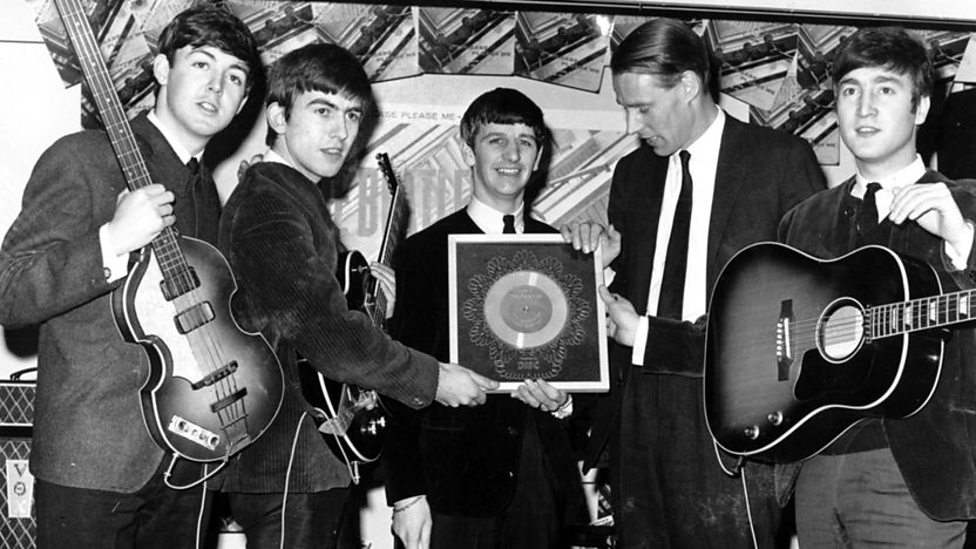
I think the photo I took from the internet is of J, P, G & R with George M getting their gold disc for ‘Please Please Me’. Looks like it from the length of their hair.


6.3.16

R&R HoF 2016


As a voter, I have been remiss in not commenting on this year's inductees into the Rock and Roll Hall of Fame., so here goes…
        It is a truth universally acknowledged that groups whose personnel has fluctuated radically during their life span will undergo problems when it comes to being inducted into the HoF. Death is not an issue, but living former members certainly are, especially as the ’25-year rule’ dictates that this length of time must elapse between the release of a debut recording and nomination. This creates situations where founder members can be nominated and inducted while current members, who may not have contributed to classic recording but have still been a member of a group for donkey’s years, are excluded.
        Those who will be inducted at the ceremony in New York this April are Cheap Trick, Chicago, Deep Purple, Steve Miller and NWA, with songwriter-producer Bert Berns as the non-performer. The nominees who failed to get past the selection process were The Cars, Chic, Janet Jackson, The JBs, Chaka Khan, Los Lobos, Nine Inch Nails, The Smiths, The Spinners and Yes. I voted for The Smiths, Deep Purple, Yes, Cheap Trick and Steve Miller, this latter choice the result of polling visitors to Just Backdated, so three of my five got in.
        I was less than surprised that The Smiths didn’t get in, not so much because they didn’t deserve it but because Morrissey’s legendary truculence would have weighed against him. The organisers don’t really want someone with his waspishness delivering a speech promoting vegetarianism or whatever cause he is espousing this year and, of course, it’s unlikely he would have willingly shared a stage with Smiths drummer Mike Joyce, his sworn adversary since the High Court ruled against Morrissey (and Johnny Marr) in the Smiths’ royalty dispute.
        I thought Yes stood a better chance as their claim goes back further and although their personnel has been unstable (20 musicians have passed through Yes at the last count) no one seems to bear a grudge against anyone else any more. Also, their nomination would have been a fitting tribute to bass player Chris Squire, who until his death in 2015 was the most consistent member of the group and the one who worked hardest at holding it together.
        As regards those who did pass muster, Cheap Trick have had their ups and downs personnel-wise, with only vocalist Robin Zander and guitarist Rick Neilsen consistent throughout. Bassist Tom Petersen is back in the fold after a wobble in the eighties, and drummer Bun E. Carlos, who sued the band over something or other, is back in the fold, albeit nowadays as a non-performing member.
        Which brings me to Deep Purple, once a group with whom I was on friendly terms and whose semi-authorised biography I wrote back in 1981. I say ‘semi’ because not everyone involved co-operated on the project, the most regrettable absentee in this regard being guitarist Ritchie Blackmore, who along with Jon Lord founded the group in 1968. Jon died in 2012 but Ritchie is alive and well, albeit it estranged from the current band which nowadays comprises the third founding member, drummer Ian Paice, as well as singer Ian Gillan and bassist Roger Glover, who have been with Purple on and off since 1969, guitarist Steve Morse, who joined in 1994, and keyboard player Don Airey who took over from Lord in 2002 when Jon decided he didn’t want to tour any more.
        Deep Purple are a relatively stable group these days, though by the time they decided to call it a day for the first time, in 1976, ten musicians had passed through their ranks. In addition to Morse and Airey, the line-ups since their reformation in 1984 have also included singer Joe Lyn Turner (1989-92) and guitarist Joe Satriani (1993/4), who was hurriedly (and briefly) recruited when Blackmore walked out on Purple for the last time in 1993.
        There is no love lost between the current band and their manager on the one side and Blackmore on the other which is why, even though he will be inducted, the guitar legend has evidently declined to attend the 2016 Hall of Fame ceremony on April 8. It seems the current band have refused to perform with Ritchie who would have been obliged to sit and watch them perform his songs, no doubt ‘Smoke On The Water’, their best known number with a riff so well known that even I can play it.
        According to reports, David Coverdale (lead singer from 1973-76) and Glenn Hughes (bass playing singer during the same period) are being inducted while current members Morse and Don Airey, who have served for the last 22 and 14 years respectively, have been excluded. I have no data regarding the two other original members singer Rod Evans and bass Nick Simper who were ousted in 1969 to make room for Gillan and Glover, but if they too are inducted it would seem to be an injustice against Morse and Airey whose length of service now exceeds even Blackmore.
        Personally I think they should let bygones be bygones, and get Ritchie up on that stage so he can crank out ‘Smoke On The Water’. It’s credited to all five members of the ‘classic’ Purple line-up but I have a sneaky feeling that it was their man in black who coined that legendary riff.

1.3.16

TEENAGE KICKS, MY LIFE AS AN UNDERTONE – By Michael Bradley


This is an extract from the newly published autobiography by Michael Bradley, the bass player in The Undertones who joined his school friends in the group in 1974. Four year later they recorded ‘Teenage Kicks’ which famously became John Peel’s favourite song ever, just as The Undertones became one of the most fondly remembered groups on the post-punk era.
          Michael’s story is a bitter sweet, heartwarming and occasionally hilarious tale of unlikely success, petty feuding and playful mischief during five years of growing up in the music industry.
We join Michael and his friends on the night in 1974 when John Peel played ‘Teenage Kicks’ for the first time on his radio show. Their world would never be the same.


We were in O’Neill’s kitchen that night listening to the radio.
          Some moments in your life can never be bettered and that was one. There wasn’t an outbreak of cheering, high fiving or back slapping. A few ‘Yes!’s may have been uttered but that was all. The reference to Loudon Wainwright III left us a bit puzzled but I suspect at that moment we would have been happy to be compared with Loudon Wainwright II or even The I.
          John Peel liked our record. Damn it, John Peel LOVED our record.
          It took a few days from Peel playing it to the first phone calls arriving from London record companies. We didn’t have a phone in our house, so I would get updates each day when I went down to Beechwood Avenue. Not that there was much to be updated on, as none of the companies suggested bringing us over to see them or, even more unlikely, them coming to see us.
          Not until the man from Sire Records got in touch.
          The story as told by no less a man than Seymour Stein himself is that he was driving – or being driven – to a Searchers show in the south of England. Seymour owned Sire Records, a New York label which had The Ramones and Talking Heads. Before punk Sire had specialised in signing British bands, including Barclay James Harvest and the Climax Blues Band, but we’ll forgive him for that.
          By 1978 he’d started to recruit new UK bands (The Rezillos) and old UK bands (The Searchers).
          He was listening to John Peel the night ‘Teenage Kicks’ was played and decided he wanted that band. Us.
          To prove he was serious he sent the entire staff from Sire’s London office to Derry to see if we were worth the chase.
          Paul McNally was that entire staff. Paul was tanned, fair haired and a very gentle man. To our ears he spoke with a posh English accent although we had only the Queen and Peter Purves to compare him with. He arrived at the Casbah in the company of Terri Hooley, who spoke the native tongue, and Ian Birch, a journalist with Melody Maker. I think the real reason Paul came over was to check that we had more songs than the four he had heard on the EP. Which we had, of course.
          There was an atmosphere of celebration when it became known that someone from Sire was in the room, someone who might give us a deal. Record companies never came to Derry. Not proper record companies who offered contracts, who released records around the world and who had bands on Top Of The Pops and The Old Grey Whistle Test. The Casbah was so small that we were in eye contact with Paul McNally the whole night but we weren’t at all nervous. We had the confidence that the Patronage Of Peel gives you. Even if Paul hated us, we were still sure that someone else would come through the Casbah’s doors, tossing 30 pence into Big Tony’s outstretched hand and holding out a piece of paper and a pen to sign it with. It turned out that Paul did like us, as did Ian Birch. After a quick conversation at the bar after the show, it was agreed that we’d meet up again the next day at Feargal’s house for a meeting about The Future. Ian Birch impressed us with the fact that he had a really nice Steel Pulse badge in his lapel. It wasn’t the standard round button job, but the band’s name cut out in, presumably, steel and attached to the lapel with a small stud fastener. Much too tempting for one of our fans who, with admirable sleight of hand, managed to remove it while Ian had his jacket casually slung over his shoulder.
          Paul McNally once said that he had difficulty working out who was actually in the band and who wasn’t, when faced with nine of us in Feargal’s front room the next day. The band were there, of course. So was Vinny, naturally. Eugene Martin took his usual place, as did Paddy Crawford (now sporting a Steel Pulse badge) and Joe Breslin. Undeterred, Paul ploughed on with his comments on the band, last night’s performance and his intention to sign us to Sire. We were flattered that the home of The Ramones was even interested in taking us in so when Paul handed us the contract he was already half way to a deal. Sixty per cent, in fact. We decided there and then that John, Billy and Dee would put their names on the dotted line as it stood. Feargal and I would only sign after negotiating better terms with the man himself, Seymour Stein.
          In 1978 Derry’s legal community was busy representing young men who were involved in the many and varied attempts at overthrowing the state. Rioting had been in decline since the early seventies but still had the occasional revival. Some of our school friends had taken the cause of Irish Republicanism a little further than others and found themselves charged with membership and possession. Membership of the IRA and possession of arms or explosives.
          So it was entirely reasonable that our local solicitors were expert at representing teenagers with guns, rather than teenagers with guitars. Feargal took a copy of the Sire contract to a legal professional on Clarendon Street, home to many solicitors offices. He looked at the clauses. Not having anything to compare it with, he declared that, yes, it was indeed a contract. Nothing unreasonable in its contents.
          So, like Michael Collins some 60 years earlier, Feargal and I were off to London to negotiate on behalf of our people back home. Collins went to Downing Street to negotiate with Lloyd George. We went to Baker Street to parley with Seymour Stein. Neither party came back with a good deal.
          The London trip started well. For one thing, we flew in an aeroplane. This is important, because a couple of months earlier, Feargal and I (along with Billy and Eugene Martin) decided to go to London for a holiday and could only afford the train. Trains were cheap then, planes were expensive.
          It is, I know, the reverse today.
          Northern Ireland Railways ran a cross-channel service to London via the Larne to Stranraer ferry. It left Derry at twenty to three in the afternoon and arrived at Euston Station the following morning at five minutes past eight. No sleep and no sleepers for us. Sitting upright on the seat and worrying about being robbed were the main ways of passing the time. We went to London to see what the centre of the punk rock universe was actually like in 1978. Neglecting to bring much money, we soon discovered that even the most horrible B&B in the most horrible street wasn’t cheap. We had enough cash for the four of us to share one room for three nights in Earls Court. After that, we were directed towards a large camp called Tent City, which was way out west. Acton, I think. We got refuge in a large green tent. Can’t remember how much we paid, but compared to the £12 each for the B&B it was a bargain. It also meant we could afford to eat. I remember on that trip we went out for something to cure our hunger and stood in the doorway of McDonalds on Earls Court Road. I was amazed at the cost of the hamburgers. We had just come from a city where even a Hawaiian Burger (pineapple ring and thousand island dressing) cost 45 pence. In 1978 the golden arches had yet to reach across to Derry but I had read about McDonalds in NME and was curious about it.
          Not that curious that I would spend 75 pence on a Big Mac, though.


17.2.16

VINYL - It's Only Rock'n'Roll


It’s always comical to see characters you’ve known in real life portrayed on film, famous or otherwise. When they get it wrong, it’s discomforting too, slightly cringeworthy. So it was with Ian Hart, the actor who played Led Zeppelin’s manager Peter Grant in the first two-hour opener of Vinyl, the Martin Scorcese/Mick Jagger dramatisation of sleazy goings on in the seventies rock business, that appeared on our TV screen this week.
          Unlike Robert De Niro, who ate a mountain of pasta to put on several stone for his role as boxer Jake LaMotta in Raging Bull, Hart wasn’t quite so dedicated, so he actually appears quite a bit shorter and not much heavier than those who recoil at his furious effing and blinding. In a brief scene copied almost word for word from Grant’s famous cameo in The Song Remains The Same – the one where he berates a promoter for permitting the sale of unauthorised merchandise inside a venue – Grant comes over not so much menacing as irritating, like one of those annoying short fat people who shout and scream a lot because that’s the only way they can be heard. Anyone confronted with the real angry Peter Grant knows how much more menacing he truly could be when he wanted.
          Unlikely as it may seem, the premise is that in 1973 Grant might sign Led Zeppelin to the fictitious label American Century instead of staying with Atlantic. Negotiations having evidently reached stalemate, a bit later he’s seen in their New York offices throwing a gigantic wobbly because the owners of the label might sell out to a German company. “My fucking nan has a piece of shrapnel in her fucking arse thanks to those Nazi bastards,” is the gist of his complaint, but in this scene, which climaxes with ‘Grant’ sending a plate of bagels across the room, he’s wearing a dark suit, not an item of clothing I ever saw Peter wearing in my day. Maybe the real Peter once wore a suit like this as a mark of respect to Jagger – but that’s about as likely as Peter ever accepting anything less than 100% of what Zeppelin was owed.
           It’s things like this – and an actor who plays Robert Plant, backstage, sounding more Australian than West Midlands – that make me recoil from productions like Vinyl. No matter how hard they try – and this one does try hard – they can’t quite get it right. Better, I think, not to have bothered with the ‘Zep might have signed with Century’ storyline, especially as it’s a subplot to the main story.
          That story hinges on whether or not the label chief, Richie Fenestra (Bobby Cannavale), can sell his once successful label to a German conglomerate for $millions when it’s on the skids, propped up by crooked book-keeping and artists long past their sell by date. Flashbacks reveal Fenestra’s beginnings in the industry, sleazy suits from the fifties having indoctrinated him into the industry’s dubious royalty accounting methods very early on. In this way we are led to believe that the music business has been riddled with corruption since the fifties, which is probably true, at least as far as the black R&B performers from that era are concerned.
          The only hope for Fenestra’s American Century seems to lie with a sparky drug-dealing assistant in the A&R department (Jamie, played by Juno Temple) who discovers a punk rock band called Nasty Bits led by nihilistic singer Kip Stevens, played in appropriately surly fashion by Jagger’s son James. “What do you care about?” she asks him after a vigorous shag. “Fucking,” he replies. “I don’t give a fuck about anything else.” A light goes on in our A&R girl’s head, the same one that illuminated Malcolm McLaren methinks.
          The production has been compared with Mad Men, but although the soundtrack, clothes and other props are authentic the dialogue is often clichéd and nowhere near as cool. The mid-morning stiff whiskey enjoyed by Don Draper and his advertising agency pals is exchanged for snorts of cocaine, of course, and the warning about strong language and adult themes is more than justified. There’s sex, drugs and cussing galore, and even a grisly murder. Most of the characters in the music business look like the notorious manager Dee Anthony; short, fat, bearded, stroppy and a bit shady, a cross between Mafiosi and the kind of slick-suited promotion men who handed over packets of white powder, $100 bills and introductions to hookers along with the records they wanted DJs to play.
           This opening episode was bookended by a New York Dolls concert attended by Fenestra at the Mercer Arts Centre, and the group that portrayed the Dolls certainly made a decent fist of ‘Personality Crisis’. At the end the Mercer comes crashing down, as it did in real life, with Fenestra scrambling from the wreckage, surely a metaphor for the way his life and the series are headed.
           I’ll keep watching, if only to see which characters I knew in real life appear next week. Maybe it’ll be an Melody Maker writer.

16.2.16

THE WHO – Last Three Track Singles

Here’s my text the final three Who singles that were included in the Track Records box set.


A: Let’s See Action
Written by Pete Townshend. © 1971 Fabulous Music Ltd.
Produced by The Who, associate producer Glyn Johns.

B: When I Was A Boy
Written by John Entwistle. © 1971 Whistle Rhymes
Produced by The Who, associate producer Glyn Johns.

Originally released as Track 2094 012 on 15 October 1971, it reached Number 16 in the British charts

Like ‘Won’t Get Fooled Again, ‘Let’s See Action’ is a call to arms, albeit less clamorous in tone with an almost folksy feel, its slight but appealing melody carried along by a trilling piano played by Nicky Hopkins. It was the first in a series of three Who A-sides to utilise songs left over from the Lifehouse sessions, the cream of which appeared on Who’s Next. So great was the surplus, in fact, that Who’s Next could easily have become a double album but wise heads at Track felt another double was a bit much so soon after Tommy, and other leftovers would appear in 1974 on Odds And Sods, an album that rounded up several interesting unreleased Who songs.
Another of Pete’s Meher Baba tributes, ‘Let’s See Action’ features a poignant middle-eight that contrasts Roger’s determined vocal with more introspective lines from Pete that are both assured and re-assuring. Its lowly chart position was largely immaterial since success on the singles charts was no longer of primary importance now that The Who were billing themselves, with no little justification, as the world’s most exciting live rock band. Indeed, it was rather unedifying to see them competing on the charts with the new wave of young glam rock acts like T. Rex, Slade, and Sweet.
The tastefully arranged brass introduction to John’s ‘When I Was A Boy’ sounds like it could have been recorded by a colliery band from South Yorkshire. This sets the mood for a nostalgic song about age and disillusionment, more sincere than is usual for The Ox but not one of his best Who B-sides.


A: Join Together
Written by Pete Townshend. © 1972 Fabulous Music Ltd.
Produced by The Who, associate producer Glyn Johns.

B: Baby Don’t You Do It.
Written by Eddie Holland, Lamont Dozier and Brian Holland. © 1964 Jobete/Carlin.
Produced by The Who, associate producer Glyn Johns.

Originally released as Track 2094 102 on 16 June 1972 it reached Number 9 on the British charts.

Opening with Roger on Jew’s harp and harmonica, or possibly Pete on synthesizer reproducing the sound of a Jew’s harp, ‘Join Together’ was a key song in Lifehouse, outlining Pete’s ultimate aim for band and audience to become one. Although – like its companion piece ‘Let’s See Action’ – its rhythms bear little relation to the power chord style normally projected by The Who, the band play it quite superbly, jostling along together with effortless syncopation.
         To promote the song, The Who made a memorable promotional film inside a studio that ended with the group walking through their audience who follow them across the set.
         Recorded live at the San Francisco Civic on December 13, 1971, ‘Baby Don’t You Do It’ is The Who’s take on a song first released by Marvin Gaye in 1964 and a fine example of what they termed ‘Maximum R&B’. It is a fierce work out, highlighted by Keith’s energetic drumming, Roger’s strident vocals and The Who’s unique ability to turn soul into furious rock at the drop of a hat. With the band on the same form as they were the night they recorded Live At Leeds, this is The Who at their live best, playing off one another as no other band could, outstanding both individually and as an ensemble. There’s some lovely bass work, and Pete’s buzz-saw guitar solo towards the end is terrific. During a furious ‘head for home’ climax Pete, John and Keith play their hearts out with Roger hollering to be heard above the din.
         The Who often played this song live during 1971 but abandoned it because the songs from Who’s Next offered them a wider choice of quality material. A studio version was recorded at the Record Plant in New York in March 1971 during the unproductive Kit Lambert-produced sessions for Lifehouse, in which they were joined by Leslie West, guitarist with Mountain, whom they had encountered while on tour and who was invited to play lead over the top of Pete’s rhythm.
          
  
A: The Relay
Written by Pete Townshend. © 1972 Fabulous Music Ltd.
Produced by The Who, associate producer Glyn Johns.

B: Waspman
Written by Keith Moon. © 1972
Produced by The Who.

Originally released as Track 2094 106 on 22 December 1972 it reached Number 21 on the British charts.

Wah-wah guitar, or ‘treated synthesizer guitar’, opens ‘The Relay’, the third and final single plucked from the residue of Lifehouse, a full-tilt rocker about the need to exchange ideas and information or at least pass them on to the next generation. With a ringing acoustic guitar in one channel and the wah-wah in the other, not to mention John’s exemplary bass playing high up the fretboard, there’s a wealth of good ideas, both musical and lyrical, here; also, a nice allegory about passing on the baton in a relay race. It was far too weighty as a single, though.
         The Who’s profile was unusually low throughout most of 1972, success having bought them the opportunity to relax, but they did make an effort to promote ‘The Relay’, appearing on Russell Harty’s TV chat show in January of the New Year, during which Keith ripped off Pete’s shirt and threatened to undress while the host struggled to maintain order.
It would be generous to describe ‘Waspman’ as undistinguished: three minutes of pure lunacy allegedly originated by Keith during a long and boring flight across America when he adopted the guise of a wasp and ran around the plane making buzzing noises with a groupie’s bra wrapped around his face. Relocated to the recording studio and inspired by a wasp costume someone had given him, Keith continues make buzz noises and shout ‘sting’ while the band play a truly monotonous three-chord riff with Roger on harmonica buried somewhere in the mix. On past instrumentals credited to Keith he’d made a point of doing something special on the drums but, alas, not this time.